
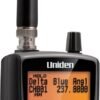
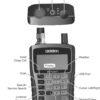
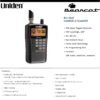
Description
Uniden Bearcat BC125AT: an analog handheld scanner with a wide receive range
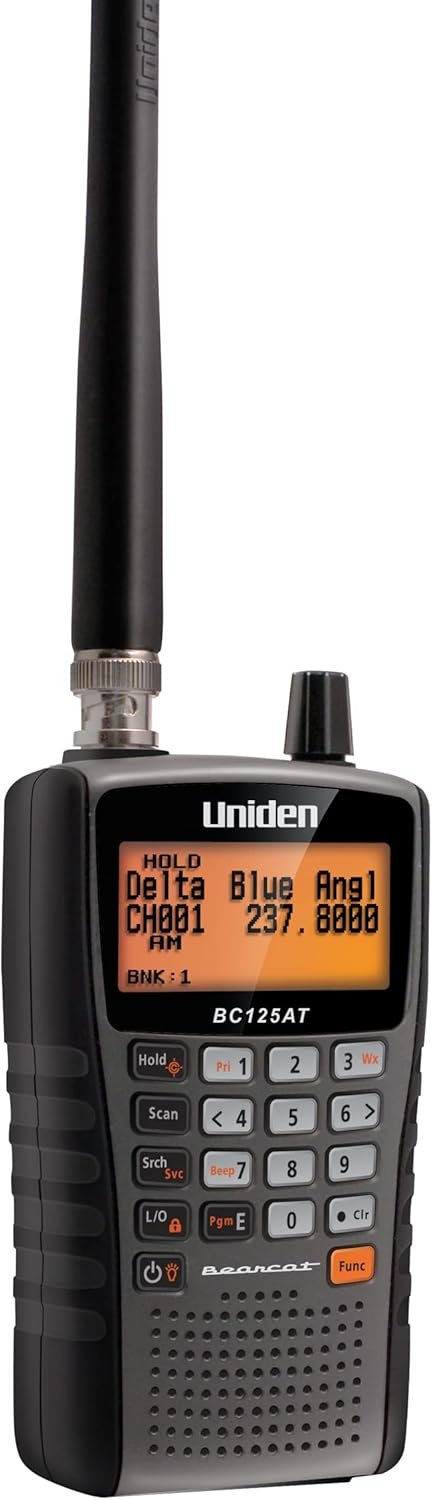
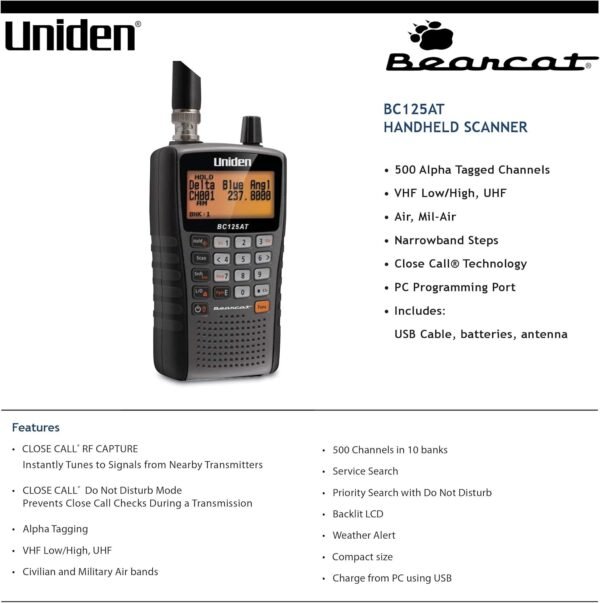
The Uniden Bearcat BC125AT is a handheld radio scanner with 500 alpha tagged channels, meaning each stored frequency can carry a text label rather than being identified by number alone. Uniden lists conventional coverage across four bands: 25 to 54 MHz, 108 to 174 MHz, 225 to 380 MHz and 400 to 512 MHz. Those ranges cover civil and military aviation, marine, railroad, business radio, amateur bands and the analog public safety allocations, which is why the product name lists aviation, marine, railroad and racing use alongside police and fire monitoring.
The unit is compact at 4.33 by 2.17 by 7.28 inches and 1.01 pounds, runs from two AA batteries which are included, and comes with a USB cable for programming from a computer using software Uniden makes available at no charge. It has been on sale since August 2011 and holds a strong position in its category with more than 9,000 ratings behind it, averaging 4.0 stars.
Close Call and how it changes the way a scanner is used
The headline feature is Close Call RF Capture. Conventional scanning requires knowing a frequency in advance and programming it in. Close Call inverts that: the scanner detects a strong signal from a nearby transmitter and tunes to it automatically, without the frequency having been programmed. At an airshow, a race track, a construction site or a public event, that turns the scanner from a device that needs research into one that finds local activity on its own.
A companion Do Not Disturb mode prevents Close Call checks from interrupting a transmission already being received, which addresses the obvious weakness of the feature. Without it, the scanner would break away from an interesting conversation every time a nearby handheld keyed up.
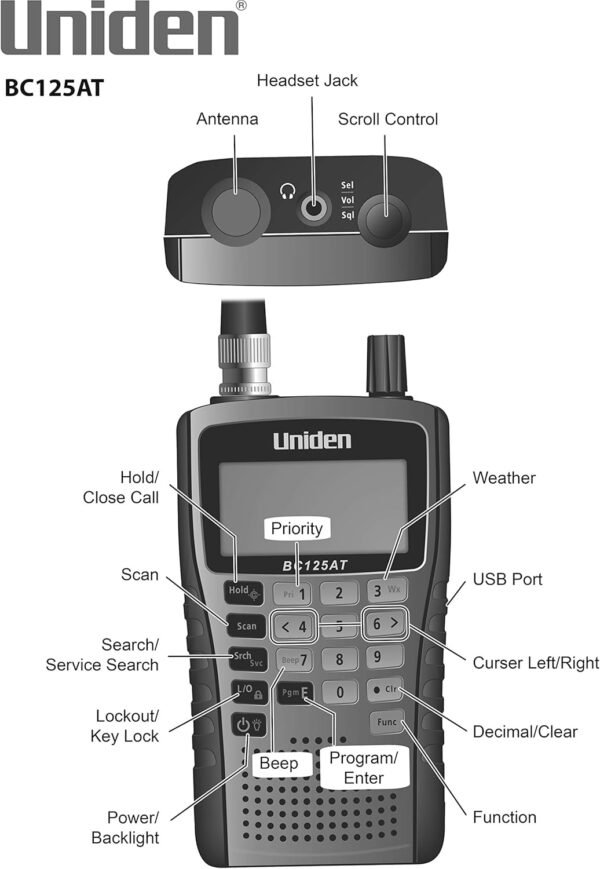
Weather alert capability is also listed, so the unit can monitor National Weather Service broadcasts. That places it alongside two way radios with the same function, such as the Midland T51VP3, with the important difference that a scanner only listens. It has no transmitter, which means no license is needed and no accidental transmission is possible.
Programming and the preset banks
The unit is PC programmable over the included USB cable, which is the practical way to load hundreds of frequencies. Entering 500 channels by keypad is possible but tedious, and software makes it straightforward to import a list for a particular county, airport or event. Uniden also builds in preset service banks that group popular frequencies by type, so the scanner is useful immediately without any programming at all.
Alpha tagging is what makes a large channel list manageable. A frequency labeled with a department or a purpose is far easier to work with than a bare number, and on a screen this small that labeling is the difference between a usable memory bank and a wall of digits. The listing notes a digital display, and the backlight helps in low light.
Search and store modes round out the day to day workflow. A scanner can sweep a band looking for activity and hold on whatever it finds, which is how most users discover local frequencies in an unfamiliar area before committing them to memory. Combined with Close Call, that gives two different ways to find traffic without prior research, and the alpha tags then turn a discovery into a permanent, labeled entry. For anyone new to the hobby, that loop is the part worth learning first, because it works the same way on almost every scanner and it makes the 500 channel capacity useful rather than merely large.
Highlights
- 500 alpha tagged channels for labeled, organized frequency storage.
- Close Call RF Capture with a Do Not Disturb mode to avoid interrupting active traffic.
- Coverage across 25 to 54, 108 to 174, 225 to 380 and 400 to 512 MHz.
- Civil and military aviation bands included.
- PC programmable over the supplied USB cable, with free software available online.
- Runs on two AA batteries, supplied in the box.
- Compact at 4.33 by 2.17 by 7.28 inches and just over one pound.
Things To Consider
The most important limitation is stated plainly in the product name and deserves emphasis: this scanner receives non digital transmissions only. It cannot decode P25, DMR, NXDN or any other digital voice format, and it cannot follow trunked radio systems. Many public safety agencies in the United States have moved to digital trunked networks, and a growing number encrypt their traffic entirely. In those areas this scanner will hear nothing from the local police or fire department no matter how it is programmed. Anyone buying specifically to monitor a particular agency should check what system that agency runs before ordering, because the answer decides whether this product is useful or useless to them.
What remains analog is still substantial. Aviation is analog worldwide and will remain so, marine VHF is analog, railroad traffic is largely analog, amateur radio is largely analog, and race teams commonly use analog handhelds. For those uses the BC125AT is well matched.
Two AA batteries are convenient but modest. Extended monitoring sessions will run through alkaline cells, and rechargeable cells are the sensible option for regular use. The listing does not describe a charging circuit, so cells should be charged externally unless the manual states otherwise.
The 4.0 star average is lower than the very high figures common in consumer audio, and it is worth reading in context. Scanners are technical products, and a large proportion of negative feedback in this category comes from buyers who discovered the digital limitation after purchase rather than from hardware faults. The listing also carries an Other Display Features field reading Wireless, which is meaningless on a device with no wireless connectivity beyond the radio receiver itself.
Who it suits
The BC125AT suits aviation enthusiasts near an airport, boaters monitoring marine channels, railfans, race spectators, storm watchers who want weather alerts, and anyone in an area where public safety traffic remains analog. The Close Call feature makes it genuinely useful at events without preparation, and the low price of entry is appropriate for a first scanner.
It is the wrong purchase for anyone in a region with digital or encrypted public safety systems, and for anyone who wants to transmit as well as listen. Buyers who need two way communication should look at the licensed and license free options in the two way radios category, such as the BAOFENG BF-F8HP Pro or the Baofeng 5RM, while listeners who want broader coverage should compare what else is available in the radio scanners category before deciding.