Description
Boss RC-202 Loop Station: a two track looper for hands, not feet
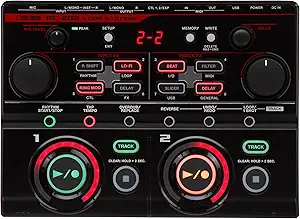
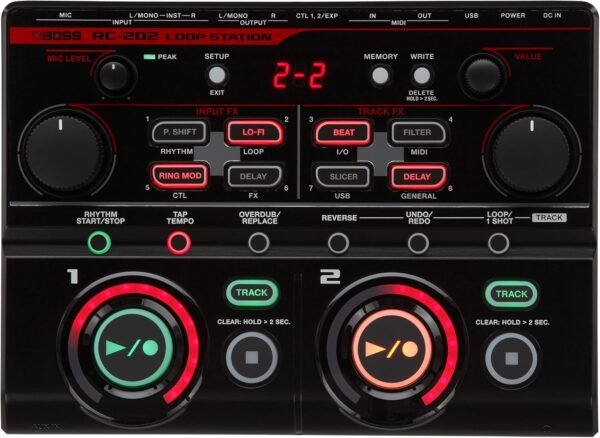
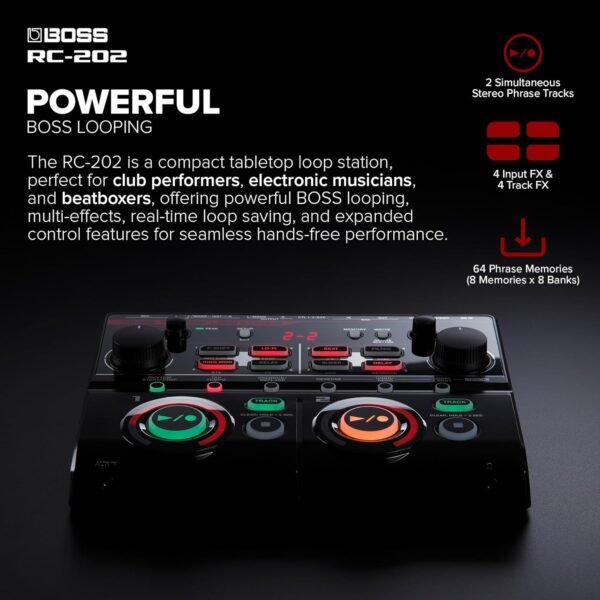
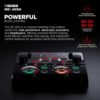
The Boss RC-202 is a compact tabletop loop station with two tracks. The tabletop part is the defining decision. Most Boss loopers are floor units operated by foot, designed for a guitarist standing with a pedalboard. This one sits on a desk or a table and is played with the hands, which changes who it is for: producers, singers, keyboard players, beatboxers and anyone building loops while seated rather than while standing with an instrument strapped on.
The listing gives a chassis of 14 by 9 by 4.25 inches at 3.77 pounds, a country of origin of Japan, USB connectivity and a 9 volt power supply. It has been in the catalog since April 2016 with a 4.4 star average across 111 ratings.
Two tracks and what that constrains
Two tracks is a real limit and it should shape expectations before purchase. One track typically holds a rhythmic or chordal foundation while the second carries a melody, a vocal or a counter line. That is enough for a great deal of solo performance and for sketching ideas quickly, and the discipline of two tracks often produces tighter arrangements than a machine with unlimited layers.
What it does not allow is building a full multi part arrangement live, where a drum part, a bass part, a chord part and several melodies each need their own track. Anyone working that way is looking at a larger unit with more tracks, and this looper will frustrate them. It is worth noting that the imported specification data contains a Size field reading RC-505, which is the model number of a different and larger Boss looper. That is an import error, not an indication of this product capability.
Effects, control and the tabletop workflow
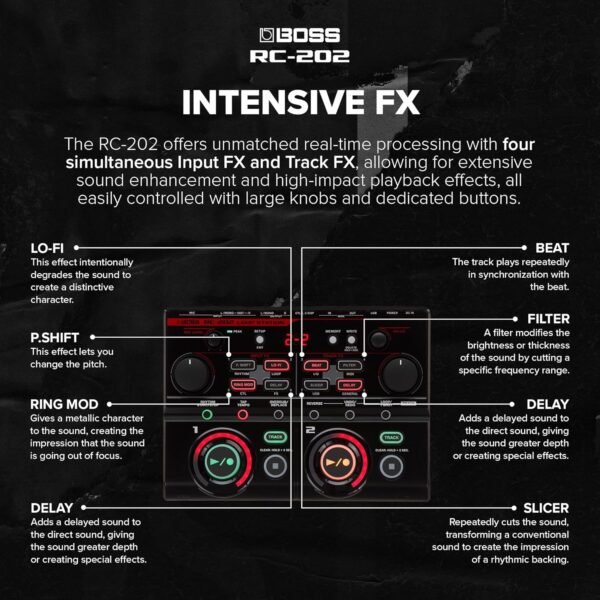
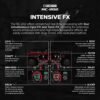
Onboard effects are part of the design, allowing loops to be modified as they play rather than only being recorded and replayed. Applied to a loop in performance, effects turn a static repeat into something that develops, which is the difference between a backing track and a live arrangement.
The hand operated layout is what makes that practical. Controls sit under the fingers rather than under a shoe, so adjustments are precise and several can be made at once. USB connectivity allows a connection to a computer, which on units of this type is typically used for moving audio and backing up settings.
Loop synchronization is the part of the workflow that separates a looper from a recorder. A looper measures the length of the first loop recorded and then holds every subsequent layer to that same length, so the second track lines up with the first automatically rather than drifting. That single behavior is what allows layers to be built live without a click track and without editing. It also explains why the first loop matters more than any that follow: everything recorded afterward inherits its length and its timing, so an imprecise first pass cannot be fixed later without starting again.
Where the tabletop format helps most is in mixing those two tracks against each other while they play. Independent level control over each track turns looping into a performance rather than a playback, letting a foundation drop away under a melody or return underneath it. That is difficult to do gracefully with a foot, and it is the strongest argument for choosing a desktop unit over a floor pedal when the player is seated anyway.
Players who want the same Boss build quality in a signal routing role should look at the Boss LS-2 Line Selector, and those building a pedalboard around modulation can compare the Boss CH-1 Stereo Super Chorus. Anyone whose interest is in triggering prepared material rather than recording it live should compare a sampler such as the Roland SP-404MKII or the smaller Roland P-6, since looping and sampling solve related but different problems.
Highlights
- Two track looping with independent control over each track.
- Tabletop format operated by hand rather than by foot.
- Onboard effects for modifying loops during performance.
- USB connectivity for computer connection.
- Compact at 14 by 9 by 4.25 inches and 3.77 pounds.
- Manufactured in Japan and in production since 2016.
- Runs from a 9 volt supply, consistent with the wider Boss range.
Things To Consider
Hand operation is a benefit for seated players and a drawback for standing ones. A guitarist whose two hands are already busy with the instrument cannot operate this without stopping to play, which is exactly the problem foot operated loopers exist to solve. Some tabletop loopers accept an external footswitch, but this listing does not describe one, so it should not be assumed. That single question decides whether the product suits a given player.
The specification data is thin. There is no stated recording time, no input list, no output list and no description of how tracks are synchronized. Recording time is the specification most likely to matter in use, since a long ambient loop needs far more memory than a two bar rhythm, and it is absent here.
Two fields are plainly wrong. Speaker Size reads 2 on a device with no speaker at all, and the Size field names a different model as noted above. Signal Format reads Analog, which is unusual to see on a digital looper, since looping requires the signal to be digitized to be stored and replayed.
Finally, looping is a skill. Timing a loop start and end precisely is harder than it looks, and an early or late punch shows up on every repeat. Beginners should expect a learning period, and should not judge the machine by the first session.
Who it suits
The RC-202 suits seated musicians, singers and producers who build ideas in layers, keyboard players who want to loop a part and play over it, and anyone who prefers hand control over foot control. It is also a sensible desktop companion for a home studio, where a compact looper doubles as a sketchpad.
It is the wrong purchase for standing guitarists who need foot control, for anyone building arrangements that need more than two tracks, and for buyers who need a stated recording time before ordering. Those buyers should compare the alternatives in the loopers and samplers category, or look at the audio samplers category if the goal is triggering prepared sounds rather than capturing live performance.