Description
What the XR20 Is
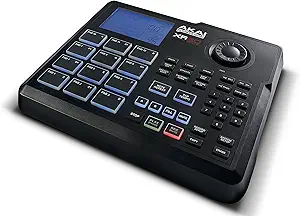
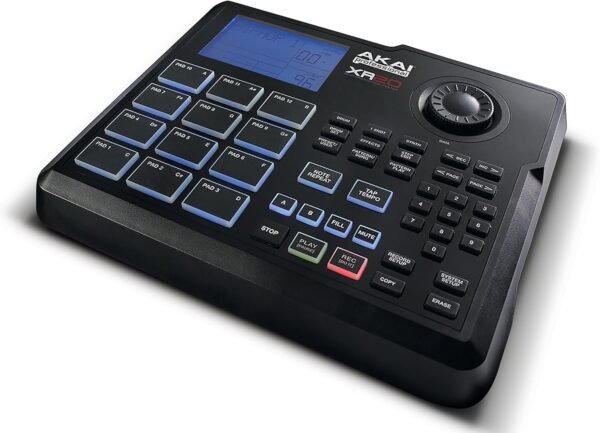
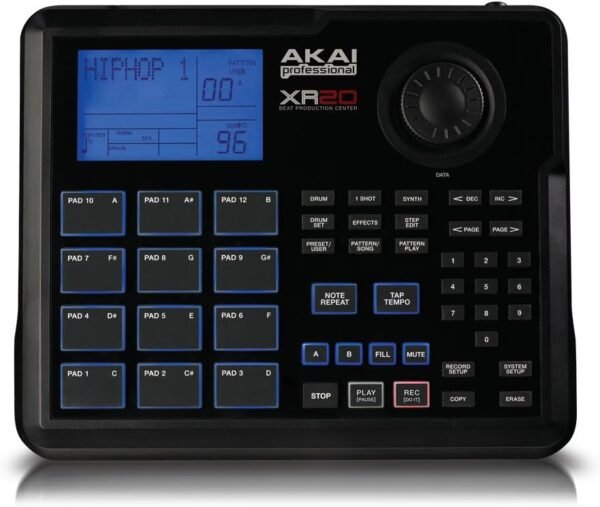
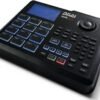
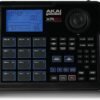
The Akai Professional XR20 is a self-contained beat production station: a drum machine with twelve velocity trigger pads, a large onboard sound library and pattern-based sequencing. It belongs to a category that has been largely displaced by software, and understanding why people still buy standalone hardware is the useful frame for judging it.
The argument is immediacy. A drum machine turns on and makes sound. There is no project to open, no plugin to load, no audio driver to configure and no screen full of windows competing for attention. Twelve pads under the fingers is a different creative experience from a grid drawn with a mouse, and for many people it produces different results. Producers who want the software-adjacent route should compare the Roland SP-404MKII, which is a sampler rather than a drum machine but occupies similar ground.
The Sound Library
Akai credits the sound content to Chronic Music and states the library exceeds 700 sounds. On a drum machine of this type the library is effectively the instrument, since there is no synthesis engine generating sounds from scratch; the pads trigger recorded samples.
Seven hundred is a large number for a device at this level, and the practical question is how they are organized. A library that size is only useful if kits can be found quickly, which is what the backlit LCD exists for. What the listing does not disclose is whether the library is fixed or whether user samples can be loaded, which is arguably the single most important question about a sample-based drum machine. Buyers who need to import their own material should confirm that before ordering, or look at a device built around user sampling such as the Roland P-6.
Pattern Storage and Workflow
Ninety-nine preset patterns and ninety-nine user patterns is a conventional structure and a sensible one. The presets serve two purposes: they are usable as backing for practice or songwriting, and they are a reference for how a genre’s parts are constructed, which is genuinely instructive for someone learning to program drums.
Ninety-nine user slots is plenty for a hardware sketchpad. The workflow on machines of this type is to build a bar or two as a pattern, then chain patterns into a song, which is the way drum machines have worked since the early 1980s and remains an efficient method. Note Repeat, named in the product title, is the feature that makes real-time programming viable: holding a pad retriggers it at a set subdivision, so rolls and hi-hat patterns can be played in rather than drawn.
The Pads and the Microphone Input
The pads are backlit and Akai describes them as glowing in time with the beat. That is more useful than it sounds. On a step-based machine, seeing which step is currently playing makes it far easier to place a new hit correctly, particularly in a dark room or on a stage. It turns the pad grid into a display as well as an input.
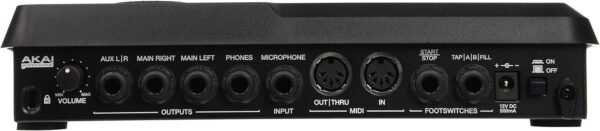
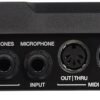
The microphone input is the more unusual inclusion, and it points at how Akai expected the device to be used. A drum machine with a microphone input can record a vocal or a spoken sample directly, without a computer, an interface or a mixer in the chain. Combined with the headphone output, it makes the XR20 a complete production tool for someone with no other equipment at all. Anyone wanting to feed it a decent signal should look at the options in the audio samplers category and pair it with a straightforward dynamic microphone.
Where It Fits in a Setup
The XR20 is most useful as one part of a small hardware arrangement rather than as a complete studio. Paired with a synthesizer such as the Behringer 2600 or with a looper like the Boss RC-202, it supplies the rhythmic foundation while other devices handle melody and arrangement.
It also functions well as a practice tool for musicians who are not producers. A guitarist or a bassist working on timing benefits far more from playing along to a programmed pattern with real dynamics than from a metronome click, and the preset library covers enough styles to make that practical. The synthesizer and workstation keyboards category covers the instruments that would sit alongside it.
Highlights
- Twelve trigger pads with backlighting that follows the beat.
- Over 700 sounds supplied with the unit.
- 99 preset and 99 user patterns for both learning and original work.
- Note Repeat, which makes real-time programming of rolls practical.
- Microphone input, so vocals can be captured without any other equipment.
- Headphone output for silent working.
Things To Consider
The most significant problem with this listing is what it does not say. The Amazon specification block is entirely empty, and the product attributes are missing as well. There is no weight, no dimensions, no power requirement, no output list beyond the headphone jack, no information about whether MIDI is present, no indication of whether user samples can be loaded, and no statement about whether it runs on batteries. For a piece of music hardware, MIDI connectivity alone is a decisive question that the listing leaves entirely unanswered.
- No specifications whatsoever are published on the listing.
- MIDI support is not stated, which matters for syncing with other hardware.
- User sample loading is not confirmed, so the library may be fixed.
- No dimensions, weight or power information is given.
- No customer rating data appears on the listing.
- Pattern-based sequencing is a specific workflow, and it suits some people far better than others.
Who Should Buy It and Who Should Skip It
The XR20 suits a beat maker who wants hardware immediacy rather than a screen, a musician who needs a programmable rhythm section for practice or songwriting, and anyone building a small hardware setup where a computer is deliberately absent. The microphone input and headphone output make it genuinely self-sufficient, which is rare at this level.
Skip it if you need confirmed MIDI synchronization with other equipment or a computer, because the listing does not establish that it exists. Skip it too if importing your own samples is essential to how you work, or if you already produce in software, where a plugin drum machine will offer more sounds and more editing for less money. Anyone who wants sampling rather than triggering should be shopping samplers instead.