Description
What the 2600 Is
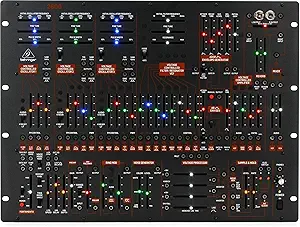
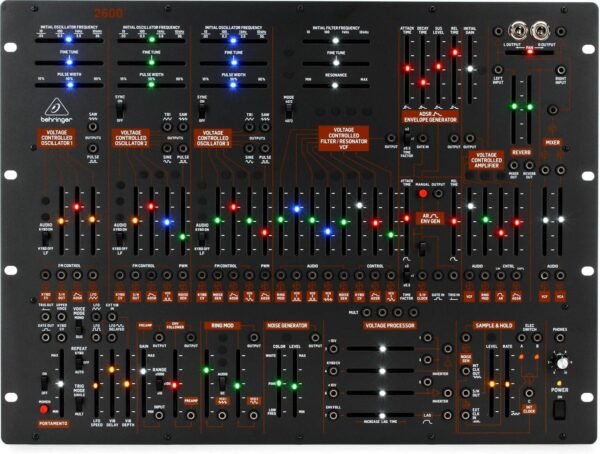
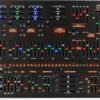
The Behringer 2600 is a semi-modular analog synthesizer, a recreation of a design first produced in the early 1970s that became one of the most recognizable instruments in electronic music. Behringer’s version places it in an 8U rackmountable format with 3.5 mm patch jacks and Eurorack compatibility, which is a significant change from the original’s larger jacks and suitcase enclosure.
The most important thing to establish is what this is not. There is no keyboard. Despite sitting in a category named for synthesizer and workstation keyboards, the 2600 is a sound source that requires an external controller, a sequencer or a MIDI source to play notes. Anyone expecting to take it out of the box and play a melody will need a second purchase. Players who want a keyboard instrument should be looking at the Korg B2SP or an arranger, not at this.
What Semi-Modular Means
This is the concept that determines whether the instrument suits a given player, and it is genuinely useful to understand. A fully modular synthesizer has no internal connections at all: nothing produces sound until the user patches an oscillator to a filter to an amplifier with physical cables. A fixed-architecture synthesizer has all those connections hard-wired and cannot be rerouted.
Semi-modular sits between them. The 2600 has a normalled signal path, meaning the standard connections are already made internally, so it produces sound immediately. Inserting a patch cable into any of the 93 patch points overrides the internal connection at that point. The result is an instrument that a beginner can use straight away and that an experienced synthesist can rewire almost arbitrarily. It is the best available answer to the steep learning curve that keeps people away from modular synthesis.
The Sound Engine
Behringer specifies three voltage-controlled oscillators, a multimode voltage-controlled filter and two envelope generators, alongside what the description calls extensive modulation and routing options. Three oscillators is a generous complement: two are enough for the classic detuned lead sound, and a third allows a sub-oscillator or a modulation source without giving up the detuning.
A multimode filter is the other significant specification, since it can be configured for low pass, high pass or band pass operation rather than being fixed to one response. Behringer also includes a digital spring reverb emulation, which is a notable inclusion because the original instrument had a real spring tank and the sound of it is part of what people associate with the design. The 78 faders and switches mean nearly every parameter has its own physical control, with no menu diving at all.
Format, Size and Integration
The 8U rack format and the 3.5 mm jacks are pragmatic decisions. Eurorack compatibility means the 2600 can act as a hub in a larger modular system, sending and receiving control voltage from other modules, and 3.5 mm cables are far cheaper and more available than the quarter inch cables the original used.
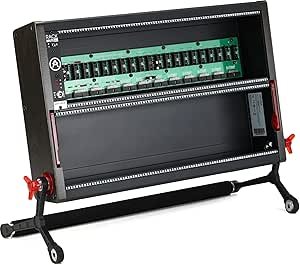
The listing gives the dimensions as 17.85 by 7.85 by 24.75 inches and the weight as 15.21 pounds, which is a substantial object requiring real desk or rack space. It is not a portable instrument. Producers building a hardware setup around it will want a sequencer or drum machine such as the Akai XR20 and somewhere to put the modules, which is where a case like the Arturia RackBrute 6U comes in. The synthesizer and workstation keyboards category covers the neighboring instruments.
Recording It
An analog synthesizer produces a line-level analog signal, which means capturing it requires an audio interface with line inputs rather than a microphone. That is a straightforward requirement but it is an additional purchase for anyone whose recording setup is currently a USB microphone.
Because the instrument is monophonic in its basic configuration and is patched by hand, the usual working method is to record performances as audio rather than as MIDI, since a patch cannot be recalled from a saved file the way a software preset can. Photographs of the front panel are the traditional patch storage method on instruments like this, and that is not a joke. Producers who want to layer and rearrange those recordings will find a sampler such as the Roland SP-404MKII a natural companion, and the audio samplers category covers the alternatives.
Highlights
- Three analog oscillators and a multimode filter in a genuine analog signal path.
- 93 patch points for rerouting almost any part of the architecture.
- Normalled connections, so it makes sound without patching anything.
- 78 faders and switches, with no menus and no encoder scrolling.
- Eurorack compatible with standard 3.5 mm patch cables.
- Digital spring reverb emulation recreating a defining part of the original sound.
Things To Consider
The listing has clearly been assembled carelessly. The bullet points read “3 Oscillats” and “2 Envelope Generats”, which appears to be the result of an automated text filter stripping the letters “or” from words. The product description is copied verbatim from a music retailer’s own website, including a sentence referring to that retailer’s staff by name, which is not something a manufacturer would write. The body material is given as bass wood and the color as multicolor. None of this affects the instrument, but it does mean the listing should not be treated as authoritative.
- No keyboard is included, and a controller or sequencer is required to play notes.
- No patch memory: settings cannot be saved and recalled electronically.
- 15.21 pounds and nearly 18 inches wide, so it needs dedicated space.
- An audio interface with line inputs is needed to record it.
- Only around 11 ratings, so the 4.1 star average carries very little weight.
- The listing description is copied from a third-party retailer.
Who Should Buy It and Who Should Skip It
The 2600 suits a producer or sound designer who wants a genuinely analog, genuinely patchable instrument at a fraction of what the design historically cost, and who already has a MIDI controller or sequencer to drive it. It is also a reasonable entry into modular synthesis for someone who wants to learn patching without first buying a case and a dozen modules, since the normalled path means the instrument is useful from day one and grows as understanding does.
Skip it if you want to play a keyboard, if you need presets you can recall, or if desk space is limited. Skip it too if the intent is to make finished tracks quickly, because a hand-patched monophonic synthesizer is a slow instrument by design. Anyone whose interest is versatility rather than depth will get further with a workstation or a software instrument.