Description
Where the Yamaha BR12M Sits in a Live Rig
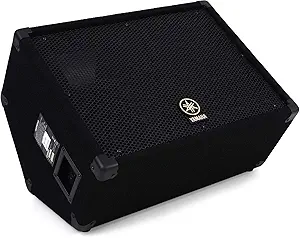
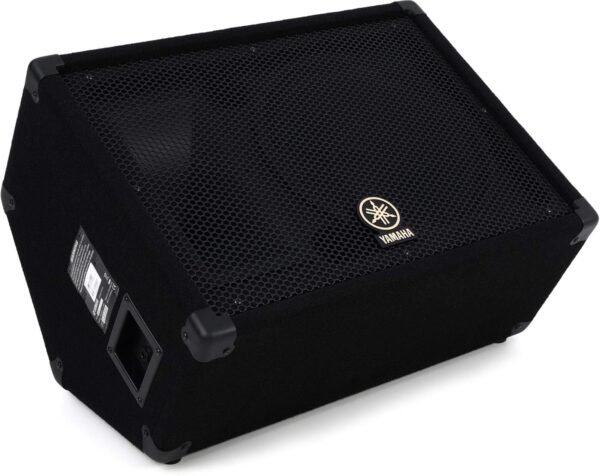
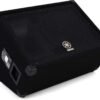
The Yamaha BR12M is a 12 inch two way floor monitor from what Yamaha describes as its most cost conscious loudspeaker line. The cabinet is cut on the angle that lets it lie on a stage floor and fire up at a performer, and Yamaha also fits a pole socket so the same box can be stood upright and used as a main speaker for a small room. That dual role is the practical argument for it: a band with four of these can run two as mains and two as wedges rather than buying two different cabinet shapes.
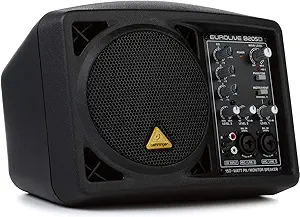
The audience is the working rehearsal room, the house of worship with a modest budget, the school stage, and the cover band that loads in and out every weekend. It is not a studio monitor and it is not a hi fi speaker. Anyone who needs a self powered box that plugs straight into a mixer should be looking at active designs instead, such as the Behringer Eurolive B205D powered monitor or the larger QSC K10.2 powered speaker, because the BR12M is a passive cabinet and needs an amplifier ahead of it.
Drivers, Horn, and Coverage
Yamaha specifies a 12 inch Eminence woofer chosen for smooth response and high power handling, paired with a 1 inch compression driver using a titanium diaphragm. The high frequency driver loads into a constant directivity horn quoted at 40 by 90 degrees. The way that pattern is written matters on a stage. Turned on its side as a wedge, the wider 90 degree axis spreads across the front of the performer while the narrower 40 degree axis limits how much energy sprays toward the microphones behind, which is the whole point of a constant directivity horn in a monitor application.
The listing gives the wattage as 600 watts, which for a passive cabinet is a power handling figure rather than an output rating, and it is the number to match against an amplifier rather than a number the speaker produces on its own. Pairing a passive monitor with an amplifier that has appropriate headroom is the part most first time buyers get wrong, and a rack amplifier such as the Crown CDi 1000 power amplifier is the class of device this cabinet expects on the other end of the cable.
Cabinet, Connectors, and Transport
The build description is the strongest part of the listing. Yamaha lists steel corner protectors, a steel grille, an oversized steel handle, and computer cut woodworking on the enclosure. Those are the details that decide whether a monitor survives three years of van loads, and they are more relevant to the buying decision than any frequency claim. The stated weight is 34.3 pounds and the given dimensions are 21.65 by 14.96 by 12.2 inches, which is a one person lift for most people but an awkward one at the end of a long night.
Connection is by two heavy duty quarter inch jacks on the jackplate, wired so a second cabinet can be daisy chained from the first. That is a simple and durable arrangement, though it is worth noting that quarter inch connectors are the older convention for speaker level connections and that many modern amplifiers and cabinets have moved to twist lock connectors instead. Buyers running a mixed rig should check what their amplifier terminates in and buy cables accordingly. The included components field lists speaker cables, so at least one run may be in the box. Cabinets that travel every week also benefit from covers, and the bags, cases and covers category collects options for that job.
Highlights
- 12 inch Eminence woofer with a 1 inch titanium compression driver on a 40 by 90 degree constant directivity horn.
- Wedge shaped cabinet with a built in pole socket, so the same box works as a monitor or as a main.
- Steel corner protectors, steel grille, and an oversized steel handle for road use.
- Two quarter inch jacks allow daisy chaining to a second cabinet.
- Stated weight of 34.3 pounds and a 600 watt power handling figure, with a limited warranty listed.
Things To Consider
The single biggest thing to understand before buying is that this is a passive speaker. It produces no sound on its own. It needs a power amplifier, and it needs speaker cable rather than a signal cable. The listing muddies this badly: the power source field reads corded electric and the control method field reads App, neither of which describes a passive loudspeaker with no electronics and no network connection. Treat both as data errors rather than features.
Other specification entries on this listing are similarly unreliable. Speaker type is given as Woofer, which describes a component rather than a finished monitor. The recommended uses field reads Compression, which is not a use. Color is listed as MultiColored for a black stage cabinet. The subwoofer diameter field repeats the 12 inch woofer measurement under a name that implies a bass cabinet this is not. None of these change what the product is, but they show how little the marketplace data can be trusted on its own.
There are also genuine limits. This is an older design, with the listing showing a first availability date in 2004, so it predates the shift toward lightweight powered cabinets with onboard digital signal processing. There is no onboard equalization, no feedback suppression, and no limiter, which means protection has to come from the amplifier and the mixer. The review count is small, at 81 ratings, so the average rating carries less weight than it would on a high volume product. And a 12 inch two way wedge will not deliver much below the low end of its passband without help, so bands relying on kick and bass in the monitors will want a subwoofer in the system.
Who Should Buy It and Who Should Not
The BR12M fits a player or engineer who already owns amplification and wants a durable, conventional wedge that can double as a pole mounted main. It also fits venues that standardize on rack amplifiers and prefer passive boxes for that reason, since the amplifier stays in a controlled rack rather than sitting on a hot stage. Buyers who value serviceability and steel hardware over onboard processing will find the priorities here match theirs.
It is the wrong choice for anyone who wants to plug a mixer output straight into a speaker, for anyone counting grams on a solo load in, or for anyone who needs onboard equalization and protection. Those buyers should shop the active side of the market, and the PA systems category lists both approaches side by side. For a portable all in one alternative aimed at smaller events, the Altec Lansing SoundRover trolley speaker takes the opposite design path.