Description
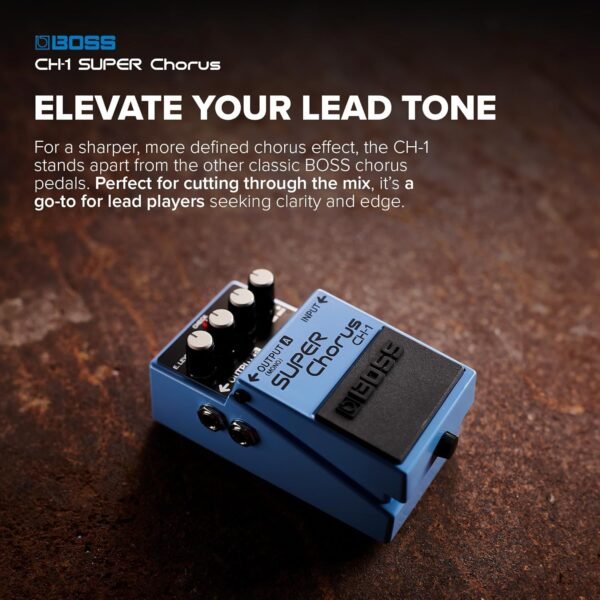
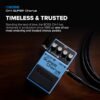
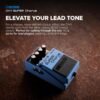
Boss CH-1 Stereo Super Chorus: a long running standard in a small blue box
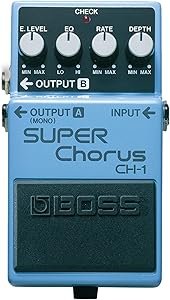
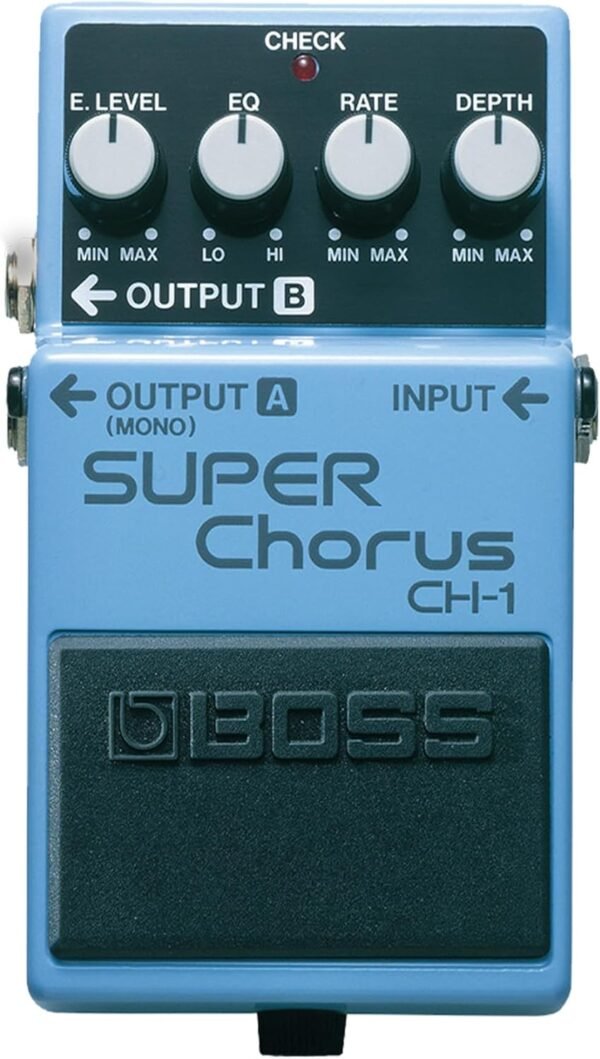
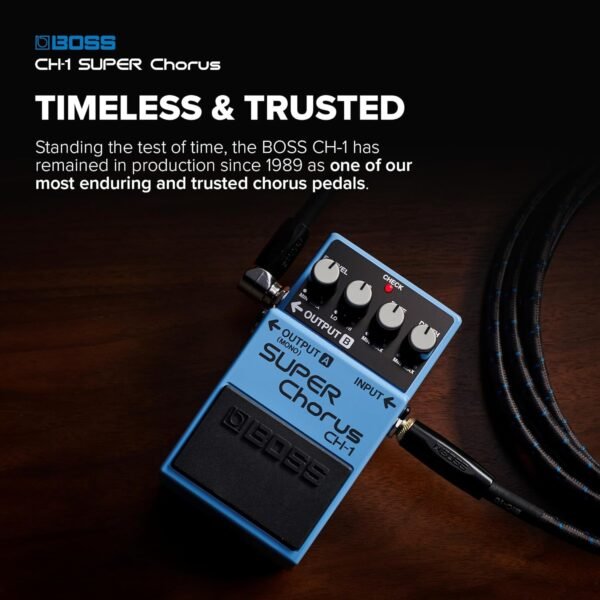
The Boss CH-1 Stereo Super Chorus is a compact guitar effect pedal that has been in production for decades. Boss describes it as delivering a clean classic chorus sound with clear highs and a stereo effect that varies between the left and right speakers. The listing gives an analog signal format, a 6.35 millimeter jack connector, a quarter inch audio hardware interface, a weight of 1.15 pounds and a footprint of 6 by 3.8 by 2.8 inches in the familiar Boss compact enclosure, finished in blue.
Chorus works by splitting the signal, delaying one copy by a few milliseconds and modulating that delay time. The delayed copy drifts slightly in pitch as the delay changes, and mixing it back with the original produces the thickened, shimmering effect that defined a great deal of guitar and keyboard recording from the 1980s onward. The CH-1 has held its position in that market for a long time, ranking near the top of the chorus category with 4.7 stars across more than 800 ratings.
The stereo output is the feature to plan around
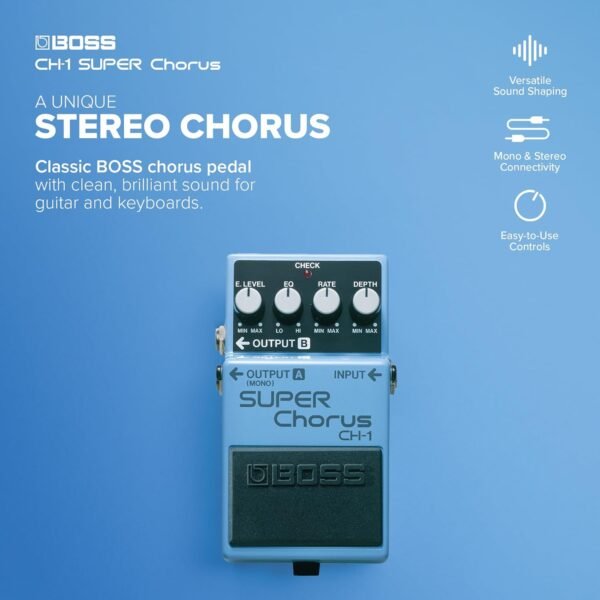
The word stereo in the name is doing real work. The CH-1 provides two outputs, and the effect is designed so that the modulated signal and the dry signal can be sent to different amplifiers or different channels. Heard through one speaker, chorus is a thickening effect. Heard through two separated speakers, it becomes a spatial effect, with the movement spreading across the space between them.
That distinction matters when planning a rig. Players running a single combo amplifier will get the traditional chorus sound and nothing more. Players recording direct, or running two amplifiers, or feeding a stereo interface, get the full benefit. Anyone building a larger stereo capable rig around a digital platform such as the Line 6 HX Effects will find the same principle applies there, with the CH-1 offering a single dedicated analog circuit instead of a menu of models.
Signal routing is where a utility pedal earns its place. A device such as the Boss LS-2 Line Selector exists to manage exactly this kind of split path, letting a player run parallel chains and recombine them without a mixer.
Build, controls and power
Boss compact pedals are known for their construction, and the format has barely changed since the late 1970s. The chassis, the footswitch mechanism and the knob layout are consistent across the range, which is why a pedalboard of Boss compacts fits together predictably and why used examples remain serviceable decades later. The CH-1 offers the standard set of chorus controls covering rate, depth, effect level and equalization, which is enough adjustment to move from a barely present thickening to a heavily modulated sound.
The power arrangement in the imported listing needs correcting. It states that two AA batteries are required and included, while the same table gives a voltage of 9.0 and lists the power source as corded electric. Boss compact pedals run from a single 9 volt battery or from a 9 volt adapter, and no pedal in this family takes AA cells. Treat the battery entry as a data error, and plan on a standard 9 volt supply. The listing also carries a Number of Strings field reading 6, which belongs to a guitar listing template and has no meaning on an effect pedal, and a Material Type of Plastic, which does not describe the metal enclosure this format is known for.
Highlights
- Analog chorus circuit in the standard Boss compact enclosure.
- Stereo outputs, allowing the effect to be spread across two amplifiers or two channels.
- Rate, depth, level and equalization controls for a wide range of intensity.
- Quarter inch jack connections throughout, compatible with any standard pedalboard.
- Compact at 6 by 3.8 by 2.8 inches and 1.15 pounds.
- Runs from a 9 volt supply, as the voltage field in the listing confirms.
- 4.7 star average across more than 800 ratings, with a long production history.
Things To Consider
Chorus is a divisive effect and its popularity moves in cycles. A player chasing a modern, dry, high gain tone will use it rarely, while anyone playing clean parts, arpeggios or eighties inspired material will reach for it constantly. Buyers should be honest about which category they fall into, because a pedal that stays switched off has cost board space for nothing.
The single circuit approach is both the strength and the limit. This pedal does one thing, with no presets, no MIDI, no expression pedal input and no alternate modes described in the listing. Players who want several modulation types on one board will be better served by a multi effects unit, which trades the immediacy of a single knob per function for breadth.
Battery operation is a poor idea in practice regardless of the confused listing. Analog pedals drain batteries steadily, and a battery that fails mid set is an avoidable problem. A regulated 9 volt supply is the sensible choice, and it is not included.
Finally, the specification sheet gives no current draw, no input or output impedance and no true bypass information, all of which matter when planning a long signal chain. Boss compacts use buffered bypass rather than true bypass, which is generally helpful over long cable runs but is a consideration for players who prefer an entirely passive path when a pedal is off. Anyone building a board around this should also think about how the rest of the chain is arranged, which is where a looper such as the Boss RC-202 Loop Station or a filter effect like the Vox V845 wah tends to sit before or after modulation depending on taste.
Who it suits
The CH-1 suits guitarists who play clean and want a dependable analog chorus that will outlast several amplifiers, players running two amplifiers or recording in stereo who can use both outputs, and anyone building a traditional pedalboard where each effect has its own box and its own knobs.
It is not the right choice for players who want many modulation types from one unit, for anyone needing preset recall or MIDI control, or for a purely direct recording setup where a plugin would do the same job. Those buyers should look at the broader electric guitar effects category, or at the pedals and footswitches category for control and switching hardware to go with a larger rig.