




Description
What the HT-X8500 Is
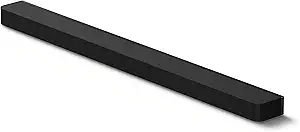
The Sony HT-X8500 is a single-bar soundbar with no separate subwoofer and no rear speakers. Sony describes it as 2.1 channel hardware capable of upscaling all sound close to 7.1.2 channel audio using its Vertical Sound Engine. Understanding what that means is the key to deciding whether this product is right for a given room, because the two numbers describe very different things.
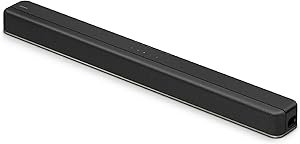
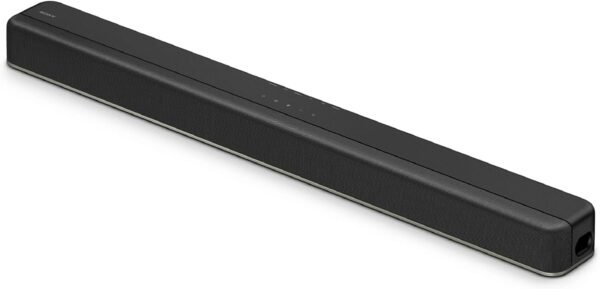
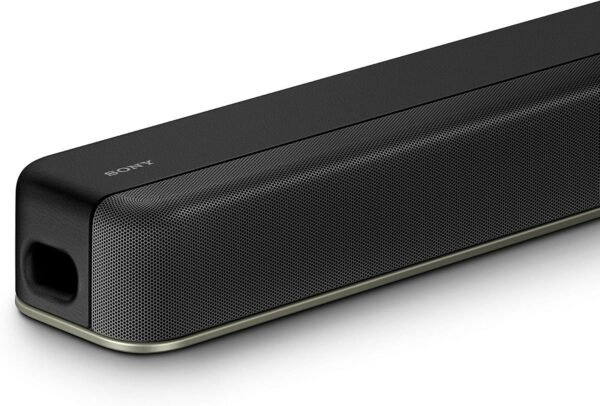
The bar measures 35 inches wide, 6.1 inches deep and 3.8 inches high, which is deliberately low so that it sits in front of a television without blocking the screen or the infrared receiver. It is a compact solution for a room where a full home theater arrangement is impractical, and Sony is direct about positioning it that way. Buyers with the space for a full multi-speaker package should look at the Sony HT-S40R or the larger Sony BAR 9.
Virtual Height: What Vertical Sound Engine Does
Dolby Atmos and DTS:X encode audio as objects with positions in three dimensions rather than as fixed channels. A system with physical height speakers reproduces those positions by firing sound at the ceiling or by mounting drivers above the listener. The HT-X8500 has neither. What it has instead is digital signal processing that manipulates timing and frequency cues to create the impression of height from drivers that are all at the same level.
The honest description is that this works, up to a point, and that the point varies enormously with the room and the listener. Virtual height processing depends on how sound reflects off surfaces and on the individual shape of a listener’s ears, and it is more convincing for some people than others. What it reliably delivers is a larger and taller-seeming soundstage than a plain stereo bar. What it does not deliver is the discrete overhead placement a ceiling speaker provides. Sony does not overclaim here, describing the effect as upscaling rather than reproduction.
Dual Built-In Subwoofers
Putting the bass drivers inside the bar rather than in a separate box is the second defining decision. It removes a large object from the room, removes a second power cable, removes a wireless pairing that can fail, and removes the question of where the subwoofer should go.
The cost is depth. A driver inside a 3.8 inch tall enclosure cannot move the air that a 10 inch driver in a large ported cabinet can, and no processing changes that. Sony’s implementation is well regarded within its constraints and produces genuine body rather than the thinness of a very slim bar, but anyone who wants a home theater to shake the sofa should plan on adding an external subwoofer, and the subwoofers category covers those options.
Connections and Everyday Use
HDMI eARC is the important connection here. Enhanced Audio Return Channel carries far more bandwidth than the older standard, which is what allows a full Atmos bitstream to reach the bar from a television over a single cable. Sony supplies the HDMI cable, and there is also an optical input for older equipment and an HDMI input with 4K HDR passthrough for a source device connected directly.
Seven sound modes cover movies, music, gaming, news and sport, selected from buttons on the supplied remote. The voice enhancement mode is worth knowing about: it lifts the frequency band where dialogue intelligibility lives, which is the most common complaint about modern television soundtracks. Buyers whose priority is specifically dialogue should also compare the ZVOX SB500, which is built around that problem, and the wider sound bars category.
What Comes in the Box
Sony lists the remote commander with batteries, a wall mount template, a quick setup guide, an instruction manual, an HDMI cable, a mains adapter with a 2 metre cable and a power cord. Supplying both the HDMI cable and the wall mount template covers the two things most commonly missing when a soundbar arrives, and the wall mount template in particular saves a genuinely annoying measuring exercise.
The product has been listed since April 2020 and holds a 4.3 star average across roughly 1,719 ratings, which is a large enough sample to be meaningful. Format support covers both Dolby Atmos and DTS:X, which matters for anyone with a physical disc collection, since many Blu-ray releases carry DTS soundtracks that some competing bars cannot decode.
Highlights
- Both Dolby Atmos and DTS:X support, so disc collections are covered as well as streaming.
- Dual built-in subwoofers, removing a separate box from the room.
- HDMI eARC with the cable included, plus optical and an HDMI input.
- 4K HDR passthrough for a source connected through the bar.
- Low 3.8 inch profile that will not block a television screen or remote receiver.
- Wall mount template supplied alongside the remote and batteries.
Things To Consider
The specification block is inconsistent. The item weight is given as 1 pound, which is impossible for a 35 inch metal soundbar with built-in subwoofers. The wireless communication technology field says “WIRED TYPE” while the connectivity protocol field says Bluetooth, which cannot both be right. The speaker size is listed as 94.61 centimetres, which is the length of the bar rather than a driver dimension, and the signal to noise ratio appears as “7E+1 dB”. None of these should be used for comparison.
- Virtual height is not physical height, and the effect varies by room and by listener.
- Built-in subwoofers cannot match an external one for depth.
- No rear speakers and no described upgrade path to add them.
- 35 inches wide, which suits a 50 inch television or larger and looks oversized under a small one.
- The weight and connectivity specifications are wrong in the listing data.
- Listed since 2020, so newer bars may offer more current connectivity.
Who Should Buy It and Who Should Skip It
The HT-X8500 suits a household that wants a meaningful upgrade over television speakers in a single object, with no subwoofer to place and no rear speakers to wire. It is a particularly good fit for apartments and shared walls, where a large external subwoofer causes complaints, and for rooms where the television sits on a low unit with limited clearance. The DTS:X support makes it a better choice than many rivals for anyone with Blu-ray discs.
Skip it if the goal is genuine overhead effects, which require physical height drivers, or if deep bass is the priority, which requires a real subwoofer. Skip it too if the room is large, where a single bar will struggle to fill it. Buyers wanting a step up in scale within the same brand should compare the larger Sony bars, and those wanting rear channels should be looking at a package that includes them.