

Description
What the SB500 Is For
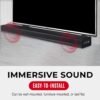
The ZVOX SB500 is a one-piece soundbar built around a specific problem rather than around a spec sheet: television dialogue that is hard to follow. ZVOX has spent years selling into that niche, and the SB500 is the company’s larger cabinet, rated by ZVOX for televisions in the 50 to 90 inch range. It contains its own bass drivers, which means the box on the shelf is the entire system and there is no wireless subwoofer to place, power and pair.
The intended buyer is someone in a household where at least one person struggles with speech intelligibility on modern mixes, whether because of hearing loss, a heavily compressed streaming soundtrack, or simply a room with hard surfaces. That is a different purchase from a home theater bar bought for surround immersion, and anyone whose priority is the latter should be comparing objects like the Sony BAR 9 instead.
AccuVoice and the Six Boost Levels
AccuVoice is ZVOX’s name for processing that lifts and isolates the frequency bands where consonant information lives, roughly the upper midrange, while holding the rest of the mix back. The SB500 exposes six levels of it from the remote, so the effect can be dialed from a light touch to a heavy one depending on the programming and the listener.
ZVOX describes the technology as derived from hearing aid work. That framing should be read carefully: the SB500 is a consumer television speaker, not a medical device, and it is not a substitute for a hearing assessment or for prescribed hearing aids. What it can reasonably do is make a difficult soundtrack easier to follow at a given volume, which is a real benefit and one that far fewer soundbars address than the marketing across the category would suggest. Buyers who want the same outcome through headphones instead have a purpose-built option in the Avantree Ensemble wireless TV headphones.
Drivers, Amplification and Bass
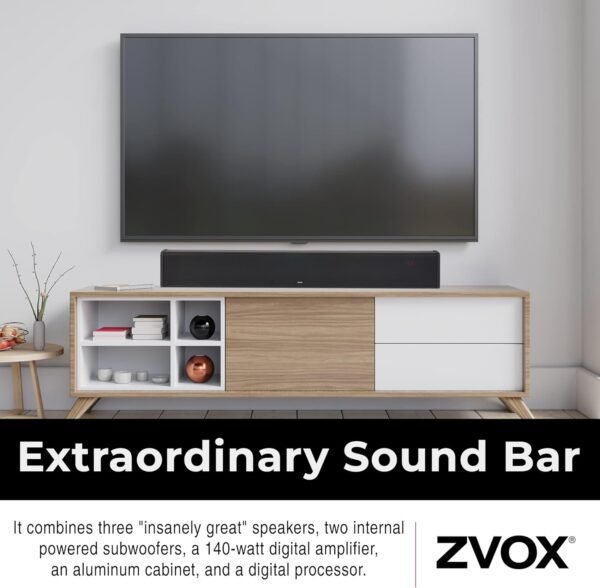
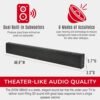
ZVOX quotes a 140-watt digital amplifier feeding a driver complement that the specification table lists as 2-inch tweeters and dual 4-inch woofers, all inside a single aluminum cabinet. Four-inch drivers in a sealed bar will not reach the depth of an external subwoofer, and the honest expectation is body and warmth rather than the low end that shakes a room. What the arrangement buys instead is simplicity: one power cable, one cabinet, no pairing routine and nothing to hide behind the sofa.
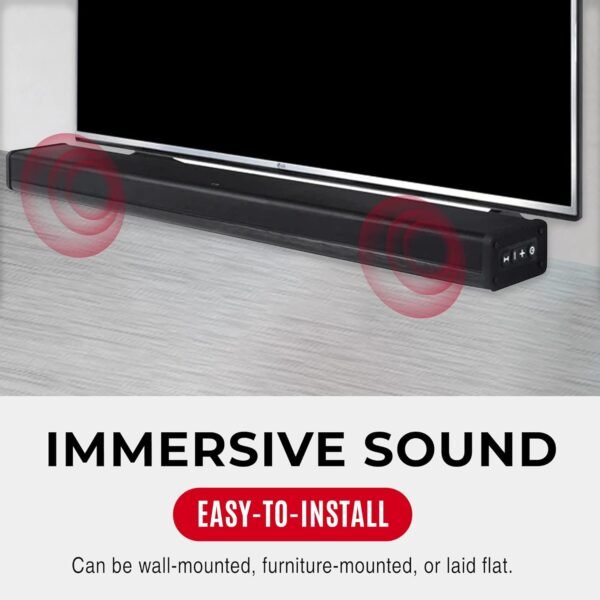
The cabinet is 43.9 inches wide, 5.7 inches tall and 3.3 inches deep, weighing 12.6 pounds, and ZVOX supports wall mounting, upright placement or flat positioning on furniture. The height figure is worth checking against a television stand before ordering, since 5.7 inches is taller than many bars and can intrude on the bottom of the screen or block an infrared receiver. Anyone who wants genuine low frequency extension should plan on adding a separate subwoofer, and the subwoofers category covers the options; the ZVOX itself has no dedicated subwoofer output described in the listing.
Everyday Controls and Output Leveling
Two smaller features do a lot of work here. Output leveling compresses the dynamic range so that loud commercials and sudden action scenes do not force a scramble for the remote. It is the same idea as the night mode found on many receivers, and it pairs naturally with dialogue boost since both are aimed at comfortable listening at moderate volume.
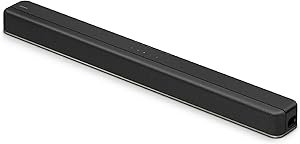
The other is the disappearing display, a four-digit readout that shows volume, bass, treble and the PhaseCue virtual surround setting, then goes dark after a few seconds of inactivity. A permanently lit display on a soundbar directly below a television is a genuine irritation in a dark room, and switching it off automatically is the right default. For a smaller room or a secondary television, a compact alternative such as the Sony HT-X8500 covers similar ground in less width.
Highlights
- Six-level AccuVoice dialogue boost, adjustable rather than a single on or off setting.
- Self-contained bass from two built-in 4-inch woofers, with no separate module to place.
- Output leveling that tames volume spikes between content and advertising.
- 140-watt digital amplifier in a 12.6 pound aluminum cabinet.
- Auto-dimming display that does not glow through a movie.
- Flexible placement: wall mount, upright, or flat on furniture per ZVOX.
Things To Consider
The Amazon specification block for this product contains entries that clearly do not belong to it. It lists a vehicle service type of “Car” on a television soundbar, an input voltage rendered as “2.4E+2 Volts”, and a battery requirement of one 12V cell, which almost certainly refers to the remote control rather than the bar. It also tags the connectivity protocol as Wi-Fi while ZVOX’s own description talks about adding a separate multi-zone streaming receiver, which implies the bar itself does not stream. These fields should be disregarded.
- Built-in 4-inch woofers cannot match an external subwoofer for depth, and the listing describes no subwoofer output.
- No Dolby Atmos or DTS:X is claimed anywhere; PhaseCue is a virtual surround effect, not an object-based format.
- 43.9 inches wide and 5.7 inches tall, which is large enough to require checking the television stand first.
- The Wi-Fi specification is contradicted by the manufacturer’s own description of the streaming path.
- AccuVoice is a consumer audio feature, not a hearing aid, and should not be treated as one.
- Heavy processing has a cost: at higher boost levels the tonal balance shifts noticeably away from the original mix.
Who Should Buy It and Who Should Skip It
The SB500 suits a household where following dialogue is the actual complaint, where a simple single-box installation is preferred, and where a large television needs a bar wide enough to look proportionate beneath it. It is also a sensible choice for anyone who dislikes the clutter and pairing hassle of a separate wireless subwoofer, and for older viewers who want fewer devices and a remote with obvious controls.
It is the wrong buy for a home theater enthusiast chasing height channels, object-based audio or deep bass, and for anyone who wants network streaming built into the bar. Those buyers should be looking at the wider sound bars category, or at a full multi-speaker system if the room and the budget allow it.