Description
What the Klipsch Surround 3 Pair Is Built For
The Klipsch Surround 3 Speaker Pair, listed under model number 1067530, is not a standalone speaker system. It is an accessory pair designed to add discrete rear channels to a compatible Klipsch sound bar. Klipsch positions it as the second step in a modular home theater path: buy the bar first, then add rear speakers when the room allows. The listing states that once the Surround 3 pair is added to a compatible bar, the bar handles Dolby Digital and DTS 5.1 decoding and routes the surround information to the rear cabinets automatically, which means no separate receiver and no channel assignment work on the part of the owner.
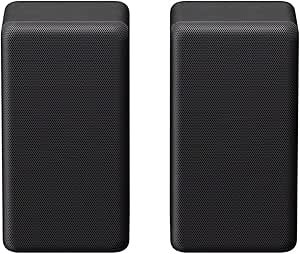
That framing sets the audience clearly. This pair suits someone who already owns a Klipsch bar and wants rear fill without running speaker wire across a room. It is a poor fit for anyone building a system from parts, because the speakers are not passive cabinets that accept a standard amplifier connection. Buyers who want a conventional wired rear pair that works with any receiver should look at a different design entirely, and buyers who are still choosing a bar should start from the bar and work outward. Sony takes a similar modular approach with the Sony SA-RS3S wireless rear speakers, which are also tied to their own family of bars.
Cabinet, Drivers, and Physical Footprint
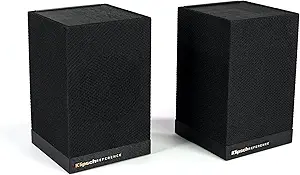
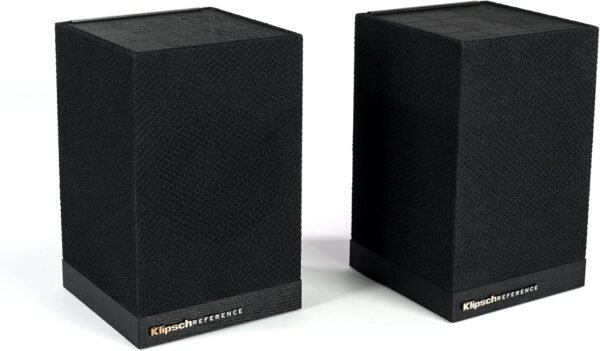
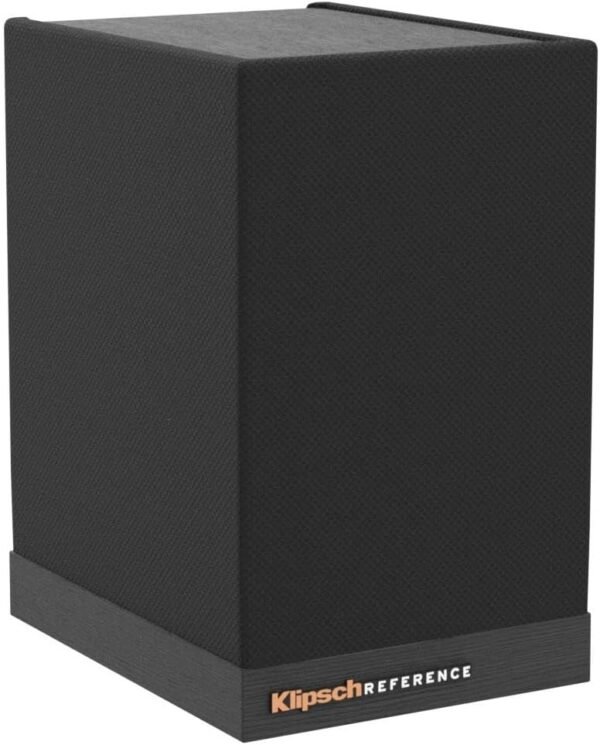
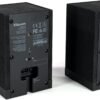
Each cabinet carries a single 3 inch full range driver, according to the specification sheet, which is what you would expect from a surround speaker meant for effects and ambience rather than full range playback. The measured dimensions given on the listing are 4.25 inches deep by 4.25 inches wide by 6.5 inches high, and the stated weight is 2.2 pounds. That is small enough to sit on a bookshelf, a side table, or a rear windowsill without dominating the space, and light enough that wall mounting hardware does not need to be elaborate. The finish is black.
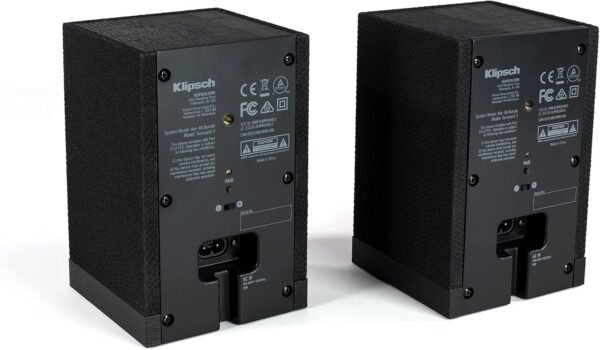
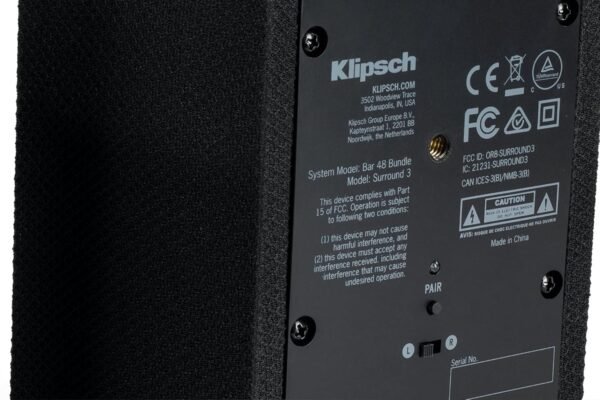
Klipsch lists mounting as bar mount and table mount, and the included components are given as a power cord, a manual, a connection dongle, and the wireless speakers themselves. The dongle is the important part of that list. It is the piece that pairs the speakers to the bar, and it is the reason the system does not work with hardware outside the compatible range. Because the speakers still need mains power at the rear of the room, the word wireless applies to signal only. Two power outlets behind the seating position are a hard requirement, and that constraint decides whether this pair is practical in a given room more often than sound quality does.
The Wireless Link and the Setup It Assumes
The specification sheet gives the wireless communication technology as 5.8 GHz, a band commonly used for dedicated audio links because it sidesteps the crowded 2.4 GHz range that Wi-Fi and Bluetooth accessories share. Elsewhere on the same listing, though, the connectivity protocol field reads Bluetooth, which contradicts the 5.8 GHz entry. Those two claims cannot both describe the same link, and the listing does not resolve them. Anyone whose purchase depends on the transport should confirm it against Klipsch documentation for their specific bar rather than the marketplace data.
The surround channel configuration field reads 2.0, which describes the pair itself rather than the finished system. Once the pair is joined to a bar with a subwoofer, the resulting layout is what the bar reports, not what this accessory reports. Owners who want the low end handled properly will still be leaning on the bar subwoofer or a separate unit, and the options in the subwoofers category cover that ground. For a sense of what a modern bar package includes before rear speakers are added at all, the Sony BAR 9 soundbar and the Sony HT-S40R 5.1 channel system show two different answers to the same question.
Highlights
- Two cabinets in the box, each with a 3 inch full range driver, per the specification sheet.
- Signal reaches the rear of the room over a dedicated link rather than a speaker cable run.
- Compact 4.25 by 4.25 by 6.5 inch cabinets at a stated 2.2 pounds, with table and bar mounting listed.
- Decoding of Dolby Digital and DTS 5.1 is handled by the compatible bar, so no receiver setup is involved.
- Klipsch lists a limited warranty, and the listing shows a 4.2 star average across 821 ratings.
Things To Consider
The compatibility ceiling is the largest limitation. These speakers only function with Klipsch bars that support the pairing dongle, so they are not a general purpose upgrade and they carry no flexibility outside that ecosystem. The listing description compounds the confusion by misspelling the brand as Kirsch and by referring to a bar 48 model, so the exact compatibility list is worth confirming with Klipsch before ordering.
Several specification fields on this listing are unreliable and should be treated as such. Input voltage is given as 240 volts, which does not match a product sold into a 120 volt market. The compatible devices field reads Tablet, which makes no sense for a rear surround speaker. The woofer and subwoofer diameter fields both read 3 inches, describing the same single full range driver twice under names that imply a bass driver these cabinets do not have. Unit count reads 1.0 while number of items reads 2, so the listing gives the quantity two different ways.
Beyond the data problems, there are real design limits. The cabinets are not water resistant, so covered patios and damp basements are out. A 3 inch driver has a physical floor on how low it can play, which is by design for a surround channel but does mean these will not carry a full range signal if someone tries to use them as stereo speakers. And because each cabinet needs an outlet, rooms without rear power will require an extension run, which undoes some of the tidiness the wireless link was meant to provide.
Who Should Buy It and Who Should Not
The Surround 3 pair makes sense for an owner of a compatible Klipsch bar who wants rear channels with minimal installation work and has power available behind the seating area. For that person the appeal is convenience: no receiver, no channel mapping, no wire across the floor. It also suits renters, since two small cabinets on side tables leave no trace.
It does not make sense for anyone without a compatible Klipsch bar, for anyone assembling a component system around a receiver, or for anyone who needs speakers to handle full range duty. Those buyers are better served by conventional passive speakers such as a matched center and rear set, and the Klipsch R-34C center channel speaker shows what the wired side of the same brand offers. Shoppers weighing several rear channel approaches can compare the field in the surround sound systems category before committing to an ecosystem.