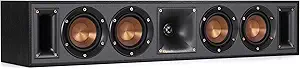
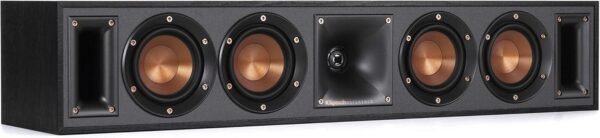
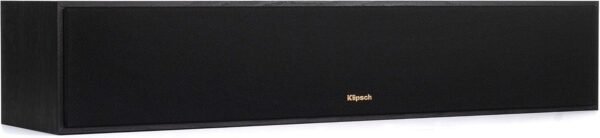
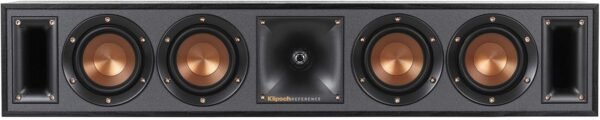

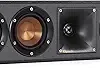
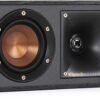
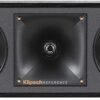
Description
Why a Center Channel Matters
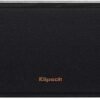
The Klipsch R-34C is a center channel speaker, which means it has one job that no other speaker in a home theater does. In a surround mix, the great majority of dialogue is placed in the center channel, so the speaker sitting under or above the television is the one that decides whether the words in a film are intelligible. Everything else in a system contributes atmosphere. The center contributes comprehension.
The listing describes the R-34C around exactly those priorities: clarity for dialogue and vocals, a low profile design intended to fit with flat panel televisions, bass response without distortion at higher volumes, a durable build, and a size aimed at small to medium rooms. That is a coherent set of claims for the role. Buyers assembling a matched system will want to keep tonal character consistent across the front three speakers, which is the main argument for buying a center from the same range as the left and right speakers. The alternatives that avoid the question entirely are collected in the sound bars category.
Placement and the Low Profile Design
The low profile shape is a practical necessity rather than a styling exercise. A center channel has to sit somewhere that does not block the screen, which in most rooms means a shelf under the television with very little vertical clearance, or a wall position directly above it. A tall cabinet simply will not fit, which is why almost every center channel is a wide, shallow, horizontal box regardless of brand.
That shape has an acoustic cost worth understanding. A horizontal arrangement, with drivers placed side by side around a tweeter, produces uneven response as the listener moves off the center axis, because the distance from each driver changes at different rates. This is a known characteristic of the format rather than a fault of any particular product, and it is why the seat directly in front of the screen usually gets the clearest dialogue in any system built this way. Positioning the speaker so it points toward ear height at the main seating position is the most effective adjustment an owner can make. Systems that need low frequency support below what a center provides can add a subwoofer from the subwoofers category.
Integration With the Rest of a System
A center channel is a passive speaker, which means it needs amplification from a receiver rather than plugging into power. The receiver also decides where the crossover between the center and the subwoofer sits, and that setting matters more for dialogue than most people expect. Set too low, a small center is asked to reproduce chest register male voices it cannot handle, and the result sounds thin and strained at volume. Set correctly, the subwoofer takes the load and the center handles the range it was designed for.
This is where the claim about bass response without distortion at higher volumes should be read carefully. A compact center in a low profile cabinet has limited internal volume, and no design overcomes that entirely. The realistic reading is that the speaker holds together within its intended range and at sensible levels for the room size the listing names. Owners who run a large room at high volume should expect to lean on the subwoofer more heavily. A receiver such as the Yamaha RX-V385 AV receiver handles that crossover assignment, and a matched subwoofer such as the Klipsch RP-1000SW subwoofer keeps the family voicing consistent.
Highlights
- Dedicated center channel speaker, the position that carries most film dialogue.
- Low profile cabinet designed to fit under or above a flat panel television.
- Voicing aimed at dialogue and vocal clarity rather than at atmosphere.
- Sized by the listing for small to medium rooms.
- Passive design that connects to a receiver rather than to mains power.
Things To Consider
The imported record for this speaker has no manufacturer description and no specification table. That leaves out everything a buyer would use to match it to a system: the driver complement, the tweeter type and whether it uses the horn loading Klipsch is known for, the impedance, the sensitivity, the recommended amplifier power, the frequency response, the cabinet dimensions, and the weight. Impedance and sensitivity in particular determine whether a receiver can drive the speaker comfortably, and dimensions determine whether it physically fits the space under a television. Both should be confirmed with Klipsch before ordering.
The claims that are present come from the marketing bullets and are subjective. Exceptional clarity, dynamic bass response, and durable build quality are assertions rather than measurements, and this page reports them as the listing description rather than as findings.
The real limitations are those of the format. Horizontal center channels have off axis response behavior that affects seats away from the middle. Compact centers depend on a correctly set crossover and a capable subwoofer to sound full. A center from one manufacturer paired with left and right speakers from another will usually produce an audible change in tone as sounds pan across the front, which is a common and avoidable mistake. And a passive speaker adds nothing to a system that does not already have a receiver with a center channel output, so this is a component purchase rather than an upgrade someone can make in isolation.
Who Should Buy It and Who Should Not
The R-34C suits someone building or completing a home theater with a receiver and matching Klipsch left and right speakers, in a small to medium room, who finds dialogue hard to follow through a television speaker or a bar. Adding a dedicated center is usually the single largest improvement available for that specific complaint.
It is not the right purchase for someone without a receiver, for someone whose front speakers come from a different brand and range, or for someone in a very large room who would need more capable speakers throughout. Buyers who want dialogue clarity without building a component system should look at a soundbar such as the Klipsch Core 200 sound bar with Sub 100, or a packaged system like the Bose CineMate GS Series II home theater system.