
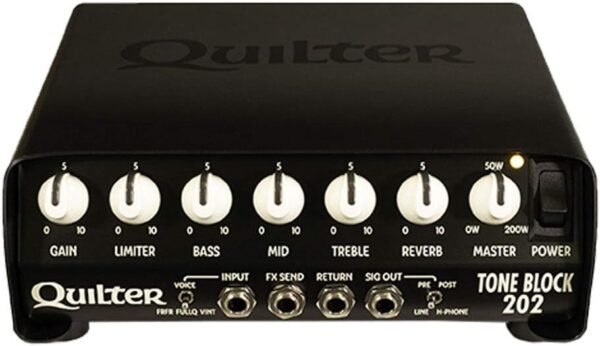
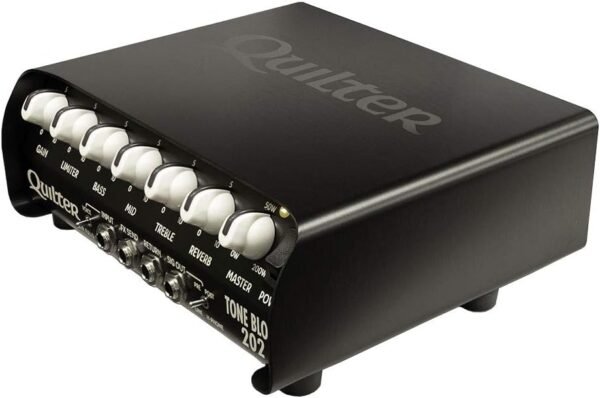
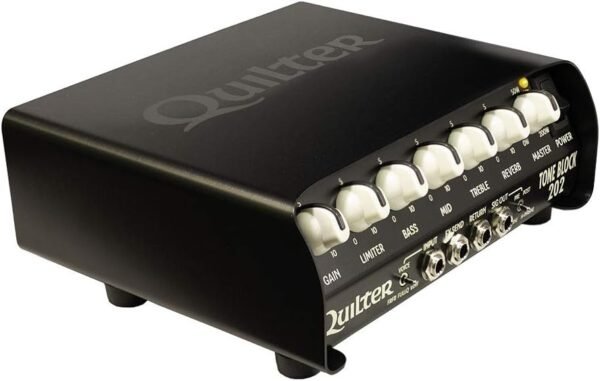
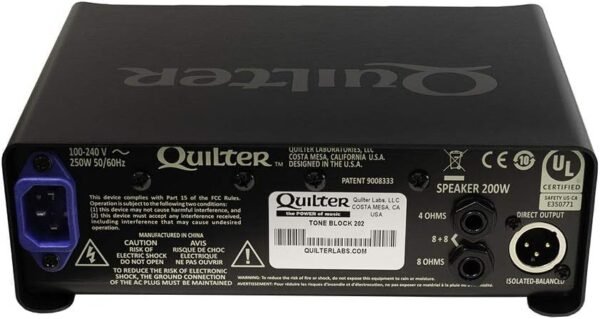
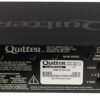
Description
What the Quilter Tone Block 202 Is
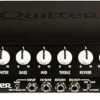
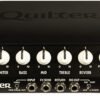
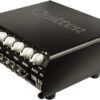
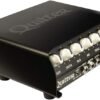
The Quilter Tone Block 202 is a guitar amplifier head rated at 200 watts in a package small enough to carry in a gig bag alongside cables and pedals. Quilter built its reputation on this specific proposition: solid state power delivered in a way intended to behave like a traditional amplifier, in an enclosure a fraction of the size and weight of the tube amplifiers it competes with. The listing summarizes the appeal as a power to weight ratio, portability, versatile voicing, a quiet direct output, and what it calls enhanced speaker drive.
A head is not a complete amplifier. It contains no speaker, so it requires a separate cabinet, a speaker cable, and attention to impedance matching. That is the standard arrangement for this class of product, and it is also the reason the format is attractive: the heavy part of the rig can live at the venue or at the rehearsal room while the amplifier travels. Players who would rather carry one object should compare a combo such as the Positive Grid Spark 40 combo guitar amplifier, and players looking at other compact heads can consider the Soldano SLO Mini guitar amp head.
Power and the Direct Output
Two hundred watts sounds like an enormous figure next to the 30 and 50 watt tube amplifiers that dominate stages, and the comparison is not straightforward. Solid state and tube power are rated the same way electrically but behave differently as they approach their limits, and the practical reason for a large solid state power rating is headroom rather than volume. Headroom means the amplifier reaches the loudness a room needs while still operating in its clean region, which matters for players using pedals for their overdrive or playing styles where clarity is the point.
The direct output is arguably the more important feature for a working player. The listing describes it as operating quietly, which in this context means low noise, and frames it for recording and for connecting to a PA system. A direct output that can be trusted means the amplifier can feed the house system without a microphone in front of a cabinet, which saves setup time, removes a variable, and makes a stage quieter. Anyone building a system where the guitar amplifier feeds front of house should also understand what is at the other end, and the amplifier heads category collects other units that take this approach.
Voicing and Speaker Drive
The listing refers to versatile voicing options for different musical styles. In a Quilter design, voicing controls typically reshape the amplifier response rather than add effects, which is a meaningful distinction. A voicing switch changes the fundamental character of the amplifier before the tone controls act on it, so it is closer to swapping amplifiers than to turning a tone knob. The imported record does not enumerate how many voicings there are or what they are called, so buyers who need that detail should get it from Quilter.
The phrase enhanced speaker drive in the listing refers to how the output stage interacts with a speaker. A conventional solid state amplifier presents a very low output impedance and effectively clamps the speaker, while a tube amplifier with an output transformer interacts more loosely and lets the speaker resonance contribute to the sound. Designs that emulate that looser interaction are trying to recover a characteristic of tube amplification without tubes. What this means in practice is that the cabinet choice affects the result more than it would with a conventional solid state amplifier, so the cabinet is part of the tone decision rather than a neutral box.
Highlights
- 200 watt output in a head small enough to carry with a guitar.
- Direct output described as quiet, suitable for recording and for feeding a PA system.
- Voicing options that reshape the amplifier character for different styles.
- Output stage designed to interact with a speaker rather than simply clamp it.
- Solid state design with no tubes to replace, bias, or damage in transport.
Things To Consider
The imported record for this product has no manufacturer description and no specification table at all. That is a significant gap for an amplifier, because the numbers a buyer needs are precisely the ones missing: the minimum speaker impedance, whether the 200 watt rating applies at 4 ohms or 8 ohms, the physical dimensions, the weight, the input and output connector types, whether an effects loop is present, and what form the direct output takes. None of that can be stated from this listing, and buyers specifying a rig should work from Quilter documentation.
Impedance in particular is not optional knowledge. Connecting a cabinet below an amplifier minimum rated impedance can damage the output stage, and a 200 watt rating usually implies a specific load. Anyone buying this head should confirm the safe impedance range before connecting anything.
The design also carries the usual solid state considerations. Players who want an amplifier that compresses and breaks up progressively as it is pushed, in the way a tube power section does, may find a high headroom solid state design cleaner and more linear than they expect. That is exactly what some players want and exactly what others are trying to avoid, and it is worth being honest that no specification sheet resolves that preference. Finally, a head plus cabinet is a two purchase decision, and the cabinet choice matters more here than usual given how the output stage interacts with it. Players building a full board around such a rig can look at the Boss RC-202 loop station and similar units for what sits in front of the amplifier.
Who Should Buy It and Who Should Not
The Tone Block 202 suits a working player who moves gear frequently, wants substantial clean headroom, and values a usable direct output for stage and studio work. It suits anyone tired of maintaining tubes, and anyone who plays venues where the house system does most of the work and the amplifier mainly needs to sound right on stage.
It is a poor first amplifier, because a head without a cabinet makes no sound and the impedance question has to be answered correctly. It is also the wrong choice for a player whose sound depends on a power section breaking up at moderate volume. Those players should look at a lower powered design or a modeling unit from the guitar combo amplifier category, where the speaker and the amplifier are matched by the manufacturer and no impedance decision is left to the buyer.