
Description
What the PSR-A5000 Is and Who It Serves
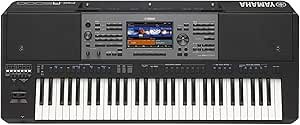
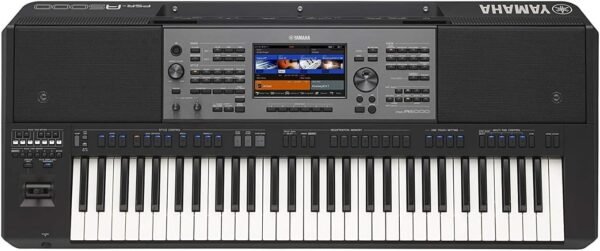
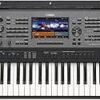
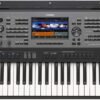
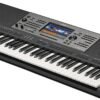
The Yamaha PSR-A5000 is a 61-key arranger keyboard built around a specific musical world rather than a general one. Yamaha lists new voice samples including the Oud, Qanoon, Nay and Watariat, alongside the Istanbul Strings ensemble, and accompaniment styles named Khaleeji, Shami, Masri, Maghrebi, Persian and Turkish. That is not a general-purpose feature list with a world music folder bolted on; it is the reason the instrument exists.
The intended player is a working keyboardist performing Middle Eastern, North African or Turkish repertoire, or a producer who needs authentic sources for that material. An arranger keyboard generates a full backing arrangement from chords played with the left hand, which makes it a one-person band instrument rather than a studio controller. Players who want a piano action and a piano sound instead should look at the Korg B2SP digital piano, which answers a completely different question.
Scale Tuning: the Feature That Defines It
The single most important capability on this instrument is real-time scale tuning available directly on the panel. Much of the repertoire the PSR-A5000 targets uses maqam scales that include quarter tones, intervals that simply do not exist on a standard equal-tempered keyboard. Without the ability to retune individual scale degrees, a Western keyboard cannot play this music correctly at all.
Yamaha lets those tunings be changed on the fly and stored as presets for quick recall, which matters because a set list may move between maqamat between songs. Being able to switch tuning from the panel rather than through a menu system is the difference between a feature that is usable on stage and one that is only usable in a studio. This is the specification that justifies the instrument’s existence, and no amount of voice count or style count substitutes for it.
Expression Controls and Voice Behavior
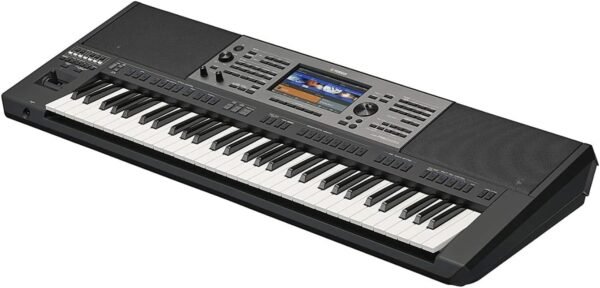
The assignable joystick sits where a pitch bend and modulation wheel would normally be and can be routed to whichever parameter the player needs. Alongside it, assignable knobs give real-time control over effects and parameters applied to voices and styles. For a performer working with heavily ornamented melodic lines, having continuous controllers under the hand rather than buried in menus is a practical necessity rather than a luxury.
Two sampling features support the same goal. Super Articulation voices reproduce the expressive behaviors of non-keyboard instruments, so a legato line or a particular attack triggers a different sample rather than simply a louder version of the same one. Key-off percussion samples add the sound of fingers leaving a drum head as the key is released, which is the kind of detail that separates a convincing part from an obviously programmed one. Velocity sensitive portamento completes the set by tying glide speed to playing force. For players building rhythm parts around a keyboard rig, an external unit such as the Akai XR20 drum machine covers ground the arranger styles do not.
Connections and Expansion
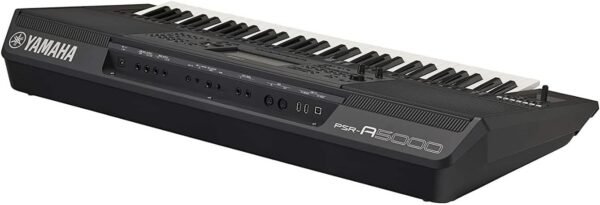
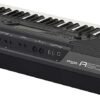
The listing specifies a USB Type B connector for computer connection, a 3.5 mm headphone jack and auxiliary connectivity. Yamaha also states that the instrument has dedicated space for expansion content, which means additional voices and styles can be loaded rather than being fixed at the factory. That is significant for an instrument aimed at regional repertoire, because it allows the sound set to grow as new expansion packs are released.
A sustain pedal is not described as included, and an arranger of this class effectively requires one for realistic piano and string parts. The Roland DP-10 pedal is one option for that, and the synthesizer and workstation keyboards category covers the neighboring instrument classes for anyone still deciding what they need.
Highlights
- Panel scale tuning with preset recall, the feature that makes maqam repertoire playable.
- 210 accompaniment styles weighted toward Middle Eastern, Turkish and North African music.
- New regional voice samples including Oud, Qanoon, Nay, Watariat and Istanbul Strings.
- Assignable joystick and knobs for direct expression control during performance.
- Super Articulation voices and key-off percussion for more convincing instrument behavior.
- Expansion memory so the sound set is not fixed at purchase.
Things To Consider
The listing data for this instrument is unreliable in ways that matter. Product dimensions are given as 17 by 14.06 by 5.5 inches, which is physically impossible for a 61-key keyboard; 61 keys alone occupy roughly 40 inches. The power source is listed as USB, when an instrument of this size and weight runs from a mains adapter. The instrument type field reads “Synthesizer”, which is not what an arranger keyboard is. Anyone planning a stand, a case or a stage footprint from these numbers will get it badly wrong.
- 61 keys are unweighted, so this is not a substitute for a piano action.
- 25.4 pounds is heavy enough to need a proper stand and a second pair of hands.
- No sustain pedal is described as included.
- The published dimensions and power source are wrong in the specification table.
- Only around 31 ratings, so the 4.7 star average rests on a very small sample.
- The style library is regionally specialized, which is the point but limits general use.
Who Should Buy It and Who Should Skip It
This instrument is aimed squarely at performers working in Middle Eastern, Turkish and North African traditions, and for that audience the scale tuning and the regional voice set make it close to a category of one at this price. It also suits producers who need credible sources for that repertoire without hiring the corresponding instrumentalists, and wedding or event players who need a full arrangement from a single instrument.
Everyone else should probably buy something else. A player working in Western pop and rock gets more relevant styles from a general-purpose arranger, and a pianist gets a far better instrument for the money from a weighted digital piano. Anyone whose interest is sound design rather than performance should be looking at the Behringer 2600 analog synthesizer or a modern workstation instead, where the money goes into synthesis rather than accompaniment.