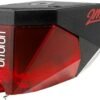
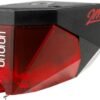

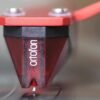
Description
Ortofon 2M Red: the default first upgrade for a moving magnet turntable
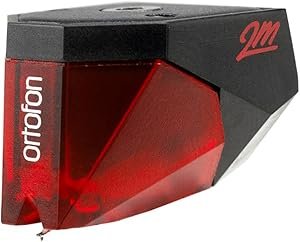
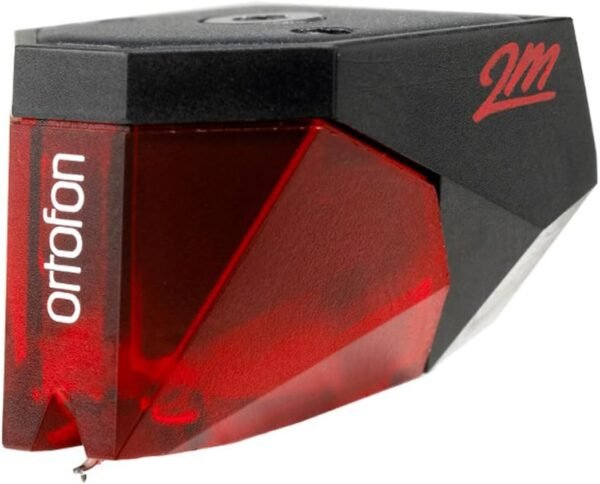
The Ortofon 2M Red is a moving magnet phono cartridge, and it occupies a specific position in vinyl playback: it is the cartridge most often recommended as a first meaningful upgrade over whatever came fitted to an entry level turntable. The listing gives a weight of 0.254 ounces, which is a little over 7 grams, and a body measuring 1.1 by 0.75 by 0.71 inches. It has been available since August 2012 and carries a 4.7 star average across more than 2,600 ratings, an unusually strong record for a component of this kind.
Moving magnet is the more common of the two cartridge designs and the more practical for most systems. A small magnet attached to the stylus assembly moves within fixed coils, generating a signal. The alternative, a moving coil design, moves the coils instead and produces a much smaller output that requires a specialized preamplifier. Moving magnet cartridges work with the standard phono inputs found on receivers and with common outboard stages such as the ART DJPRE II, which is why they dominate at this level.
What a cartridge actually changes
The cartridge is the only part of an audio system that touches the recording directly. Everything downstream, from the preamplifier to the speakers, works with whatever the stylus retrieves from the groove, and nothing further along the chain can recover detail the stylus failed to trace. That is why cartridge changes are audible in a way that many component swaps are not.
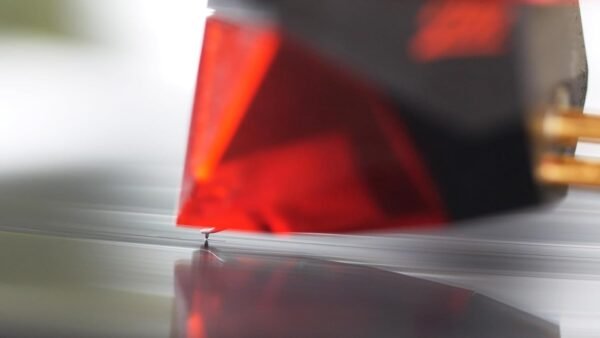
Two things determine what a cartridge retrieves: the shape of the stylus tip and how well the whole assembly tracks the groove without adding its own movement. The stylus shape decides how much of the groove wall the tip contacts, and better shapes follow the modulation more accurately, particularly toward the end of a record side where the groove geometry becomes more difficult. The listing does not specify the stylus profile, the recommended tracking force or the output voltage for this cartridge, so those figures should be taken from the manufacturer documentation before setup.
The 2M series is also designed with an upgrade path in mind: within this family, higher models generally accept the stylus assembly of the model below, meaning an owner can move up without replacing the entire cartridge body. Anyone considering that route should confirm compatibility for the specific models involved before buying.
Installation and system context
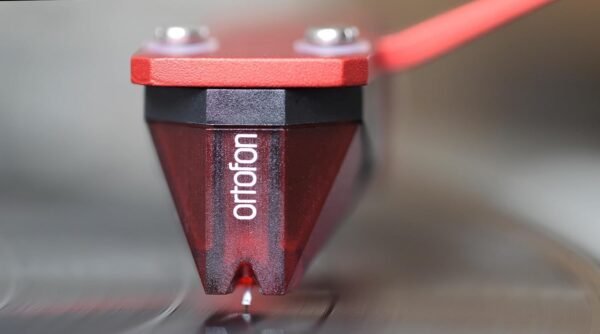
Fitting a cartridge is a job that rewards patience. It mounts to the headshell with two small screws, four wires connect to the pins by color, and then the alignment, tracking force and antiskate all have to be set. Alignment in particular uses a protractor and determines whether the stylus sits tangentially in the groove across the record. Done carelessly, a good cartridge will sound worse than a cheap one fitted properly, and it will wear records unevenly.
The cartridge should also be matched to the turntable rather than chosen in isolation. A deck such as the Pro-Ject Debut Carbon EVO has a tonearm designed for cartridges in this class, while a more basic all in one player like the Denon DP-29F may not have an arm that can be adjusted at all. Checking whether the tonearm allows tracking force and alignment adjustment is the first step, because without it a cartridge upgrade cannot be set up correctly.
Highlights
- Moving magnet design compatible with standard phono inputs and outboard preamplifiers.
- Widely stocked and widely supported, with replacement styli readily available.
- Part of a series with a documented upgrade path within the same family.
- Light at a listed 0.254 ounces, suited to common entry and mid level tonearms.
- 4.7 star average across more than 2,600 ratings, a large sample for a cartridge.
- Long production history, listed continuously since 2012.
- Distinctive red body, easy to identify visually on a headshell.
Things To Consider
The listing publishes almost none of the specifications a cartridge buyer needs. There is no stylus profile, no recommended tracking force range, no output voltage, no channel separation figure, no frequency response and no recommended load impedance. Those figures determine both how the cartridge should be set up and whether it will match a given phono stage, and they are entirely absent here. A Color Screen field marked No appears instead, which is a template artifact from a completely different product category.
A cartridge is also a consumable. The stylus tip wears with every hour of playing, and a worn stylus damages records permanently. Manufacturers publish expected lifetimes in playing hours, and owners should track usage rather than waiting for the sound to degrade audibly, because by then the damage to the collection has already happened.
Setup requires tools most people do not own: a protractor for alignment and a scale for tracking force. Both are inexpensive, but they are additional purchases and additional learning. Anyone unwilling to do that work should have the cartridge fitted by a dealer rather than approximating the settings.
Finally, expectations should be proportionate. A cartridge upgrade improves what the system already does; it does not transform a poor turntable into a good one. If the deck has a noisy motor, a wobbly platter or an unadjustable arm, that is where the money should go first. A well set up system also benefits from the rest of the chain being ready, whether that means a receiver with a phono input or a compact system such as the Klipsch The One II, which includes a phono stage of its own.
Who it suits
The 2M Red suits an owner of an entry or mid level turntable with an adjustable tonearm who wants a clear improvement over a basic fitted cartridge, and anyone replacing a worn stylus on a deck they intend to keep. Its wide compatibility with standard phono stages makes it a low risk choice.
It is not the right purchase for a turntable with a fixed, non adjustable arm, for anyone unwilling to align and weigh the cartridge properly, or for a system built around a moving coil phono stage. Those buyers should look through the alternatives in the turntable cartridges category, or consider replacing the deck entirely by comparing what is available in the turntables category first.