
Description
ART DJPRE II: the small box that makes a turntable audible
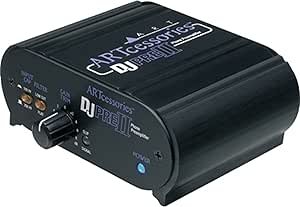
The ART DJPRE II is a phono preamplifier, and understanding why one is needed explains the entire product. A phono cartridge produces a signal thousands of times smaller than a line level source, and that signal is deliberately recorded with an altered frequency balance. Records are cut with the bass reduced and the treble raised, which is what allows a groove to hold a long side without the stylus jumping. A phono preamplifier does two jobs: it amplifies the tiny signal up to line level, and it applies the inverse of that curve to restore the original balance. The listing states that this unit meets the RIAA specification, which is the standard describing exactly that curve.
Without a phono stage, a turntable plugged into a line input sounds quiet and thin. That is not a fault, it is the recording standard being played back uncorrected. Some turntables include their own preamplifier, such as the Denon DP-29F with its built in phono equalizer, and some receivers still include a phono input. Anyone whose deck and amplifier both lack one needs a box like this.
Adjustable gain and the rumble filter
Two features raise this above the simplest phono stages. The first is adjustable gain. Cartridges vary considerably in output, and a fixed gain preamplifier can leave one cartridge too quiet and push another into distortion. An adjustable control allows the output to be matched to the amplifier and to the cartridge in use, which matters if the cartridge is ever changed. Pairing with a common moving magnet design such as the Ortofon 2M Red is the usual case, and adjustable gain means the preamplifier does not have to be replaced when the cartridge is upgraded.
The second is the low cut filter, sometimes called a rumble filter. Turntables produce very low frequency noise from motor vibration, warped records and footfall through the floor, all of it below the range of anything musical. Left alone, that energy reaches the speakers and makes woofers move visibly without producing useful sound, wasting amplifier power and reducing clarity. A switchable filter removes it. On a system with a subwoofer this is more than a refinement, since a subwoofer will happily reproduce rumble that smaller speakers ignore.
The unit is listed with two channels, a metal chassis, a weight of 1.1 pounds and surface mounting, and it has been in the catalog since April 2004 with a strong position in the preamplifier category.
Power supply and compliance
The listing gives a 12 volt supply. Note that the voltage appears twice with different descriptions, once as 12 Volts DC and once as a maximum supply voltage of 12 Volts AC, so the listing states the power requirement two different ways. External supplies for units like this are commonly AC or DC depending on the internal design, and connecting the wrong type can damage the device, so the supplied adapter should always be used and its type confirmed if it is ever replaced.
The compliance list is more informative than it looks: RIAA, FCC, CE, RoHS and WEEE. RIAA confirms the equalization standard, while the others cover electromagnetic emissions, European conformity, restricted substances and disposal. For a small audio accessory, that list indicates a product built to be sold across multiple regulated markets rather than assembled to a price alone.
Highlights
- RIAA compliant phono equalization for correct playback of records.
- Adjustable gain to match different cartridges and amplifiers.
- Switchable low cut filter to remove turntable rumble.
- Two channel stereo operation in a metal chassis.
- Light at 1.1 pounds and designed for surface mounting.
- Runs from an external 12 volt supply.
- Long production history since 2004 with a strong ranking among preamplifiers.
Things To Consider
The listing does not state which cartridge types are supported, and that is the most important compatibility question for a phono stage. Moving magnet cartridges output far more signal than moving coil designs, and a preamplifier built for one will not properly serve the other without enough gain. Most units in this class and price are designed for moving magnet cartridges. Anyone using a moving coil cartridge should confirm compatibility before buying rather than assuming the adjustable gain covers it.
Two entries in the data are unreliable. The Size field reads 14.1 by 7.3 by 2.3 inches, which describes packaging rather than a device weighing just over a pound, and a Color Screen field marked No is a template artifact with no relevance to a phono stage that has no display at all.
External power supplies are also the usual failure point on small audio boxes. They get lost, they get swapped, and they are the component most likely to need replacing years later. Keeping the original adapter with the unit is worth doing, given the voltage confusion noted above.
Finally, a phono preamplifier is a link in a chain and it cannot compensate for what happens before it. A worn stylus, a poorly aligned cartridge or an unlevel turntable will all degrade the sound in ways no preamplifier can correct. Buyers looking to improve vinyl playback should address the deck and cartridge first, and consider a well specified turntable such as the Pro-Ject Debut Carbon EVO if the existing one is the weak point.
Who it suits
The DJPRE II suits anyone connecting a turntable to an amplifier, receiver or powered speaker without a phono input, listeners who want a rumble filter for a system with a subwoofer, and buyers who expect to change cartridges and want the gain flexibility to accommodate that.
It is unnecessary for owners of turntables with a built in preamplifier, and for anyone whose receiver already has a phono input, since adding a second phono stage in series would produce distortion rather than improvement. A receiver such as the Yamaha R-S202 should be checked for a phono input before buying anything. For alternatives, see the preamplifiers category, and browse the turntables category to see which decks include a stage of their own.