Description
What the Behringer Eurolive F1220D Is
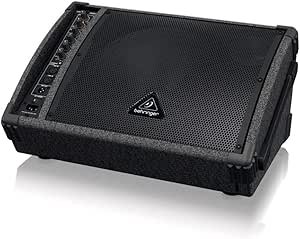
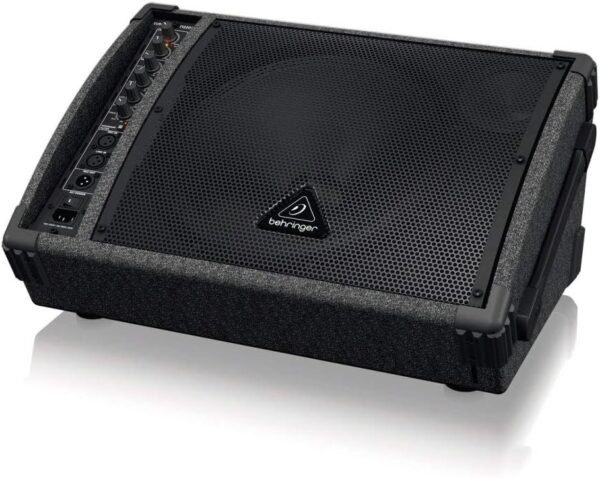
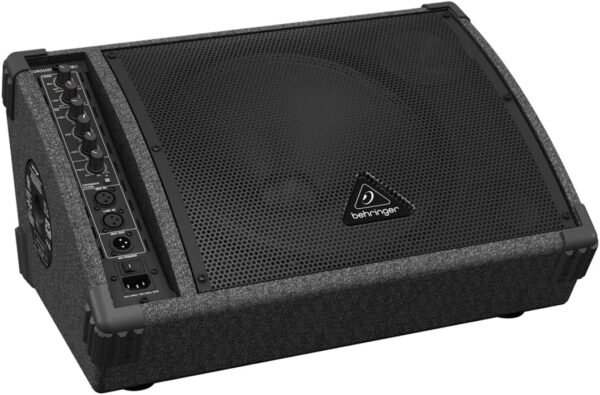
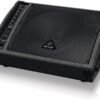
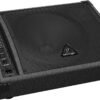
The Behringer Eurolive F1220D is a self powered floor monitor rated at 250 watts, built for the stage rather than for a room. A floor monitor, often called a wedge, sits on the stage in front of a performer and fires upward so the performer can hear vocals and instruments over the band. That is a distinct job from a front of house speaker, which faces the audience, and the angled cabinet shape follows directly from it.
Self powered means the amplifier is inside the cabinet, so the wedge takes a signal cable from a mixer aux send and a power cable from the wall. Nothing else is required. That is the main practical advantage over a passive wedge such as the Yamaha BR12M passive floor monitor, which needs an amplifier ahead of it and a speaker cable rather than a signal cable. Behringer sells the F1220D against exactly that comparison, and buyers weighing the two should understand which cables and which rack they already own.
The Feedback Filter
The feature the listing highlights most is a feedback filter, and on a monitor wedge that is the correct thing to highlight. Feedback is a monitor problem before it is anything else. A vocal microphone points at the singer, a wedge points back at the singer, and the loop between the two is closed the moment the monitor level goes up. Every additional decibel of monitor level pushes that loop closer to oscillation.
A feedback filter, sometimes called a feedback destroyer or a notch filter, detects the frequency where the loop is building and applies a narrow cut at that frequency. Done well it buys several decibels of usable level before the loop closes. Done badly it hunts, cutting frequencies that were never the problem and hollowing out the vocal. Either way it is a tool rather than a solution: microphone choice, monitor placement, and stage discipline still do most of the work. Having the filter built into the wedge rather than requiring a separate rack processor is nonetheless a real convenience for small operations. Larger systems handle this in the rack, alongside amplification such as the Crown CDi 1000 power amplifier.
Portability and Where It Fits
The listing emphasizes a compact and lightweight design for transport and setup, and durability under frequent use. Those are the right priorities for a wedge, which gets loaded into a vehicle, carried across a car park, set on a dusty stage, and stood on by accident more than any other speaker in a system. Weight matters twice over on a monitor, because a wedge is usually carried one handed while something else is carried in the other.
A 250 watt rating places this at the entry to the powered wedge market. That is enough for a small stage, a rehearsal room, a house of worship, or a solo performer with a vocal microphone and an acoustic instrument. It is not enough to compete with a loud drummer and a guitar amplifier on a large stage, where higher rated cabinets are the norm. Buyers who need more output should look at the QSC K10.2 powered speaker, and those who move gear weekly should factor in protection from the bags, cases and covers category.
Highlights
- Self powered wedge rated at 250 watts, requiring only a signal cable and mains power.
- Built in feedback filter, addressing the problem monitors create more than any other speaker.
- Angled cabinet shaped to sit on a stage floor and fire up at a performer.
- Compact and light enough for one person to load and position.
- Positioned for small stages, rehearsal rooms, and solo performers.
Things To Consider
The imported record for this product contains no manufacturer description and no specification table whatsoever. That is a serious gap for a loudspeaker. There is no driver complement, no horn coverage pattern, no frequency response, no maximum sound pressure level, no input connector list, no weight, and no dimensions. For a wedge, the coverage pattern and the maximum level are the two figures that decide whether it works on a given stage, and neither is available here. Anyone specifying this monitor should get those numbers from Behringer.
This product is also filed on the site under monitor, speaker and subwoofer parts, which is wrong. It is a complete powered loudspeaker, not a component or a replacement part. That is a categorization error rather than a product problem, but it is worth knowing if the surrounding category listings look unrelated.
The design carries the usual considerations for a powered wedge. The amplifier travels with the speaker, which means it is exposed to the same transport, heat, and moisture the cabinet is, and it cannot be swapped quickly if it fails during a show. Mains power has to reach the monitor position on the stage, which is one more cable across a performance area. A 250 watt rating limits the size of stage this can serve. And the feedback filter, useful as it is, can encourage operators to push monitor levels past what the room supports, which trades one problem for another. A second wedge such as the Behringer Eurolive B205D powered monitor is often a better answer than more level from one.
Who Should Buy It and Who Should Not
The F1220D suits a solo performer, a small band, a house of worship, or a rehearsal room that needs a straightforward wedge without buying an amplifier rack. The onboard feedback filter is genuinely useful for operators who are also performing and cannot stand at a mixer adjusting an equalizer mid song.
It is not the right monitor for a loud stage, for a permanent installation where amplification is better kept in a protected rack, or for anyone who needs published coverage and output figures before specifying a system. Those buyers should look at higher rated cabinets in the powered cabinets category, or at a passive system driven from a rack if serviceability matters more than convenience.