

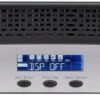
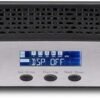
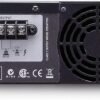
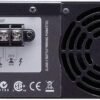
Description
What the Crown CDi 1000 Is Designed For
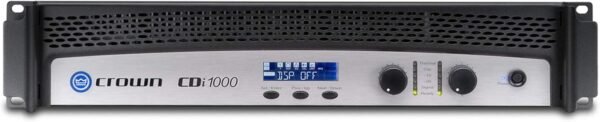
The Crown CDi 1000 is a two channel power amplifier aimed at installed sound rather than at touring. Crown is explicit about this in its own description: the CDi Series amplifiers are professional tools designed and built for installed sound applications, and the series comprises four models that are identical apart from output power, running from the CDi 1000 through the CDi 2000, CDi 4000, and CDi 6000. Choosing a model within that family is therefore a matter of matching power to the load rather than choosing between different feature sets.
Installed sound means fixed systems: ceiling speakers in a restaurant, paging in a warehouse, background music in a retail space, a school gymnasium, a house of worship. Those jobs have different priorities from a band on a stage. Reliability over years matters more than portability, remote or unattended operation matters more than front panel convenience, and the ability to drive long cable runs to many speakers matters more than raw output into a single cabinet. Operators building a portable rig instead will usually reach for self powered cabinets such as the QSC K10.2 powered speaker, which put the amplifier inside the box.
Output Ratings and Distributed Line Operation
The model designation in the product title gives the amplifier as 500 watts per channel into 4 ohms, with 70 volt and 140 volt operation also listed. That second part is the important one and it is what defines this amplifier class. A constant voltage distributed line, usually called a 70 volt system, sends audio at a higher voltage and lower current so that a single amplifier channel can feed many speakers over long cable runs without the losses that a conventional low impedance connection would suffer. Each speaker carries a transformer with selectable taps, so the installer decides how much power each one draws.
Anyone who has wired a background music system knows why this exists. Running dozens of ceiling speakers from a conventional amplifier means solving a series and parallel impedance puzzle and accepting cable losses across a building. A distributed line turns that into simple arithmetic: add up the tap settings and stay under the amplifier rating. Built in 70 volt and 140 volt capability, rather than an external transformer, is the practical reason to choose an amplifier like this over a general purpose one. Passive cabinets that pair with an amplifier of this kind include the Yamaha BR12M passive floor monitor, though a wedge is a stage product rather than an install one.
Physical Format and Build
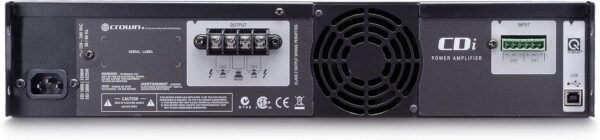
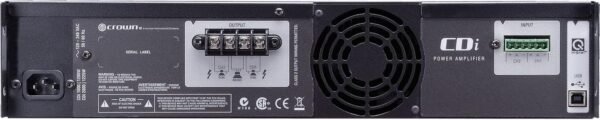
The listing gives the dimensions as 12.3 by 19 by 3.5 inches, which is a standard 19 inch rack width at 2 rack units of height, and the weight as 22 pounds. The materials are listed as steel and aluminum, the voltage as 120 volts, and the specification met field lists CSA and CE approvals. For an installed product, agency approval markings are not decoration. They are frequently a requirement for a permanent installation to pass inspection, and their presence on a listing is a genuine buying consideration for a contractor.
Crown describes the series as rugged and lightweight for its class. Twenty two pounds in 2 rack units is reasonable for a professional amplifier and reflects a modern power supply rather than a heavy linear one. The listing also mentions front panel controls and digital signal processing options among the marketing bullets, though the imported record does not enumerate what processing is included. Contractors specifying an amplifier for a rack should confirm the exact processing feature set and the input connector type from Crown documentation, and should plan rack ventilation around the heat any amplifier of this power produces. Systems built this way often live alongside portable equipment, and the power amplifiers category shows how the two markets overlap.
Highlights
- Two channel design rated at 500 watts per channel into 4 ohms per the product title.
- Direct 70 volt and 140 volt distributed line operation without external transformers.
- Standard 19 inch rack format at 2 rack units of height, listed at 22 pounds.
- Steel and aluminum construction with CSA and CE approvals listed.
- Part of a four model series that differs only in output power, simplifying specification.
Things To Consider
The output rating on this listing is given three different ways and they do not agree. The output power field reads 5E+2 watts, which is 500 written in scientific notation. The size field reads 500-Watts. But the output wattage field reads 700 watts. There is no way to reconcile a 500 watt and a 700 watt claim for the same channel, and the difference is large enough to affect a speaker matching decision. Anyone specifying this amplifier should work from Crown published data rather than the marketplace figures.
Other fields are wrong in ways that are easier to dismiss but still worth noting. The connector type reads Usb, which does not describe the input or output connections on a professional power amplifier. The mounting type reads Surface Mount for a rack mounted product. Crown own description also uses a comparative value claim about the class that this page will not repeat, since it is a marketing assertion with nothing measurable behind it.
The practical limitations are those of the category. A power amplifier makes no sound by itself and is useless without speakers, cable, and a signal source, so it is a component purchase rather than a system. Rack mounting requires a rack, and 2 rack units of amplifier generates heat that has to leave the enclosure. The listing shows a 3.8 star average across 36 ratings, a small sample and a middling average, which is worth reading through rather than averaging. And with a first availability date in 2007, this is a long lived design, which cuts both ways: proven and widely deployed, but predating the network control and monitoring features that many current install amplifiers include.
Who Should Buy It and Who Should Not
The CDi 1000 makes sense for a contractor or facilities manager installing a distributed speaker system in a commercial space, where 70 volt operation, rack format, and agency approvals are requirements rather than preferences. It also suits anyone replacing a failed amplifier in an existing Crown based install, where matching an established series keeps the rest of the system unchanged.
It is the wrong purchase for a home listener, for a mobile operator who would be better served by self powered cabinets, and for anyone who wants to plug speakers in and hear sound without designing a system first. Portable event operators should compare active options and protective transport, including the Behringer Eurolive F1220D powered speaker and the equipment protection options in the bags, cases and covers category.