



Description
What the Jabra Engage 65 Is Built For
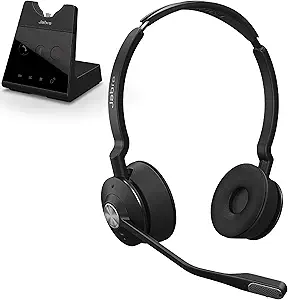
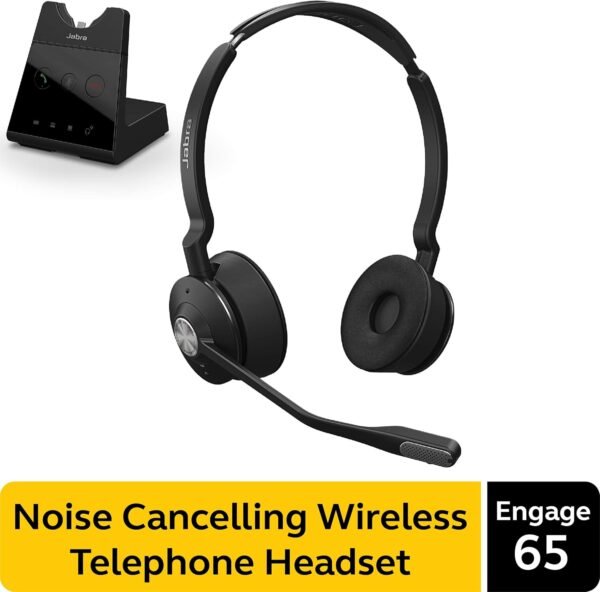
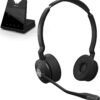
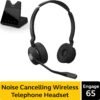
The Jabra Engage 65 Stereo is a professional telephone headset, not a consumer listening product. It uses DECT wireless rather than Bluetooth, connects to a desk phone or a computer through a base station, and is designed for people who spend most of a working day on calls. The listing gives a range of up to 150 meters, or 490 feet, the ability to connect two devices at once, and a battery quoted at 13 hours of talk time.
The DECT choice is the central design decision. DECT operates in a band reserved for cordless telephony rather than the crowded 2.4 GHz range Bluetooth shares with Wi-Fi, which is why the range figure is an order of magnitude beyond a Bluetooth headset. In a call center or an office with many headsets in use, that separation also reduces interference between users. Buyers who want a Bluetooth headset for mixed use should compare the Poly Voyager 5200 Bluetooth headset, and general purpose alternatives are in the on ear headphones category.
Hearing Protection and Sustained Use
The features that distinguish this headset from a consumer product are the ones aimed at people wearing it for eight hours a day. Jabra describes PeakStop, which limits sudden loud sound spikes before they reach the ear, and IntelliTone 2.0, which keeps average sound exposure below defined thresholds across a working day. Both address occupational hearing risk rather than sound quality.
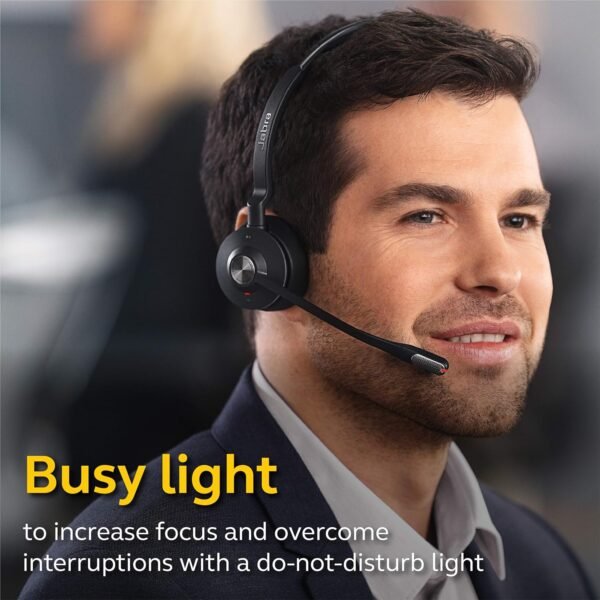
That distinction matters. A consumer headphone is designed on the assumption that the user controls the volume and stops when they want. A contact center headset is worn by someone who cannot predict what will arrive down the line, including feedback squeals, line faults, and shouting, and whose total daily exposure is a workplace health matter. Level limiting of this kind is a genuine feature with a regulatory context behind it, not a marketing addition. The integrated busylight, which shows colleagues when the wearer is on a call, addresses the other occupational problem: interruptions.
Connectivity, Compatibility, and What Comes in the Box
The included components list describes the real scope of the product: a headset, a base station, a power supply, a USB cable, a desk phone cable, and documentation. This is a system rather than a headset. The base is what provides the DECT link, the charging cradle, and the connections to both a desk phone and a computer, and the ability to connect two devices at once means a user can take calls from a physical phone and a softphone without swapping hardware.
The listing states that the headset meets Skype for Business Open Office requirements, which is a certification aimed at deployment in shared workspaces. Jabra also states that 40 engineers spent more than 115,000 hours in development and that four patents resulted. This page reports those as manufacturer claims. The listing describes the microphone as noise cancelling, which improves what the caller hears. Anyone who wants noise reduction for the wearer should look at a cancelling headphone such as the Sennheiser ACCENTUM Plus wireless headphones instead.
Highlights
- DECT wireless with a stated range of up to 490 feet, well beyond Bluetooth.
- Connects to two devices at once, covering a desk phone and a computer softphone.
- Integrated busylight acting as a visible do not disturb signal to colleagues.
- PeakStop and IntelliTone 2.0 hearing protection aimed at all day wearers.
- Base station, power supply, USB cable, and desk phone cable included.
Things To Consider
One specification field is misleading in a way that matters. The noise control field reads Active Noise Cancellation, which will be read by most buyers as meaning the headset cancels noise for the wearer. Everything else on the listing describes a noise cancelling microphone, which is a different feature entirely: it reduces background noise on the transmitted signal so the person on the other end hears the speaker clearly. Nothing in the description supports active cancellation for the wearer. A buyer choosing this headset to escape office noise would be disappointed.
Other fields are simply wrong. The charging time reads 13 hours, which is the battery life figure repeated in the wrong field. The cable feature reads Without Cable, while the included components list two cables. The frequency response reads 16000 Hz alone, half of the 40 Hz to 16,000 Hz range given elsewhere. The headphones jack field reads Wireless. The earpiece shape reads Over-ear while the product is filed on this site under on ear headphones. The item weight of 2.89 ounces is plausible for the headset alone but sits oddly next to a product that ships with a base station.
The practical considerations are those of a professional product used outside its intended setting. A DECT headset requires its base station, so it is not portable in the way a Bluetooth headset is and it will not pair with a phone. The frequency range topping out at 16 kHz reflects a voice oriented design rather than a music one, so this is not a listening headphone. The listing shows a 4.1 star average across 243 ratings, a moderate score worth reading through given that the buyers are likely to be businesses deploying in volume.
Who Should Buy It and Who Should Not
The Engage 65 Stereo suits a contact center, a busy office, or a home worker who takes calls all day on both a desk phone and a computer, needs to move away from the desk while talking, and benefits from hearing protection and a busylight. For that user the DECT range and the dual device connection are the features that justify the purchase.
It is the wrong product for anyone who wants a headset for music, for anyone who needs to pair with a phone or a tablet directly, and for anyone expecting noise cancellation for the wearer. Those buyers should look at Bluetooth designs, at the computer headsets category for desk oriented alternatives, or at the Jabra Evolve2 true wireless earbuds for a portable option from the same manufacturer.