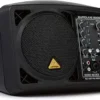
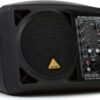
Description
Behringer Eurolive B205D: a 150 watt monitor built to sit on a mic stand
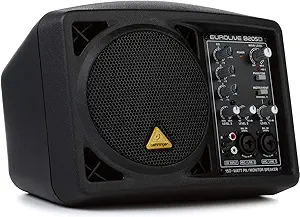
The Behringer Eurolive B205D is an active, single driver monitor speaker aimed at musicians and presenters who need reinforcement in a small room without carrying a full PA rig. Behringer describes it as an ultra compact 150 watt PA and monitor speaker system, and the listing positions it for vocal and keyboard monitoring, multimedia playback, press conferences and home recording. The defining idea is the mic stand integration system: the cabinet threads onto a standard stand so the box can be aimed directly at the performer rather than parked on the floor.
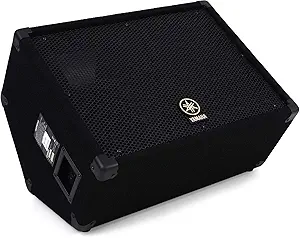
The specification sheet lists a weight of 7.05 pounds and a cabinet measuring 8.66 by 11.42 by 7.28 inches, which is roughly the footprint of a small studio monitor. That size is the whole argument for this product. A singer songwriter working coffee shops, a keyboard player who needs a personal wedge, or a meeting room that needs one voice carried to the back row are all situations where a 12 inch powered cabinet is more speaker than the job requires. Anyone who needs to cover a real room with a full band should look at something like the Yamaha BR12M floor monitor or a powered box in the class of the QSC K10.2 instead.
Amplifier, driver and the numbers behind them
Behringer specifies a Class D amplifier rated at 150 watts driving a 5.25 inch full range neodymium driver. Class D is the reason the cabinet weighs as little as it does, since the amplifier module and its switch mode power supply avoid the heavy transformer of an older analog design. The listing also credits that switch mode supply with low noise operation and low power draw, which matters when several of these are chained on one circuit at a small venue.
A single 5.25 inch driver covering the whole range sets realistic expectations. There is no separate tweeter listed and no woofer to hand off low frequencies to, so vocals, spoken word and keyboard patches are the natural fit while deep bass reinforcement is not. Behringer includes an integrated limiter for system protection, which is the sensible engineering answer to a small driver being asked for more level than it can produce.
One number in the imported listing does not fit a product sold in the United States. The attribute table gives Voltage as 240 Volts while the same table lists Output Wattage as 150 Watts and Wattage as 150 watts, effectively stating the power figure twice. Treat the 240 volt entry as an artifact of a global listing rather than a confirmed regional detail, and check the plug and voltage on the unit you are actually buying. The table also carries a Color Screen field marked No, which is a data field inherited from a different product class and means nothing on a monitor speaker.
The mixer section is what separates it from a plain powered speaker
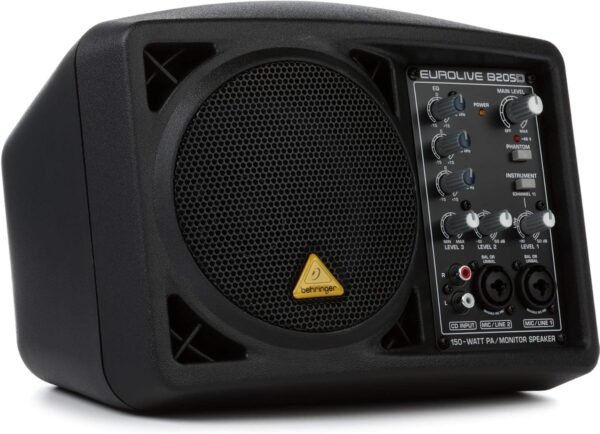
The B205D is not simply an amplified box. Behringer builds in a three channel mixer with three band EQ covering bass, mid and treble. Two of those channels are microphone preamps with phantom power, so a condenser microphone can be plugged in without an external interface, and one input is described as instrument ready, meaning a guitar or bass can go straight in without a DI box. A dedicated stereo input handles keyboards, a phone or a media player.
There is also an XLR through connector with a mic and line switch, which lets one B205D pass its signal to another. For a duo where each player wants a personal monitor, that link is the feature that keeps the setup from needing a separate mixer. If you are pairing this with a handheld dynamic microphone, the Shure SM48 is the kind of low cost vocal mic that suits the two preamps here. Anyone whose needs grow past three inputs will end up in front of a larger powered cabinet such as the Behringer Eurolive F1220D, which is the same family idea scaled up to a 12 inch driver.
Highlights
- Class D amplification rated at 150 watts into a 5.25 inch full range neodymium driver.
- Cabinet listed at 7.05 pounds and 8.66 by 11.42 by 7.28 inches, with an integrated top carry handle.
- Three channel mixer with three band EQ, two microphone preamps with phantom power and one instrument ready input.
- Dedicated stereo input for keyboards, phones and media players.
- XLR through connector with mic and line switch for linking additional units.
- Mic stand integration system so the cabinet can be aimed at head height.
- Integrated limiter and an impact resistant enclosure.
Things To Consider
A 5.25 inch driver is a real limit, not a marketing detail. Kick drum, bass guitar and heavily produced backing tracks will not be reproduced with authority at volume, and the built in limiter exists precisely because the driver runs out of excursion before the amplifier runs out of watts. Read the 150 watt figure as headroom for clean vocal and keyboard level in a small room rather than as an indication of how loud the box will play a full mix.
The listing data is also thin and inconsistent. The 240 volt entry noted above, the meaningless Color Screen field and the absence of any published frequency response, maximum sound pressure level or dispersion figure mean there is no manufacturer stated performance envelope to compare against competitors. Buyers who want measured numbers will not find them in this listing.
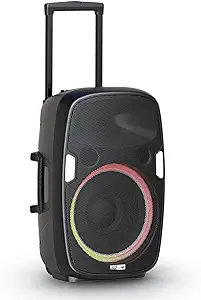
This is also a long lived product. The listing gives a first availability date of April 14, 2010, and marks it as not discontinued. That longevity says the design has held its place in the market, but it also means the feature set predates conveniences that are now common in this category, including Bluetooth playback and app control. There is no wireless input of any kind. Everything arrives over a cable, which is a fair trade for reliability at a gig but worth knowing before purchase. If wireless is the actual requirement, a battery powered Bluetooth box like the Altec Lansing SoundRover trolley speaker answers a different question entirely.
Who it suits
The B205D makes sense for a solo performer or duo who needs a personal monitor that can also work as a small front of house speaker, for a keyboard player who wants their own wedge, and for meeting rooms, classrooms and small presentations where one or two microphones need to be heard clearly. Its weight and stand mount make it easy to move alone.
It is the wrong purchase for anyone reinforcing a drummer or a bass rig, for outdoor use where there is no room to load the sound, or for a buyer who expects Bluetooth streaming and app control. Those requirements point toward larger powered enclosures. Browse the rest of the PA systems category for wider coverage options, or the powered cabinets category if the job needs more driver area than a 5.25 inch cone can supply.