
Description
What the SM48 Is and Where It Sits
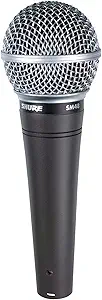
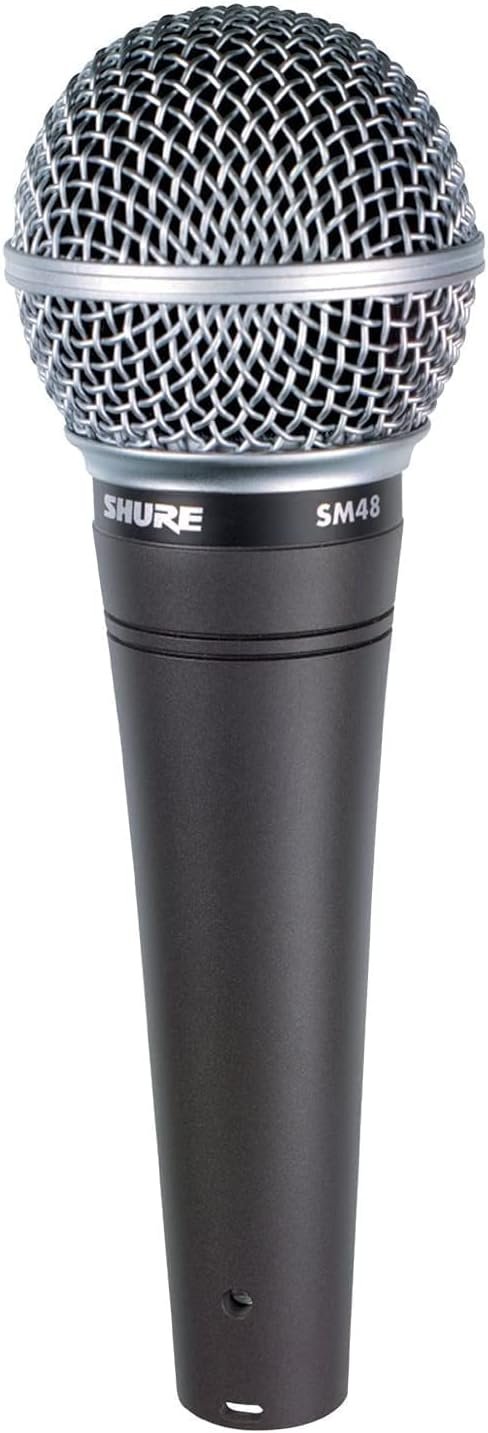
The Shure SM48 is a cardioid dynamic handheld microphone built for lead vocals, backing vocals and spoken word. It sits just below the SM58 in Shure’s range, sharing the same basic philosophy of a rugged body, a shock-mounted cartridge and a response shaped for the human voice rather than for flat accuracy. The listing here is the SM48-LC, and the LC suffix is not decorative: it means less cable, so an XLR lead is a separate purchase.
The audience is anyone who needs a microphone that will be handled roughly and still work: a church sound system, a school hall, a rehearsal room, a small venue, a community radio setup. It is a workhorse rather than a specialist, and that is exactly the point. Buyers who want a supercardioid pattern for tighter isolation on a loud stage should compare it against the sE Electronics V7, which trades some forgiveness for more gain before feedback.
The Cardioid Pattern and Tailored Response
Shure states that the SM48 maintains a true cardioid pattern throughout its frequency range. That claim is more significant than it sounds. Many inexpensive microphones are cardioid at midrange frequencies and become progressively more omnidirectional lower down, which is precisely where stage feedback and spill originate. Holding the pattern consistently across the band is what delivers the promised rejection of off-axis sound and the resulting gain before feedback.
The frequency response is deliberately not flat. Shure describes a presence rise that brightens the mid-range, lifting the consonant information that makes a voice intelligible over a band, together with a low frequency roll off that controls proximity effect. Proximity effect is the bass boost that occurs when a directional microphone is worked very close, and singers who eat the microphone will otherwise sound muddy. The roll off is a built-in correction for the way people actually use handheld microphones.
Build, Handling and What Comes in the Box
The SM48 uses a shock-mounted cartridge, meaning the capsule is suspended inside the body rather than bolted rigidly to it, so knocks and grip changes are absorbed before they reach the diaphragm. A steel mesh grille protects the capsule, and an integral pop filter sits behind it to reduce plosive breath blasts and wind noise. Together these are the three details that separate a microphone designed for hands from one designed for a stand.
Shure supplies a stand adapter and a carrying bag. It does not supply a cable in this configuration, which trips up first-time buyers regularly. The listing puts the packaged weight at 1.25 pounds and the shipping dimensions at 10 by 5 by 3.5 inches; the microphone itself is considerably lighter than that figure implies, since the number covers the box, the bag and the clip. For applications where the microphone will live permanently on a boom in a fixed studio position, a broadcast-focused design such as the Rode Procaster is the better tool, and the wider vocal microphones category covers the range.
Longevity and Reputation
The listing shows the SM48 as first available in July 2004 and carrying an average of 4.7 stars across roughly 4,116 ratings. Two decades of continuous availability is itself a meaningful data point in a category where models come and go, and the rating volume is large enough that the average is not being set by a handful of reviews. What it does not tell you is how the microphone sounds compared to alternatives, only that a very large number of buyers have found it does what they expected.
Shure’s other dynamics on this site show how the family diverges once you move away from general vocal duty. The BETA 52A is built specifically for kick drums and bass cabinets, while the Green Bullet 520DX is a deliberately colored harmonica microphone. Neither would substitute for the SM48, and the SM48 would not substitute for either.
Highlights
- Consistent cardioid pattern across the frequency range, not just in the midrange.
- Presence rise and bass roll off tuned specifically for close-worked vocals.
- Shock-mounted cartridge that attacks handling noise mechanically.
- Built-in pop filter and steel mesh grille for breath blasts and physical protection.
- Stand adapter and storage bag included with the microphone.
- Long track record, with a 4.7 star average over roughly 4,116 ratings.
Things To Consider
The specification data attached to this listing includes claims that are simply wrong for the product. It states that one AAA battery is required, twice. The SM48 is a passive dynamic microphone: it generates its own signal from the movement of the diaphragm and needs no battery and no phantom power whatsoever. The table also includes a “Color Screen: No” field, which is meaningless on a microphone. These are import artifacts, not features.
- No cable is included in the LC configuration, so budget for an XLR lead.
- A dynamic capsule needs a preamp with reasonable gain; quiet sources on a weak interface will sound noisy.
- The 1.25 pound figure is packaged weight, not the weight of the microphone in hand.
- The battery specification is incorrect and should be ignored entirely.
- It is not a studio condenser and will not capture the detail one does on quiet, controlled sources.
- The tailored response is a commitment: it flatters voices and is less suitable for instruments needing neutrality.
Who Should Buy It and Who Should Skip It
The SM48 is a sound purchase for anyone equipping a venue, a place of worship, a school or a rehearsal space, where microphones get dropped and passed around and need to keep working. It is equally appropriate as a first serious handheld for a singer stepping up from a bundled microphone, and for spoken word applications such as announcements and panel discussions where intelligibility beats character.
It is the wrong choice for studio recording of quiet sources, for instrument work that requires a neutral response, and for anyone who needs a supercardioid pattern to survive a very loud stage. Podcasters and streamers should also look elsewhere, since the products in the multipurpose microphones category include USB models that plug straight into a computer and remove the need for a separate interface entirely.
