Description
What the POD Go Is
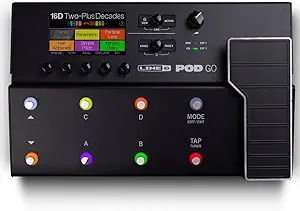
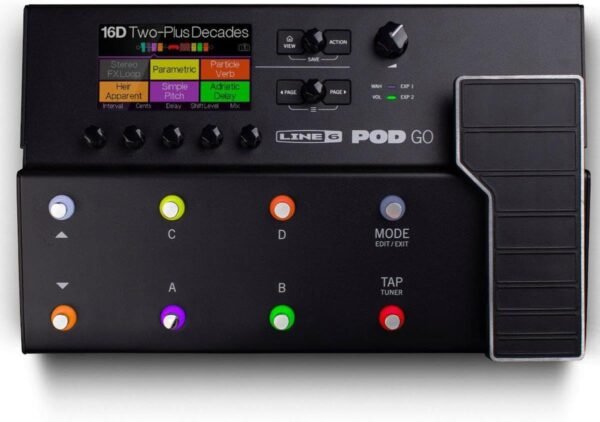
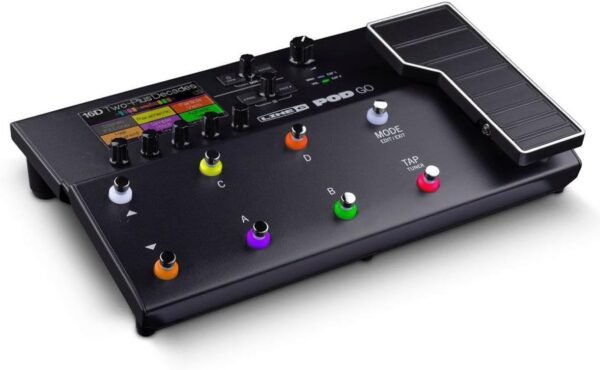
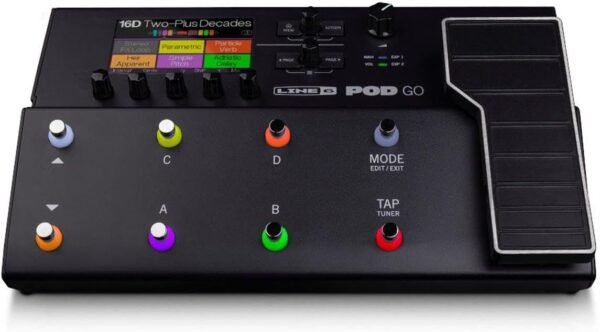
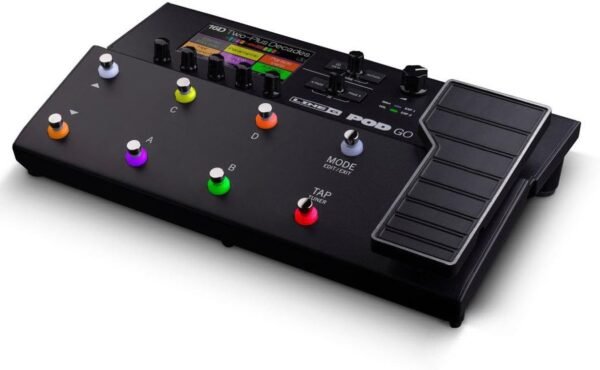
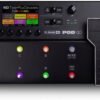
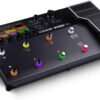
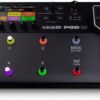
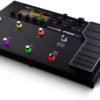
The Line 6 POD Go is a floor-based guitar multi-effects processor that borrows its amp, cabinet and effect models from the HX family used in the considerably more expensive Helix range. Line 6 positions it as a simpler and more portable route to those tones, and the design reflects that: a large color LCD, five push encoders, eight footswitches, and a cast aluminum expression pedal, in a unit measuring roughly 14 by 9 inches and weighing about 6 pounds.
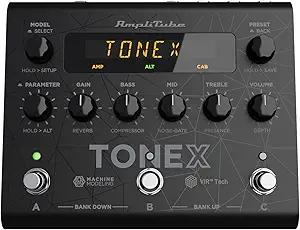
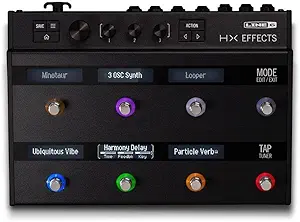
The competitive argument is straightforward. A modeler at this level is buying access to a model set rather than a specific circuit, and the HX models have an established reputation. Buyers comparing the alternatives should look at the effects-only Line 6 HX Effects from the same manufacturer and the capture-based IK Multimedia TONEX pedal, which takes an entirely different approach to the same problem.
The Signal Chain and Its Fixed Blocks
POD Go simplifies the Helix architecture by fixing several blocks in place. There is a preset structure with dedicated amp, cab, EQ, volume and wah positions, plus a limited number of free blocks for additional effects. That constraint is the entire design philosophy: it removes the routing decisions that make a full Helix intimidating, at the cost of the flexibility a power user might want.
For most players this is a good trade. The majority of guitar rigs are a drive, an amp, a cabinet, a modulation and a delay in that order, and having the frame pre-built means presets can be edited rather than constructed. Players who find the fixed blocks limiting have effectively outgrown the product and should be looking at the full Helix range. The floor multieffects category covers the neighboring options.
Connections: What Makes It Usable Beyond Practice
The connection set is unusually complete for a compact unit and is the strongest part of the specification. Balanced stereo outputs allow the POD Go to feed a mixing desk directly at a gig without a DI box. A separate amp output tapped before the cab and impulse response block sends an unspeakered signal to a real guitar amplifier, which is the correct way to use a modeler on stage alongside a physical amp. A stereo effects loop lets an external pedal be inserted at a chosen point in the chain, and a headphone jack covers silent practice.
The USB port exposes a 4-in and 4-out audio interface with re-amping, which means a dry guitar signal can be recorded alongside the processed one and re-processed later with a different amp model. That is a genuinely professional workflow feature and it is unusual to find it at this level. Third-party impulse response loading extends the same logic to cabinets, letting the user substitute their own captures for the built-in ones. Guitarists building a recording setup around this should also consider a looper such as the Boss RC-202 for practice and arrangement work.
Controls and Expansion
Eight footswitches is enough for most live use, and Line 6 supports two additional external footswitches or a second expression pedal for players who need more. Snapshots are the feature worth understanding: rather than switching between entirely separate presets, snapshots change multiple parameter values within one preset instantaneously and without an audio gap. That solves the single most annoying problem with modelers on stage, which is the momentary silence when changing presets mid-song.
The expression pedal is cast aluminum rather than plastic, which matters on a unit that will be stood on repeatedly. Power is 9 volts from an external supply. Line 6 notes that the shoulder bag is sold separately, and the listing shows the product at number 6 in Electric Guitar Floor Multieffects with a 4.7 star average across roughly 918 ratings.
Practical Notes for Live Use
Two details determine how well a modeler works on a real stage. The first is how quickly it recovers when power is interrupted, since a unit that takes twenty seconds to boot is a problem between songs at a festival changeover. The second is whether the display is readable under stage lighting, and a large color LCD is a meaningful advantage over the two-line monochrome screens found on older units.
The eight footswitches also need thinking about in advance. Assigning them badly is the most common reason players struggle with a floorboard, because the switch layout has to match the song structure rather than the preset structure. This is where snapshots earn their place: assigning a switch to a snapshot rather than to an individual effect means a single press can change the amp channel, the delay level and the volume at once, which is far closer to how a player actually thinks about a song section.
Highlights
- Over 270 HX and legacy models, inherited from a considerably more expensive product line.
- Snapshots for gapless parameter changes within a single preset.
- USB audio interface with re-amping, a professional recording feature at an entry price.
- Third-party IR loading for custom cabinet captures.
- Balanced outputs plus a pre-cab amp out, covering both desk and backline use.
- Cast aluminum expression pedal rather than a plastic one.
Things To Consider
The specification block lists the signal format as “Analog”, which is straightforwardly wrong for a digital modeling processor whose entire function is digital signal processing. It also gives the item weight as 6 pounds, which is heavier than the unit itself and likely includes packaging. Neither error affects the product, but neither field should be relied on.
- The fixed block structure limits routing compared with a full Helix.
- The number of free effect blocks is restricted, so complex chains hit a ceiling.
- The power supply is external at 9 volts and is another item to pack.
- The carry bag is sold separately.
- Editing is faster on a computer, so the desktop application becomes part of the workflow.
- The signal format specification is incorrect in the listing data.
Who Should Buy It and Who Should Skip It
The POD Go suits a gigging or home player who wants HX-quality models in something that fits in a backpack, who values the balanced outputs and the amp out for flexible stage use, and who will make real use of the USB interface for recording. It is also an excellent choice for anyone tired of maintaining a pedalboard, since it replaces a chain of individual pedals, their cables and their power supply with a single unit.
Skip it if you already know you want deep routing control, parallel paths and unrestricted block counts, because the fixed structure will frustrate you quickly. Skip it too if the requirement is simply a practice amp with some effects, where a modeling combo such as the Positive Grid Spark 40 or something from the combo amps category will be cheaper and simpler.