
Description
What an Open Ear Design Changes
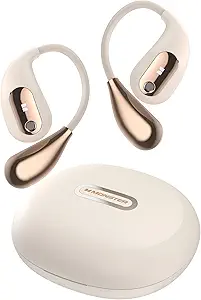
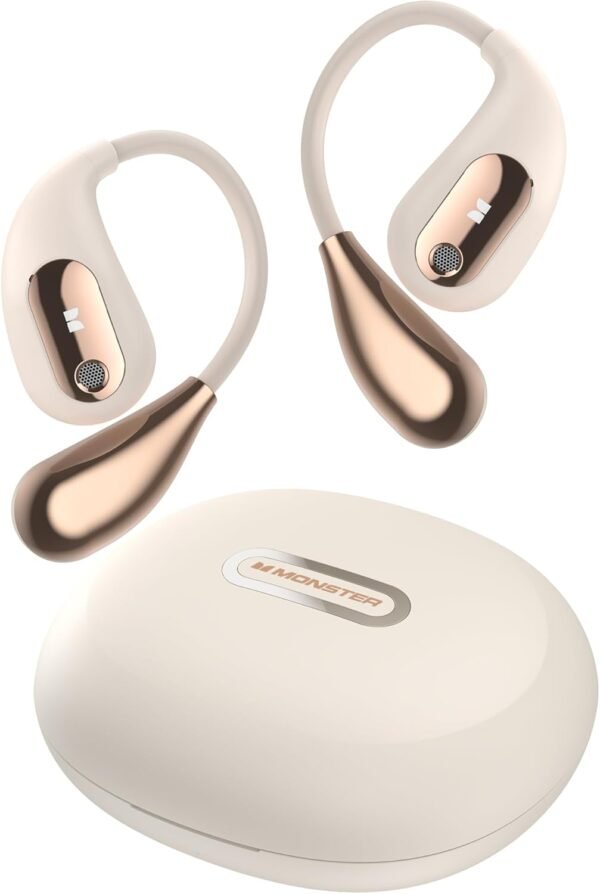
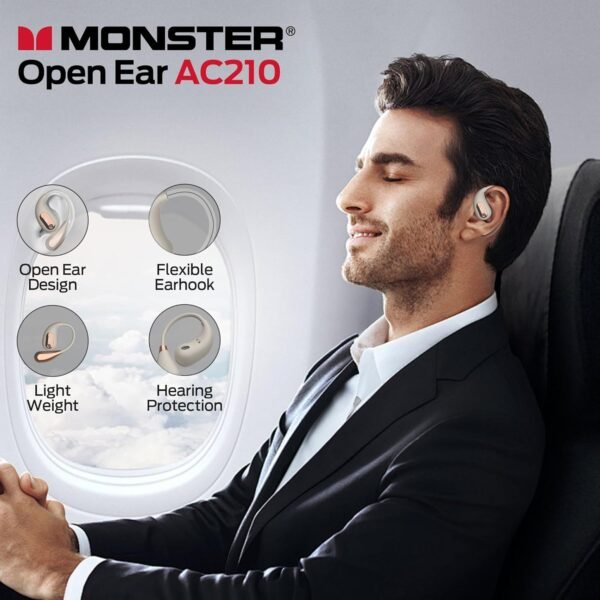
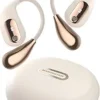
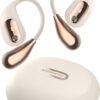
The Monster Open Ear AC210 belongs to a category that has grown quickly: earphones that never enter the ear canal. Instead of sealing a tip inside the ear, an open ear design suspends a small driver just outside the canal opening, usually held by a hook or a clip. The listener hears the music and the room at the same time. That is the entire proposition, and it is a genuinely different product from a noise isolating earbud rather than a lesser version of one.
The trade is symmetric and worth stating plainly. Because nothing seals the canal, there is no passive isolation, so ambient noise comes through unchanged and low frequency response is physically harder to produce. In exchange, the wearer keeps situational awareness, avoids the pressure sensation some people get from sealed tips, and can wear the set for hours without the occlusion effect that makes your own voice sound strange. Runners on public roads, cyclists, parents listening for a child, and office workers who need to hear a colleague approach are the people this format is built for. Anyone shopping this way should also look at the open ear headphones category, where bone conduction and air conduction approaches sit alongside each other.
Connection, Battery, and Charging
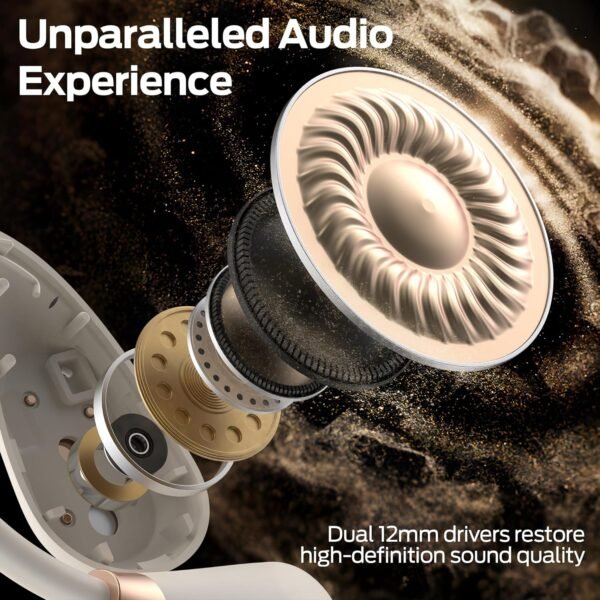
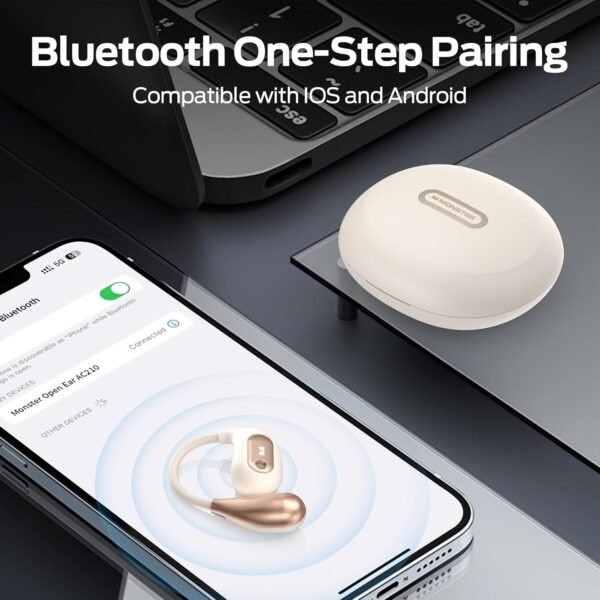
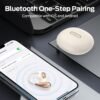
Monster lists Bluetooth 5.4 for the wireless connection, which is a recent revision of the standard and generally associated with more efficient connection maintenance rather than any change a listener would hear directly. The listing states stereo sound and gives a dynamic driver as the transducer type, without specifying the driver diameter. Charging is over USB Type-C, which is worth noting as a positive: a set that charges from the same cable as a modern phone is one less accessory to carry, and Type-C connectors are more durable than the older micro USB standard they replaced.
Battery figures on this listing appear in two forms that need reading together. The product title claims 30 hours playback, while the specification table lists battery life as 6 hours. Those are not contradictory if the 6 hour figure refers to a single charge of the earpieces and the 30 hour figure refers to the total with the charging case, which is how the marketing bullets describe it. That interpretation is reasonable but it is an interpretation, not something the listing states outright. A buyer whose use depends on single charge endurance should treat 6 hours as the working number and confirm with Monster. Anyone who needs longer single charge runtime will find over ear designs generally do better, and the Sony WH-CH720N noise canceling headphones illustrate the difference a larger chassis makes.
Fit, Compatibility, and Everyday Handling
The earpiece shape is listed as Open and the package dimensions are given as 5.28 by 4.49 by 1.85 inches with a listed item weight of 5.6 ounces, which describes the case and contents rather than what sits on the ear. The color offered here is white, and the listing includes a user manual among the components. Compatible devices are given broadly as smartphones, laptops, tablets, smart speakers, televisions, and cars, which is a way of saying standard Bluetooth audio rather than a specific compatibility claim. There is no mention of multipoint pairing in the imported record, so buyers who need to hold connections to a laptop and a phone at once should confirm that separately.
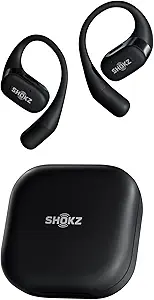
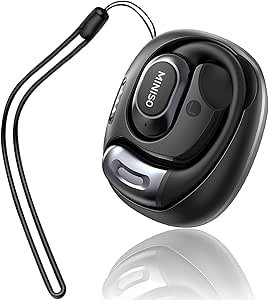
Fit is the deciding factor with any open ear set. Because the driver has to sit in a consistent position relative to the canal opening to sound the way the designer intended, small differences in ear anatomy have a larger effect than they do with a sealed tip that can adapt. Glasses wearers should also consider whether a hook design will compete with temple arms. Shoppers who want to compare hook geometry across brands can look at the SHOKZ OpenFit open ear headphones and the MINISO MS156 open ear headphones, which solve the same retention problem differently.
Highlights
- Open ear format that leaves the ear canal unblocked, preserving awareness of surroundings.
- Bluetooth 5.4 connection with a dynamic driver listed as the transducer.
- USB Type-C charging, so the set shares a cable with most modern phones.
- Combined runtime quoted at up to 30 hours with the charging case.
- Broad device compatibility listed across phones, laptops, tablets, televisions, and cars.
Things To Consider
This listing carries a direct contradiction that a buyer should notice. The product title advertises IPX5 waterproofing, while the specification table states the water resistance level is Not Water Resistant. Those two claims cannot both be true, and the listing gives no basis for choosing between them. Since water exposure is exactly the kind of thing a warranty claim turns on, anyone planning to run in rain or sweat heavily in these should confirm the rating with Monster before buying and should not rely on either figure as published.
Other fields are simply wrong or unusable. Connectivity technology reads Electronics, which is not a connection type. The style field reads E29white, which is an internal code rather than a description. The battery entry claims one A battery is required and included, which does not describe a rechargeable earphone. The headphones jack field reads No Jack, which is accurate but says nothing useful. As with much of the imported data across this catalog, the specification table should be treated as a starting point rather than a source of truth.
The design limits are real and unavoidable. Open ear sets cannot block noise, so they are a poor fit for aircraft, trains, and open plan offices where the goal is to remove distraction rather than stay aware of it. Bass response is constrained by physics rather than by engineering effort, so listeners who want weight in the low end will generally be happier with a sealed design. Leakage runs in both directions, which means the person next to you can hear a portion of what you are playing at higher volumes. And with a first availability date in late 2024 and 269 ratings on the listing, the long term durability record for this specific model is still thin.
Who Should Buy It and Who Should Not
The AC210 makes sense for someone who wants audio while remaining aware of traffic, colleagues, or family, and who values comfort over isolation. It is a reasonable pick for walking, light exercise, household use, and calls, particularly for listeners who find sealed tips uncomfortable after an hour. The USB Type-C charging and recent Bluetooth revision are sensible modern basics.
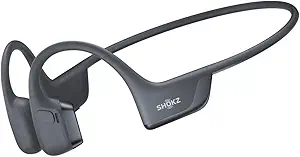
It is the wrong purchase for commuters who want to remove noise, for listeners who want deep bass, and for anyone who needs a documented water resistance rating today rather than after a support inquiry. Those buyers should look at sealed and active cancelling designs instead, including the options in the earbud headphones category. Anyone specifically wanting an open format built for sport rather than general listening should compare the SHOKZ OpenRun Pro2 bone conduction headphones, which use a different transmission method entirely.