Description
What the RHB70 Is
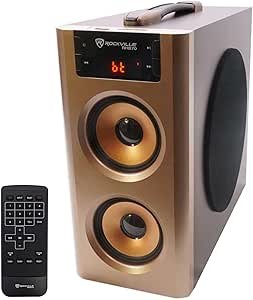
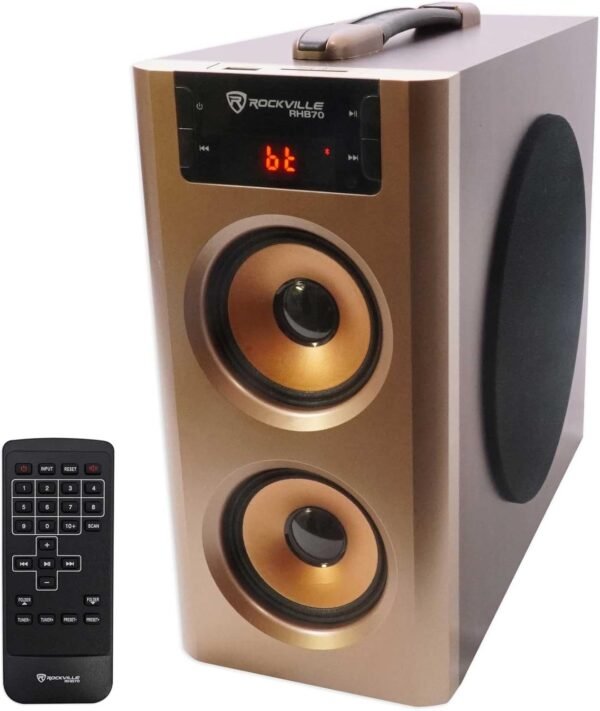
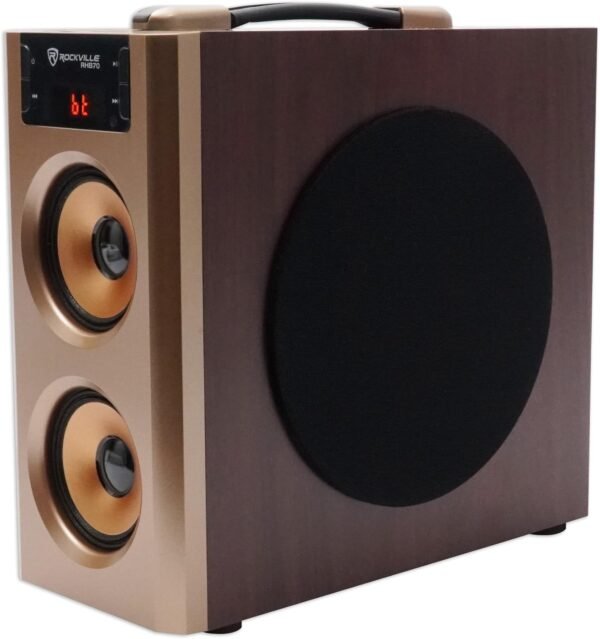
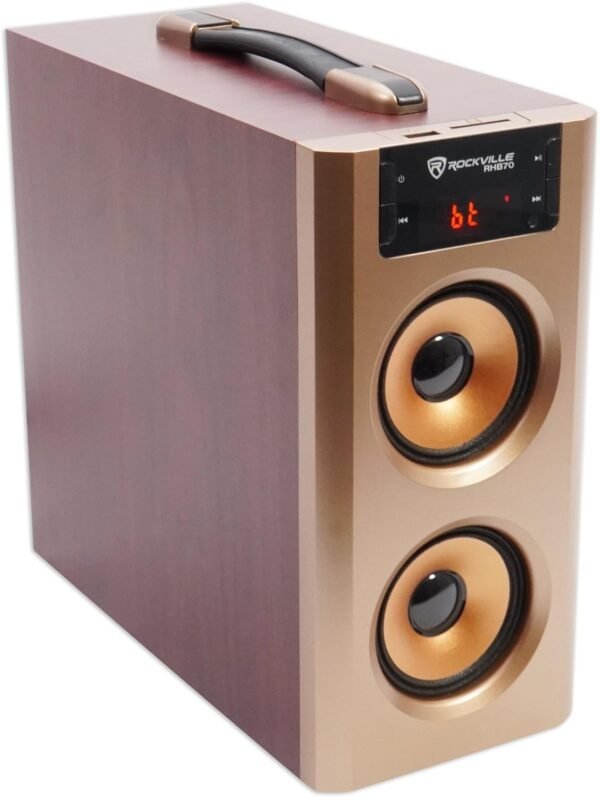
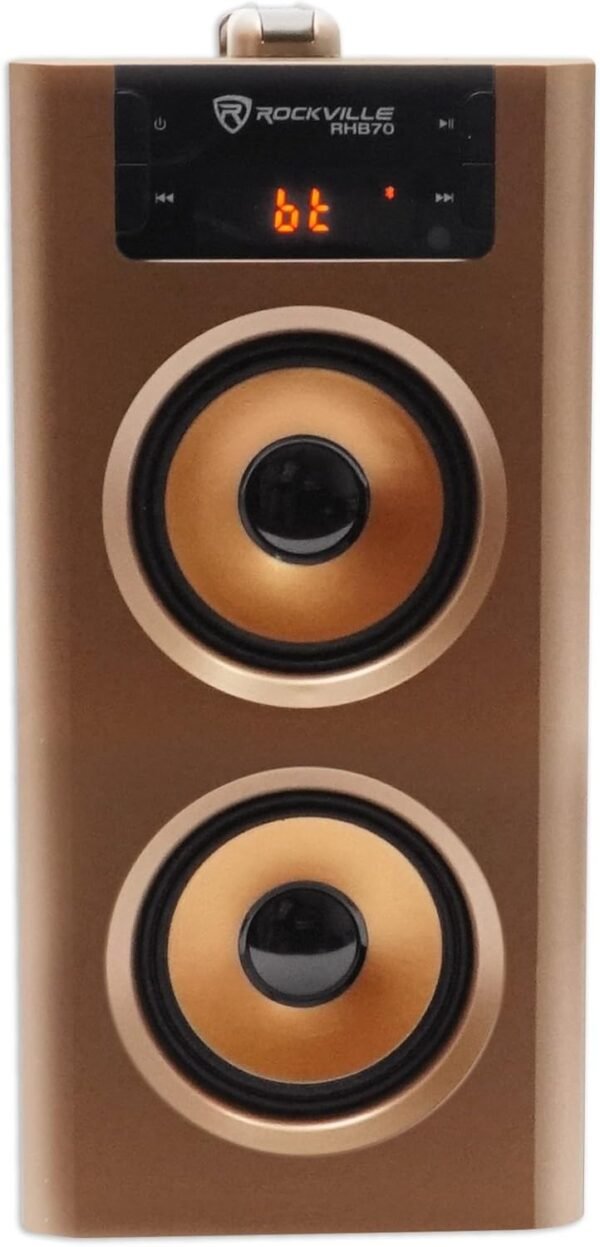
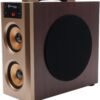
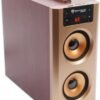
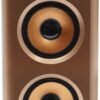
The Rockville RHB70 is a compact self-powered speaker system built around a 4 inch woofer and two 3 inch full-range drivers, with the amplifier, the tuner and the input switching all inside the cabinet. It requires nothing else to work: no receiver, no separate amplifier and no external subwoofer. That all-in-one construction is the product’s reason for existing.
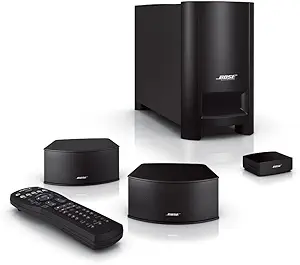
Rockville describes it as designed for small spaces, naming apartments, bedrooms and offices, and it is filed under home theater systems. That last label needs qualifying. A single cabinet with three small drivers is a stereo speaker with reinforced bass; it is not a surround system, and there is no center channel, no rear speakers and no surround decoding described anywhere. Buyers who want actual home theater should look at the Bose CineMate GS Series II or a soundbar such as the Sony HT-X8500.
Inputs: The Actual Selling Point
The connection list is the strongest part of this product and is more generous than most modern equivalents. Bluetooth 5.0 covers phones and tablets. A USB port and an SD card slot, the latter supporting cards up to 32 GB, allow playback with no source device at all, which is useful in a workshop or a garage where a phone would be inconvenient. RCA inputs take a television or a turntable preamp, and a 3.5 mm auxiliary input covers everything else. An FM tuner is included.
That breadth is genuinely unusual. Most current compact systems have quietly dropped SD card slots, FM tuners and sometimes even auxiliary inputs in favor of Bluetooth alone, and for a buyer with an existing media collection or a preference for local playback, having all of them in one cabinet is the reason to choose this over a newer alternative. The stereo shelf systems category shows how competitors handle the same requirement.
Drivers and Realistic Output
A 4 inch woofer paired with two 3 inch drivers in a small enclosure defines what this system can and cannot do. It will produce clear midrange and usable bass for speech, podcasts and most popular music at moderate volume in a small room. It will not produce cinema low end, and it will not fill a large living room. Rockville’s own description sets the expectation correctly by repeatedly naming small spaces.
The published power figures are where the listing falls apart, and they deserve to be stated as they appear rather than reconciled. Rockville’s description says the system delivers 70 watts peak power. Rockville’s own bullet points, on the same listing, say 25 watts RMS, 50 watts program and 100 watts peak. Those two peak figures cannot both be correct. The 25 watt RMS number is the only one that describes continuous output and is the figure a buyer should work from; the peak figures should be disregarded entirely, as peak ratings are marketing conventions rather than measurements.
Physical Size and Placement
Here the listing contradicts itself a third time. The description gives the size as 10.2 by 5.9 by 7.1 inches. A bullet point gives 4.73 inches wide by 9.65 inches high by 10.64 inches deep. The specification block gives 11.62 inches deep by 6.62 inches wide by 12.41 inches high. Three different sets of dimensions appear in one listing, and anyone measuring a shelf before ordering has no reliable number to work from.
The cabinet is wood with a cherry finish and an LED display on the front panel, and the listed weight is 5.43 pounds. The included components are the speaker, a 3.5 mm to dual RCA cable, a remote control with a battery, and a manual. For a similar all-in-one intended for a desk with a stronger emphasis on sound quality, the Klipsch The One II is the obvious comparison, and the home theater systems category covers the multi-speaker route.
Highlights
- Genuinely comprehensive inputs: Bluetooth, USB, SD card, RCA, 3.5 mm and FM.
- Self-contained, requiring no amplifier, receiver or external subwoofer.
- Remote control included with the battery already in the box.
- Local playback from USB or SD with no phone required.
- Wood cabinet with a cherry finish rather than plastic.
- Long track record, listed since 2017 with roughly 1,931 ratings at 4.2 stars.
Things To Consider
The specification block is among the least reliable encountered on this site. It lists the power source as “Battery Powered” while also giving an input voltage of 110 volts; this is a mains-powered product. It gives a charging time of 40 hours on a device with no battery. The number of items is listed as 223. The surround sound channel configuration says 1.0 for a 2.1 system, and the manufacturer is given as “Audiosavings” rather than Rockville. None of these fields should be read as descriptive.
- The peak power figures contradict each other, at 70 watts and 100 watts in the same listing.
- Three different sets of dimensions are published, so the physical size is unverifiable from the listing.
- It is not a home theater system despite the category, with no surround channels or decoding.
- 25 watts RMS through small drivers limits it to small rooms.
- The power source and charging time specifications are false.
- The 4.2 star average is middling for a product with this many ratings.
Who Should Buy It and Who Should Skip It
The RHB70 makes sense for a bedroom, a home office, a garage or a small apartment where one compact box needs to handle a television, a phone and a memory card without a rack of equipment behind it. The input breadth is the real value, particularly the SD card slot and the FM tuner, both of which have largely disappeared from newer products.
Skip it if the room is large, if you expect cinema-style bass, or if you were buying it on the strength of the peak power numbers, which the listing itself cannot state consistently. Skip it too if the intended use is a genuine home theater with rear channels, which this product cannot provide under any configuration.