





Description
What the Poseidon D60 Actually Is
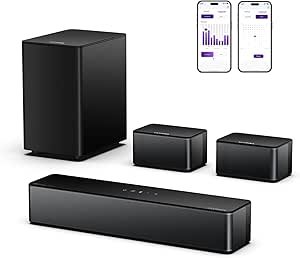
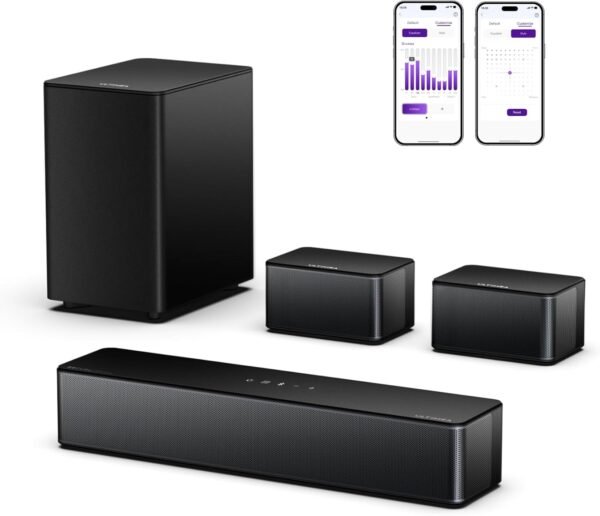
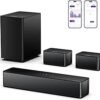
The ULTIMEA Poseidon D60 is a complete 5.1 package sold at a price where most competitors offer a bar and nothing else. The box contains a three-channel front soundbar, a wireless subwoofer, two surround speakers, and the cables to connect all of it, including HDMI and optical. ULTIMEA lists a 410W peak power figure and a 5.25 inch subwoofer driver, and dates the listing to February 2025 as a new model.
It is important to understand what the word wireless covers here. The subwoofer is wireless and links to the bar over its own radio connection. The two surround speakers are not: they connect to the subwoofer by a 6 metre cable, which means the subwoofer needs to sit somewhere between the front of the room and the seating position, and two cables need to be routed to the rear. Buyers who assumed a fully wireless rear pair should compare the Sony SA-RS3S wireless rear speakers, which take a different approach.
Dolby Atmos and the eARC Connection
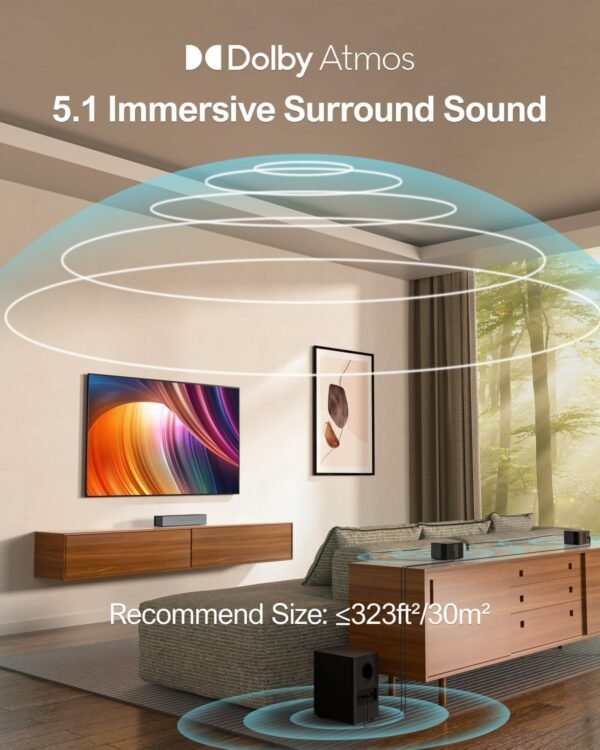
ULTIMEA specifies Dolby Atmos decoding and pairs it with an HDMI eARC input. That combination is the correct one and it is not universal at this price. Enhanced Audio Return Channel carries far more bandwidth than the older ARC standard, which means a television can pass a full lossless Atmos bitstream back to the bar rather than a compressed approximation. Supplying the HDMI cable in the box removes the most common reason these setups fail on day one.
What buyers should temper is the expectation of height. This is a 5.1 system, not a 5.1.2, so there are no upward-firing drivers listed anywhere in the specification. Atmos decoding on a system without height channels means the object metadata is rendered down into the available speakers, producing a wider and more enveloping effect than plain stereo but not genuine overhead placement. That is a legitimate implementation and ULTIMEA does not claim otherwise, but the marketing language around 3D sound fields invites a stronger reading than the hardware supports. A comparison against a bar with real upfiring drivers, such as the Sony BAR 9, is worth making before deciding.
Bass, Adjustment and Everyday Control
The subwoofer carries a 5.25 inch driver and ULTIMEA layers its BASSMX processing on top to lift the low end. Five and a quarter inches is small for a home theater subwoofer, and the honest expectation is impact and presence in a normal living room rather than the deep extension a dedicated subwoofer delivers. Anyone who wants that should plan on replacing it eventually, and the subwoofers category covers what a real upgrade looks like.
More useful is that ULTIMEA exposes independent bass and surround level adjustment on the remote. Systems in this class frequently ship with the subwoofer running far too hot out of the box, and the ability to pull it back is the difference between a system that sounds impressive for ten minutes and one that stays comfortable through a film. App control is also listed. The customer rating on this listing sits at 4.4 stars across roughly 96 ratings, a small sample that should be read with that in mind.
Format Support and Its Limits
ULTIMEA states plainly in its own bullet points that the Poseidon D60 does not support DTS decoding. That is an unusually direct admission and it deserves credit, but it also matters practically. A large amount of physical media, particularly Blu-ray discs, carries DTS or DTS-HD Master Audio as the primary track. On a system without DTS decoding, playback depends on the source device converting to PCM or Dolby, and if a disc player is set to bitstream output the result can be silence.
Streaming users are less affected, since Netflix, Prime Video and the other major services distribute in Dolby formats. Disc collectors should treat this as a genuine constraint and check their player settings before buying. Anyone comparing the range should look at the larger ULTIMEA Poseidon D80 7.1 system from the same manufacturer, and at the rest of the sound bars category.
Highlights
- A genuine 5.1 speaker count rather than a virtualized two-channel bar.
- HDMI eARC support with the HDMI cable supplied.
- Independent bass and surround level controls from the remote.
- Wireless subwoofer, removing one cable run from the front of the room.
- Comprehensive cable bundle, including optical, RCA and a 20 foot run.
- Wall mount kit and brackets included in the box.
Things To Consider
The specification block on this listing has clear errors. Product dimensions are given as 15.75 inches deep by 2.76 inches wide by 3.54 inches high, which describes no soundbar ever made; the depth and width labels have plainly been swapped or mismeasured, and even then a 15.75 inch bar would be far narrower than the product images suggest. The included components list also contains raw encoding artifacts where the separators should be. These are import faults rather than product faults, but they make the listing unusable for checking whether the bar will fit a given television stand.
- No DTS decoding, which affects Blu-ray playback more than streaming.
- No height channels, so Atmos is rendered rather than reproduced overhead.
- The surround speakers are wired to the subwoofer, which constrains where the subwoofer can go.
- A 5.25 inch subwoofer driver is modest for a home theater application.
- The published dimensions are wrong and should not be used for planning.
- Only around 96 ratings at the time of writing, so the average is not yet well established.
Who Should Buy It and Who Should Skip It
The Poseidon D60 makes sense for someone furnishing a first proper home theater on a limited budget, who wants real rear speakers rather than a simulation and is willing to run two cables to achieve it. It also suits renters and shared households where a full receiver-and-speakers setup is impractical, since everything arrives in one box with the cabling included. The DTS limitation is far less of a problem for a streaming-only household.
Skip it if you own a Blu-ray collection and expect to bitstream DTS tracks, if overhead effects are the reason you want Atmos, or if the room layout makes running rear cables impossible. Buyers who want a single-box solution with no rear speakers at all will be happier with something like the Klipsch Core 200, which trades channel count for simplicity.