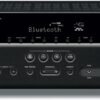
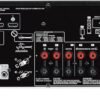
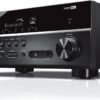
Description
What the Yamaha RX-V385 Covers
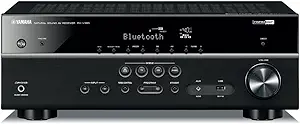
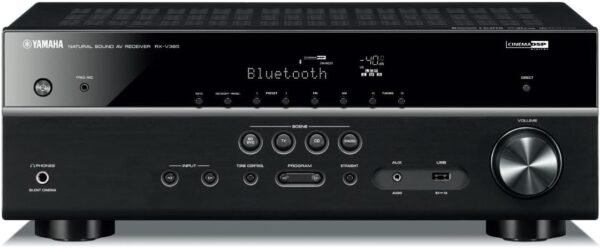
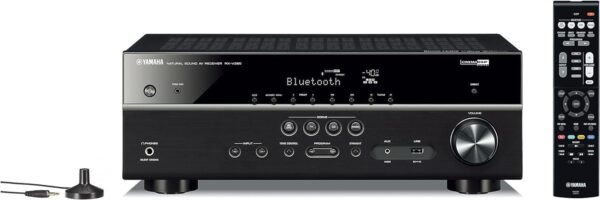
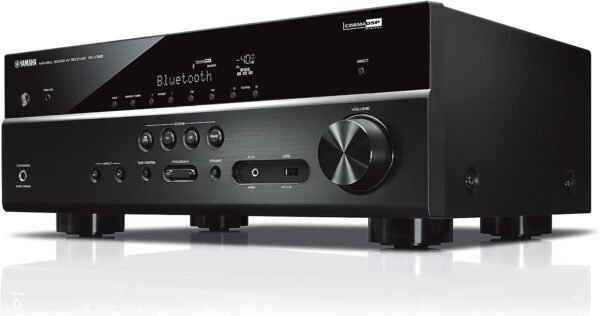
The Yamaha RX-V385 is a 5.1 channel audio and video receiver, which makes it the central switching and amplification point of a conventional home theater. It takes video sources in, passes the picture through to a television, decodes the surround soundtrack, and drives five speakers plus a subwoofer output. Yamaha lists 4K Ultra HD passthrough, Dolby Vision, HDR10, Bluetooth, and the company YPAO automatic room calibration, along with a standby power draw of 0.2 watts or less.
A 5.1 channel receiver sits at a specific point in the market. It handles the standard surround layout of front left, center, front right, two surrounds, and a subwoofer, and it does not attempt the height channels that object based formats such as Dolby Atmos use. For a normal living room, 5.1 remains the layout most people actually install, since height speakers require either ceiling mounting or upward firing modules. Buyers who want the full modern format list should look at newer models, and those comparing an all in one alternative can consider the Sony HT-S40R soundbar system.
Video Passthrough and Format Support
Video handling on a receiver is easy to misunderstand. The receiver does not improve the picture. Its job is to accept HDMI sources, switch between them, and pass the signal to the display without degrading or blocking it. What matters is whether it passes through the formats a modern source and display use, and this one lists 4K Ultra HD, Dolby Vision, and HDR10.
Those three cover most current content. Dolby Vision and HDR10 are high dynamic range formats, and a receiver that does not pass them will silently strip the picture back to standard dynamic range, which is a frustrating fault to diagnose. Listing both is therefore meaningful rather than decorative. What the listing does not state is the number of HDMI inputs, the HDMI specification version, or whether features such as variable refresh rate or 4K at 120 Hz are supported. Those matter to anyone connecting a current games console, and they should be confirmed against Yamaha documentation. Owners running a two channel system instead can compare the simpler Yamaha R-S202 stereo receiver, which drops video entirely.
YPAO Calibration and Setup
YPAO is Yamaha automatic calibration system. A supplied microphone sits at the listening position, the receiver plays test tones through each speaker in turn, and the system sets speaker distances, levels, crossover points, and equalization based on what it measures. That process is more valuable than most single specifications on a receiver, because the most common cause of disappointing surround sound is not the equipment but the setup: speakers at unequal distances, a subwoofer level set by ear at the wrong time of day, and crossover points left at defaults that do not match the speakers.
Automatic calibration is not infallible and its equalization can be worth revisiting by ear, but as a starting point it is far better than guessing. Bluetooth is included for casual streaming from a phone, which is the feature most likely to be used daily by people who bought the receiver for movies. The listing gives the dimensions as 12.4 by 17.13 by 6.34 inches and the weight as 16.3 pounds, and notes that two AAA batteries are included, which are for the remote. Owners adding low frequency support will want to see how a subwoofer integrates, and the SVS SB-1000 Pro subwoofer shows what the receiver crossover has to hand off to.
Highlights
- 5.1 channel amplification with a subwoofer output, covering the standard surround layout.
- 4K Ultra HD passthrough with Dolby Vision and HDR10 support.
- YPAO automatic room calibration using a supplied measurement microphone.
- Bluetooth streaming for casual listening from a phone or tablet.
- Standby power consumption listed at 0.2 watts or less, with a listed weight of 16.3 pounds.
Things To Consider
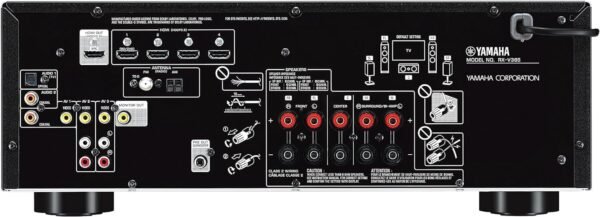
The imported record for this receiver is thin where it matters most. There is no power rating per channel, no impedance specification, no HDMI input count, no HDMI version, no statement of which surround formats are decoded beyond the video formats listed, and no mention of network features such as Wi-Fi or streaming service support. For a component whose entire purpose is connecting things together, an input count is not an optional detail. Buyers should get the connection list from Yamaha before assuming a given set of sources will fit.
Yamaha description text on this listing leads with a claim about value and price that this page does not repeat, since price claims are outside what a specification supports and prices change constantly.
The real limitations follow from where this model sits in the range. A 5.1 channel receiver does not support height channels, so Dolby Atmos and DTS:X content will be played back in a down mixed form rather than with overhead effects. Bluetooth is included but network streaming is not mentioned, which means multiroom and streaming service integration are likely absent. And with a first availability date in 2018, this is an older model whose HDMI capabilities predate the current generation of games consoles, which is the most likely source of a future compatibility problem. On the positive side, the listing shows a 4.5 star average across 3,093 ratings, which is a large and consistent ownership record.
Who Should Buy It and Who Should Not
The RX-V385 suits someone building a first proper home theater around five speakers and a subwoofer, who wants automatic calibration to handle setup, and whose sources are a television, a streaming device, and a disc player. It is a straightforward, well proven component with a large ownership base, and the calibration system means a good result does not depend on the owner knowing how to set crossovers.
It is the wrong receiver for anyone who wants Dolby Atmos with height channels, for anyone connecting a current generation games console who needs the latest HDMI features, and for anyone who expects network streaming built in. Those buyers should look at newer models in the receivers category, and listeners whose needs are simpler can consider adding Bluetooth to an existing system with the Audioengine B1 Bluetooth receiver or the FiiO BR13 HiFi Bluetooth receiver instead of replacing anything.