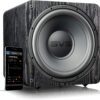

Description
What the SVS SB-1000 Pro Is
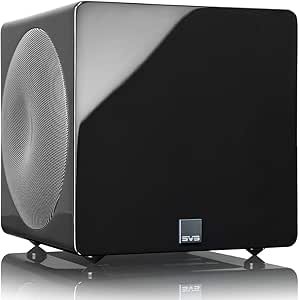
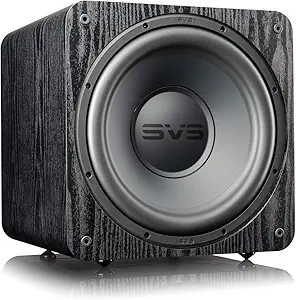
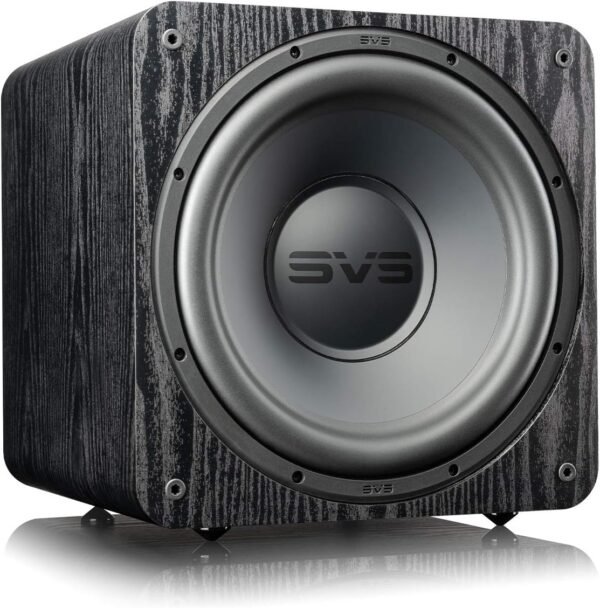
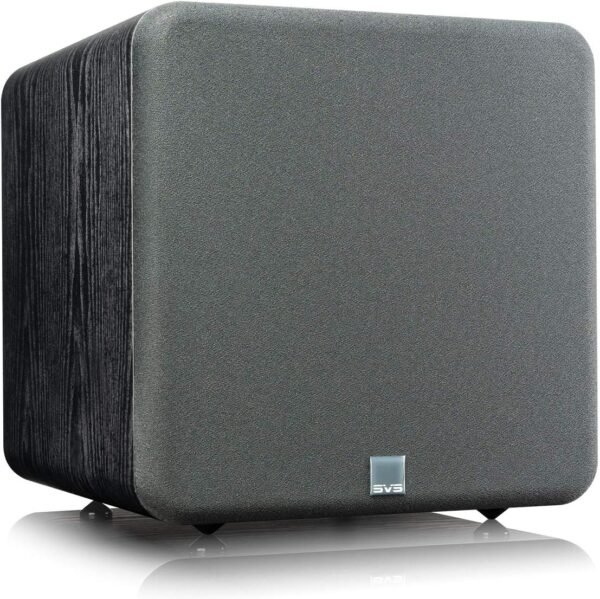
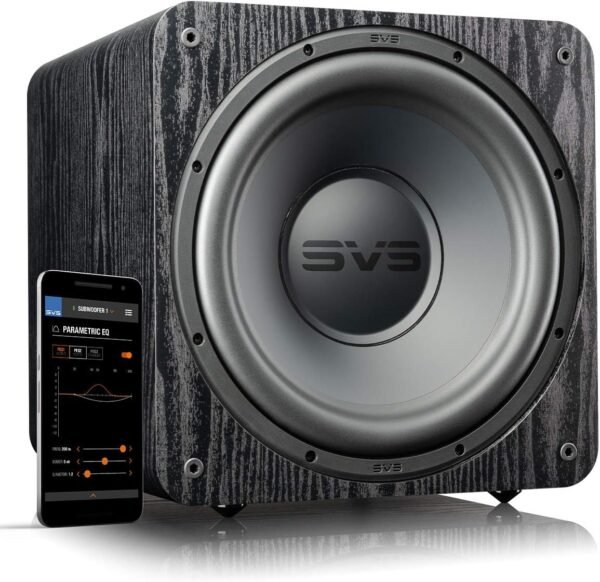
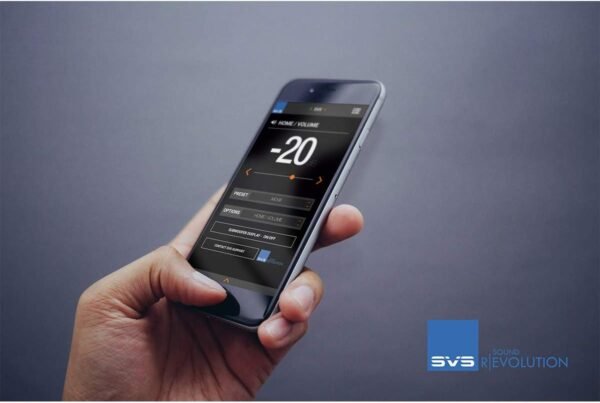
The SVS SB-1000 Pro is a sealed subwoofer built around a 12 inch high excursion driver in a cabinet SVS describes as 13 inches, with a dual ferrite motor assembly. The amplifier is what SVS calls a Sledge design, rated at 325 watts continuous and more than 820 watts peak, with a fully discrete MOSFET output stage and a 50 MHz digital signal processor. SVS quotes output down to 20 Hz and supplies a smartphone application for tuning and control.
The word sealed is the most important one in that description. A sealed subwoofer has no port, which means the enclosure acts as an air spring behind the driver. Sealed designs roll off more gently at the bottom than ported ones and generally have tighter transient behavior, at the cost of lower maximum output for a given cabinet size and driver. Ported designs go louder and dig deeper at the tuning frequency but roll off sharply below it. Neither is better in the abstract, and the choice usually comes down to whether a listener prioritizes music or movie effects. Buyers comparing both approaches can browse the subwoofers category.
Amplifier and Digital Signal Processing
The 325 watt continuous rating is the number worth attending to, because continuous power is what determines sustained output while peak figures describe brief transients. Quoting both, as SVS does here, is more honest than quoting only the larger one, which is common practice in this category. The discrete MOSFET output stage refers to the amplifier being built from individual components rather than an integrated module, a design choice associated with better thermal behavior under sustained load.
The 50 MHz digital signal processor is what makes the app control meaningful. Onboard processing in a subwoofer typically handles the low pass filter, phase and polarity, parametric equalization to tame room modes, and protective limiting. Parametric equalization is the feature that matters most in a real room, because the largest audible problem with any subwoofer is not the subwoofer but the room resonances it excites. Being able to pull down a single problem frequency rather than turning the whole subwoofer down is the difference between bass that sounds even and bass that booms in one seat. Owners assembling a complete system will want a receiver with bass management, and the Yamaha RX-V385 AV receiver is an example of what that layer provides.
Cabinet, Size, and Placement
The listing gives the dimensions as 14 inches deep by 13 inches wide by 13.5 inches high and the weight as 31.9 pounds. That is a genuinely compact footprint for a 12 inch driver, and it is the design achievement SVS is pointing at when it talks about maximizing surface area within an acoustically inert cabinet. Note that the description refers to a 13 inch enclosure while the dimensions field gives 14 inches in the deepest direction, so the listing describes the size two slightly different ways.
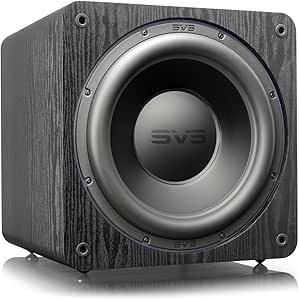
A sealed cabinet is more forgiving about placement than a ported one, since there is no port output to be disrupted by a nearby wall. That said, room boundaries still reinforce low frequencies substantially, and moving a subwoofer a few feet changes the response at the listening position more than any control on the amplifier will. Thermal management gets specific mention in the SVS description, which is a genuine consideration when a high power amplifier and a large motor assembly share a small enclosure. Buyers who need more output than a compact sealed design provides should look at the larger SVS SB-3000 subwoofer, and those with less space at the SVS 3000 Micro subwoofer.
Highlights
- 12 inch high excursion driver with a dual ferrite motor in a sealed cabinet.
- Sledge amplifier rated at 325 watts continuous and more than 820 watts peak.
- Discrete MOSFET output stage with 50 MHz digital signal processing.
- Smartphone application for tuning, including equalization and crossover control.
- Compact 14 by 13 by 13.5 inch footprint at a listed 31.9 pounds, with a limited warranty.
Things To Consider
The SVS marketing description on this listing is written in superlatives that this page does not repeat as fact. It claims the product shatters expectations, demolishes performance benchmarks in its range, and is in a class of its own. Those are comparative assertions with no measurement attached and no basis a buyer can check. The technical content of the same description, the driver size, the amplifier ratings, the processor, and the frequency claim, is specific and useful, and that is what this page reports.
Several specification fields do not describe the product. The subwoofer connectivity technology field reads Wireless and the connectivity protocol field reads Bluetooth, while the style field reads Wired. The reality behind that confusion is that the Bluetooth connection exists only for the control application, and the audio connection is a wired line level input. The vehicle service type field reads Car. The recommended uses field reads Volume. The compatible devices field lists Phones and Smartphone, which describes the app rather than the audio source. The surround sound channel configuration field reads 5.1 and 7.1, which describes systems the subwoofer might join rather than the subwoofer itself.
The genuine limitations follow from the sealed design. A sealed 12 inch subwoofer will not reach the maximum output of a ported cabinet of similar size, so listeners chasing the loudest possible movie effects in a large room may find one unit insufficient and end up wanting two. App dependence is also a long term consideration: features accessed only through a phone application are only available for as long as that application is maintained and compatible with current phones. And at 31.9 pounds this is heavy enough to make repositioning a two hand job, which matters because finding the right position is the single most valuable thing an owner can do.
Who Should Buy It and Who Should Not
The SB-1000 Pro suits a listener who cares about accuracy in music as much as impact in film, has limited floor space, and wants proper control over crossover, phase, and room equalization. The sealed alignment and the processing together make it a good fit for a medium sized room and for a system where the subwoofer needs to blend with speakers rather than dominate them.
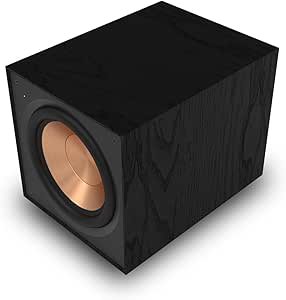
It is less suitable for a large room where maximum output is the goal, for a buyer who wants a set and forget product with no app involved, and for anyone whose system has no subwoofer output or bass management. Those buyers should consider a ported design or a full home theater package instead, and the Klipsch R-101SW subwoofer and the options in the floorstanding speakers category show two other ways to add low frequency weight to a room.