






Description
What Planar Magnetic Means
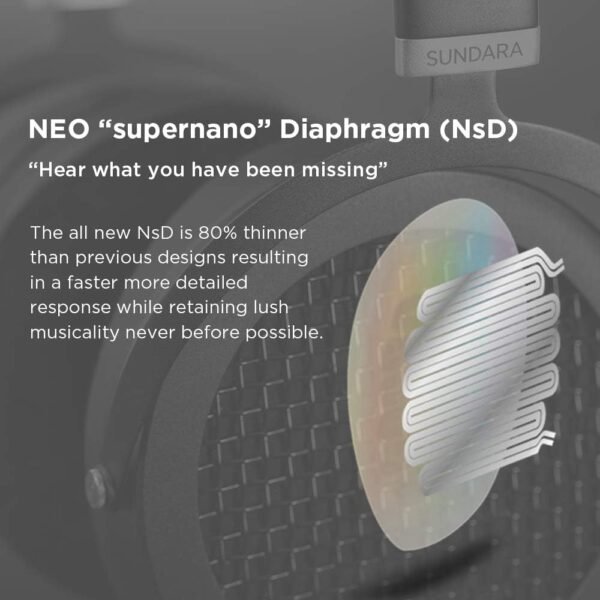
The HIFIMAN Sundara uses planar magnetic drivers rather than the conventional dynamic drivers found in almost every headphone. The difference is fundamental to how the sound is produced. A dynamic driver has a voice coil attached to the centre of a cone, so force is applied at one point and the rest of the diaphragm follows. A planar magnetic driver has a conductive trace printed across a large, very thin flat film suspended between arrays of magnets, so force is applied evenly across the entire surface.
The practical consequence is that the diaphragm moves as a single unit rather than flexing, which reduces a category of distortion that dynamic drivers work hard to control. HIFIMAN specifies that the Sundara diaphragm is 80 percent thinner than the one used in its HE400 series, which reduces moving mass and, in the company’s words, results in a wider and faster response. Buyers comparing planar designs should look at the Audeze LCD-2 Classic and the SIVGA P2 PRO.
The Amplification Question
This is the most important practical consideration and it is easy to overlook. HIFIMAN publishes a sensitivity of 94 dB and an impedance of 37 ohms. Ninety-four decibels is on the low side, meaning the Sundara needs more power to reach a given volume than a typical consumer headphone does.
A phone or a laptop headphone output will produce sound, but usually not with authority: the bass loses control and the whole presentation feels flat and quiet at the volume limit. Planar magnetic headphones in general reward more capable amplification than dynamic ones, and HIFIMAN’s own listing copy effectively concedes this by recommending one of its portable players as a partner. That player is not included. Anyone buying the Sundara should budget for a headphone amplifier, and HIFIMAN’s own EF400 is one option among many in the amplifiers category.
Open Back and Where It Can Be Used
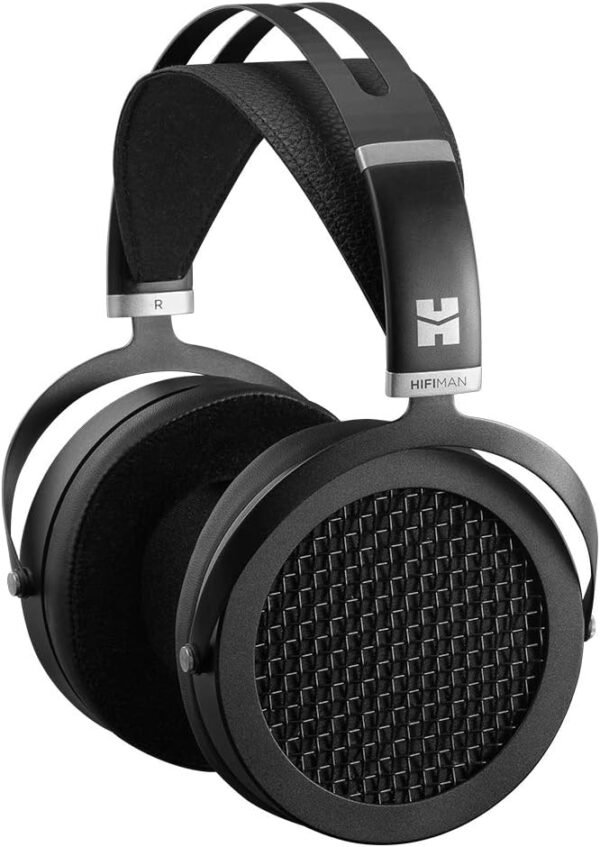
The Sundara is an open-back design, which is the norm for planar magnetic headphones at this level because a sealed enclosure behind a large flat diaphragm creates acoustic problems that are difficult to solve. Open construction gives the wider, less congested presentation that these headphones are bought for.
The cost is absolute: there is no isolation in either direction. Everything in the room is audible while wearing them, and everyone in the room hears the music. They cannot be used on public transport, in an office, or anywhere a microphone is open. This is a headphone for a quiet room and nothing else, and buyers who need to record or commute must look at closed designs instead. A less expensive open-back option for the same room is the Grado SR60x, and the over-ear headphones category covers closed alternatives.
Build, Weight and Comfort
HIFIMAN specifies an all-metal headband with a weight-spreading strap and a matte black finish, describing the construction as built for the rigors of urban life. Metal construction is appropriate at this level and the suspension strap is the correct approach for a heavy headphone, since it distributes load across the top of the head rather than concentrating it on one line.
Weight is where planar magnetic designs pay for their advantages. The magnet arrays on either side of the diaphragm are heavy, and the Sundara comes in at 372 grams, considerably more than a typical dynamic headphone. The suspension strap mitigates this rather than eliminating it, and it is a genuine consideration for anyone who listens for hours at a stretch. Comfort is personal enough that no listing can settle it.
The Cable Connection
HIFIMAN uses 3.5 mm connectors at each earcup, which the company describes as a change made for enhanced durability. Earlier HIFIMAN models used a screw-on SMC connector that had a reputation for being fragile and awkward, and moving to a standard 3.5 mm jack is a straightforward improvement.
It also opens up the aftermarket. Because the connector is a common type, replacement and upgrade cables are widely available, including balanced cables for use with amplifiers that provide balanced output. Given the amplification requirements discussed above, that flexibility is worth something. The listing dates the product to December 2017, so this is an established model with a long track record rather than a new release.
Highlights
- Planar magnetic drivers with a diaphragm 80 percent thinner than the previous HIFIMAN series.
- Open-back architecture for a wide, uncongested presentation.
- All-metal headband with a weight-spreading suspension strap.
- Detachable 3.5 mm cables at both earcups, replaceable and upgradeable.
- Stated 6 Hz to 75 kHz response at 37 ohms.
- Established model on sale since December 2017.
Things To Consider
The specification block contains several fields that do not apply. The wireless communication technology is given as “Planar Magnetic”, which is a driver type rather than a wireless standard, on a headphone with no wireless capability at all. A charging time of 6 hours is listed for a passive product with no battery. The control method reads “Remote” though there are no controls. Most misleadingly, the included components list mentions ear buds, which are not part of this product. The listing description also promotes a HIFIMAN portable player that is not included in the purchase.
- A headphone amplifier is effectively required given the 94 dB sensitivity.
- No isolation in either direction, so these are unusable outside a quiet room.
- 372 grams is heavy, and comfort over long sessions is personal.
- No microphone, controls, wireless or cancellation of any kind.
- The listing lists ear buds as included, which they are not.
- Pad wear is a long-term consumable on any headphone at this level.
Who Should Buy It and Who Should Skip It
The Sundara suits a listener with a quiet room, a headphone amplifier or the willingness to buy one, and a genuine interest in what a well-engineered planar magnetic driver sounds like. It is one of the more accessible entry points into the format, and the detachable standard cable connector means it fits into a larger system rather than locking the owner into a proprietary accessory.
Skip it if the headphones are for a commute, an office or anywhere with other people, because the open design makes that impossible. Skip it too if the plan is to run them from a phone, where the result will be disappointing and will unfairly reflect on the headphone rather than on the source. Anyone who needs isolation, wireless or a microphone is shopping in the wrong category entirely.