

Description
What the SR60x Is
The Grado SR60x is the entry point to the Prestige series, an open-back over-ear headphone with 44 mm dynamic drivers that Grado assembles by hand in Brooklyn. The company has been in the same family since 1953 and the SR60 line has existed in various revisions for decades, which makes it one of the most recommended headphones in audio at its price.
Two things define it. The first is the open-back architecture, which lets sound pass freely through the rear of the earcup rather than sealing it in. The second is the Grado house tuning, described by the company as rich mids, sparkling highs and tight bass. Neither is a neutral choice, and buyers should know what they are getting rather than assuming a general recommendation applies to their situation.
The Open-Back Trade-Off
An open-back headphone sounds noticeably wider and less congested than a closed one because the driver is not fighting a sealed volume of air behind it, and because the reflections that build up inside a closed cup are absent. That is why open designs dominate at the high end for critical listening and why Grado uses one at every price point in the range.
The cost is total: there is no isolation in either direction. Everything in the room is audible while wearing them, and everyone in the room can hear what is playing. They are unusable on a train, in an office, or anywhere a microphone is open. Anyone who needs to record while wearing headphones must have a closed design such as the Audio-Technica ATH-M40x or the Shure SRH440A. The SR60x is a headphone for a quiet room and nothing else.
Fit, Comfort and the Foam Pads
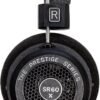
Grado states 6.7 ounces in its product copy and describes improved cushioning over the previous generation. The design uses flat foam pads that rest on the ear rather than surrounding it, mounted on a simple metal headband with leather. That approach is polarizing: it is extremely light and it keeps the driver close to the ear, but the foam sits directly on the cartilage and some listeners find it uncomfortable within an hour.
There is no way to know which group you fall into without wearing a pair, and the pads are a consumable that can be replaced. It is worth mentioning because comfort complaints are by far the most common criticism of Grado headphones generally, and they are not a manufacturing defect but a consequence of the design. Listeners who want a plush circumaural fit at a similar level should look at the Sennheiser HD 400S.
Driving Them and System Context
The SR60x terminates in a gold-plated 3.5 mm plug on a four-conductor cable, with a 6.3 mm screw-on adapter supplied for use with an interface or an amplifier. Grado emphasizes that the wired connection means no compression and no latency, which is straightforwardly true and is the main argument for a wired headphone in a wireless market.
Grado headphones at this level are efficient enough to run from a phone or a laptop, though a dedicated headphone output will generally produce a firmer result. Buyers who want to explore that should look at the amplifiers category, which covers desktop DAC and amplifier combinations. Listeners drawn to the open-back presentation who want to go considerably further should audition a planar magnetic design such as the HIFIMAN Sundara or the wooden-cupped SIVGA P2 PRO.
The Prestige Series Position
Grado uses a deliberately incremental range structure, with the SR60x at the bottom of the Prestige series and each step up sharing the same basic architecture with better drivers, cables and housings. That has a practical consequence for a buyer: the SR60x is a reliable preview of the Grado character, so a listener who dislikes it will dislike the whole range, and one who likes it knows exactly which direction an upgrade should go.
The company has also kept the design visually unchanged for decades, which some buyers read as heritage and others read as dated. The plastic housings, the exposed foam and the thick unsleeved cable look inexpensive next to competitors that spend more of the budget on presentation. Grado’s argument, implicit in the hand assembly claim, is that the money went into the driver instead. Whether that is the right allocation is a judgment each buyer has to make, but it is a coherent position rather than a cost-cutting accident.
Highlights
- Open-back architecture that delivers a wider presentation than closed designs at the price.
- 44 mm dynamic drivers, larger than most headphones in this bracket.
- Hand assembled in Brooklyn, which is unusual in a category dominated by mass production.
- Very light at Grado’s stated 6.7 ounces.
- 6.3 mm adapter supplied for studio and amplifier use.
- Long-standing reputation, with a 4.4 star average across roughly 546 ratings on this listing.
Things To Consider
The listing data for this product is contradictory in ways that matter. Grado’s own bullet gives the weight as 6.7 ounces while the specification block says 12.3 ounces, a difference of nearly a factor of two; the second figure is most likely the packaged weight. The specification block also lists Bluetooth as the wireless communication technology, sets the control method to “Remote” and the controller type to “remote control”, on a passive wired headphone with no electronics at all. The cable feature says “Retractable”, which it is not. Amazon simultaneously ranks the product in On-Ear, Over-Ear and Earbud categories.
- No isolation whatsoever: open-back means sound goes both ways.
- The foam on-ear pads are divisive and cause comfort complaints for some listeners.
- The cable is not detachable, so cable damage is a repair rather than a swap.
- No microphone, no controls, no wireless of any kind.
- Two conflicting weight figures appear in the same listing.
- Filed under earbud headphones on this site, which does not describe the product.
Who Should Buy It and Who Should Skip It
The SR60x suits a listener with a quiet room who wants to understand what a serious headphone sounds like without spending seriously, and who values an open, immediate presentation over bass weight. It is also a good first step for someone curious about hi-fi listening, because it makes the difference between a good and a bad recording obvious in a way that most consumer headphones do not.
Skip it if listening happens on public transport, in a shared office, or anywhere with background noise, because the design offers no defense against any of it. Skip it too if a microphone will be open in the same room, if you need Bluetooth, or if on-ear foam pads are already known to be uncomfortable for you. Buyers in those situations should be shopping the closed designs in the over-ear headphones category instead.