
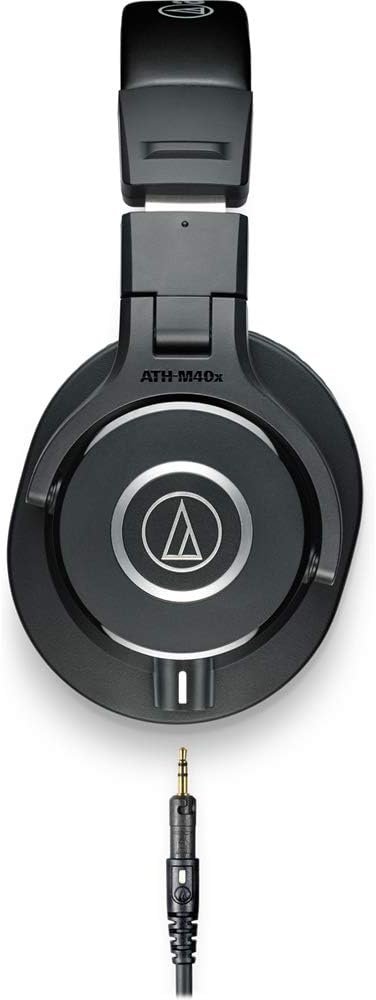





Description
What the M40x Is
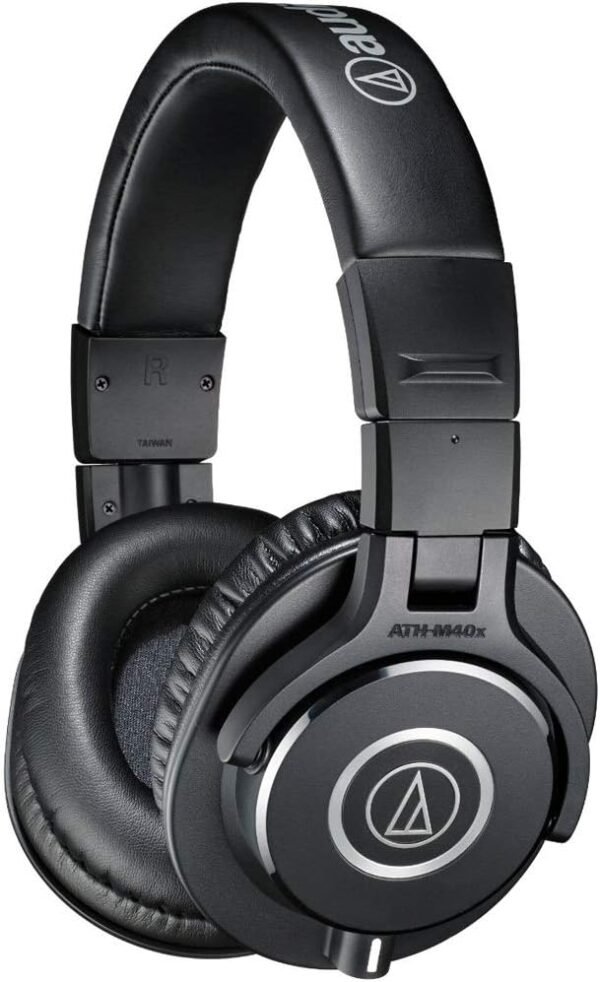
The Audio-Technica ATH-M40x is a closed-back studio monitoring headphone and one of the most widely owned products in its category, with roughly 16,114 ratings at a 4.6 star average on this listing and a presence dating back to January 2014. It sits between the M20x and the M50x in Audio-Technica’s M series, and its defining characteristic is the tuning: Audio-Technica states plainly that it is tuned flat.
That word is doing a lot of work and deserves unpacking. The M50x, its better-known sibling, has a pronounced bass lift that makes it enjoyable for casual listening. The M40x deliberately does not, which makes it less immediately impressive and more useful for the job it was built for. If a mix sounds balanced on a flat headphone it stands a better chance of translating to other systems, whereas a bass-boosted headphone tempts an engineer to under-apply low end.
Drivers, Isolation and Monitoring Use
The 40 mm drivers use rare earth magnets and copper-clad aluminum wire voice coils, a construction that keeps the moving mass low while maintaining magnetic strength. The circumaural design contours around the ear rather than pressing on it, which Audio-Technica presents as delivering isolation in loud environments, and the closed back is what makes the headphone usable while a microphone is open.
The 90 degree swiveling earcups matter more than they appear to. Single-ear monitoring, with one cup on the ear and the other pushed back onto the head, is how engineers and DJs listen to a room and a mix simultaneously, and a headphone whose cups will not rotate makes that awkward. Combined with the collapsible frame it also makes the headphone easier to pack. Anyone comparing the standard studio options should look at the Shure SRH440A, which competes directly, and DJs should consider the Pioneer DJ HDJ-CUE1, which is built specifically for booth use.
The Two Cable System
Audio-Technica supplies both a 3 metre straight cable and a coiled cable that extends from 1.2 to 3 metres, both detachable and locking into the left earcup. Shipping two cables is not a small courtesy. A coiled cable suits a fixed studio position where slack should stay off the floor, while a straight cable suits a desk or a mobile setup where the spring of a coil is an irritation. Most manufacturers make the buyer choose and then sell the other one separately.
The detachable design also solves the failure mode that ends most headphones. Cables break at the strain relief long before drivers fail, and a locking detachable connector turns that from a repair into a spare part. A screw-on 6.3 mm adapter and a protective pouch complete the package. The listing gives the weight as 8.4 ounces without the cable.
Sound Character and Who It Suits
A flat tuning is not a neutral recommendation. Listeners coming from consumer headphones frequently describe the M40x as lacking bass on first hearing, and that reaction is the tuning working as intended rather than a fault. What the design delivers instead is midrange clarity that makes vocal problems, room reflections and editing artifacts easy to hear.
The consequence is that the M40x is a better tool than it is a pleasure. For mixing, editing and tracking it is well regarded precisely because it does not flatter, and Audio-Technica names studio tracking, mixing and DJ monitoring as its intended applications. Anyone who wants an enjoyable listen for music on a commute should look at the wireless and consumer models in the over-ear headphones category, or at an open-back design such as the Grado SR60x for a more spacious presentation in a quiet room. Driving them from a dedicated headphone amplifier rather than a laptop output generally tightens the result; the amplifiers category covers those options.
Where It Sits in the M Series
Audio-Technica’s M series is deliberately tiered, and understanding the tiers avoids a common mistake. The M20x below it uses a fixed cable and a simpler driver. The M50x above it uses larger 45 mm drivers and a bass-forward tuning that has made it enormously popular with consumers, to the point where many buyers assume it is the more professional product. It is not; it is the more enjoyable one.
The M40x occupies the position most often recommended by engineers precisely because it sacrifices the consumer appeal. Its detachable cable matches the M50x, its tuning is more neutral, and it costs less. For someone buying a headphone to work on rather than to listen with, that combination is the argument, and it explains why a product first listed in 2014 continues to rank at number 222 in Over-Ear Headphones more than a decade later.
Highlights
- Flat tuning that reveals problems rather than smoothing them over.
- Two detachable cables included, straight and coiled, both locking.
- 90 degree swiveling earcups for single-ear monitoring.
- Collapsible frame and a protective pouch for transport.
- Screw-on 6.3 mm adapter that will not be left behind in a socket.
- Very large rating sample: roughly 16,114 ratings at 4.6 stars.
Things To Consider
The specification block for this listing is one of the more corrupted on the site. It claims a lithium ion battery is required, on a passive wired headphone. It lists “Number of USB 2 Ports: 4”, “Computer Memory Type: DIMM”, “Voltage: 240 Volts” and “Color Screen: No”, none of which have any relationship to a headphone. The control method is given as “Remote” and control type as “Volume Control” on a product with no controls at all. The recommended uses field contains the garbled phrase “Disc Jazz Usage”, which appears to be a corruption of disc jockey.
- The flat tuning will disappoint bass-focused listeners, and that is by design.
- Closed-back cups trap heat during long sessions.
- Faux leather pads wear out over a few years and become a consumable.
- No microphone, controls, wireless or noise canceling of any kind.
- Multiple specification fields describe a computer rather than a headphone.
- The single frequency response figure of 24 kHz contradicts the stated 15 Hz to 24,000 Hz range.
Who Should Buy It and Who Should Skip It
The M40x suits a home recordist, podcaster or editor who needs an honest closed-back headphone, values the replaceable cable, and will make use of the swiveling cups. It is also a sensible choice for a studio or school buying several pairs, since the two cables and the detachable design lower the long-term running cost, and the enormous rating base means it is a known quantity.
Skip it if the purchase is for enjoyment, where a more forgiving tuning will make ordinary recordings sound better. Skip it too if you need wireless, cancellation or an inline microphone, none of which this headphone offers. Mixing engineers who never track alongside an open microphone should at least audition an open-back alternative before settling on a closed design.