





Description
What the M6 Is and Why It Persists
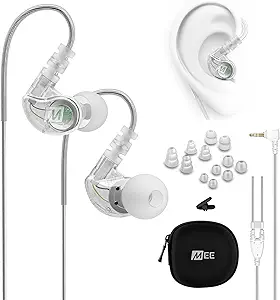
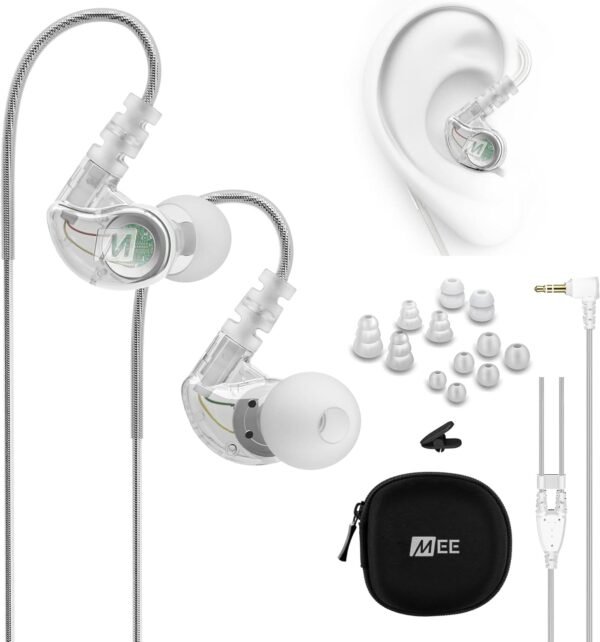
The MEE audio M6 is a wired in-ear sport earphone with memory wire earhooks and a 3.5 mm plug. It has been on sale since February 2010, which in consumer audio terms is an extraordinarily long run, and it has accumulated roughly 8,749 ratings at a 4.1 star average in that time. Products do not survive fifteen years in this category by accident.
The reason it persists is that it solves the fit problem more reliably than most wireless alternatives, and it does so cheaply. Memory wire earhooks can be bent to the shape of an individual ear and will hold that shape, which is a mechanical solution to a problem that most true wireless earbuds try to solve with wings and tip sizes. For running, cycling and gym work, that matters more than any specification on the sheet. Buyers who would rather go wireless for the same use case should compare the Occiam T9 or the bone conduction approach of the SHOKZ OpenRun Pro2.
The Case for Wired in a Wireless Category
There is a real argument for a wired sport earphone in 2026 and it deserves stating rather than treating wired as simply outdated. There is no battery to charge or to degrade, no pairing to fail mid-run, no latency, no codec negotiation and no firmware. The earphone works with anything that has a 3.5 mm socket, including gym equipment, in-flight entertainment systems and older audio players, and it costs a fraction of a wireless equivalent.
The counter-argument is equally real: many current phones no longer have a headphone socket, which means an adapter, and MEE audio’s own listing acknowledges this by noting that a 3.5 mm adapter may be required for iPhone and iPad. A cable also produces microphonics, the rustling sound transmitted up the wire when it brushes clothing, which is why the supplied shirt clip is not an afterthought. Anyone buying this should plan to use it.
Drivers, Isolation and Fit
MEE audio specifies 9 mm dynamic drivers and describes the tuning as emphasizing bass with vivid mids and clear highs, which is the standard description for a consumer sport tuning. The listed frequency range is 20 Hz to 20,000 Hz and sensitivity is given as 98 dB. As with almost every earphone at this level, those numbers describe the category rather than the product.
Isolation comes from the seal rather than from electronics: this is a noise isolating design with no active cancellation. Six sets of ear tips are supplied, and MEE audio explicitly asks buyers to try all of them, which is unusually direct advice and worth following. With an in-ear design the tip determines the seal, the seal determines the bass, and a poor seal makes an otherwise capable earphone sound thin and hollow. Buyers who want to hear what a properly fitted in-ear can do at a higher level should look at the ARTTI T10 Pro or the Truthear Zero RED.
Durability and What Is Included
The IPX5 rating covers water projected from a nozzle from any direction, which in practice means heavy sweat and rain rather than immersion. That is the correct rating for exercise gear; anything more would be over-specification for a product that will never be swum in. The cable is described as tangle free and the earhooks as adjustable memory wire.
The box includes a carrying case, a shirt clip and the six sets of tips. The case is a small point but a real one: earphones that live loose in a gym bag fail at the cable strain relief, and a hard case is the least expensive insurance against that. The listing weight of 1.6 ounces covers the whole packaged set. The rest of the earbud headphones category shows how the wireless competition at this price handles the same problems, and the open-ear headphones category covers the designs built to leave the ear canal clear for traffic awareness.
Highlights
- Memory wire earhooks that can be shaped to the individual ear and hold that shape.
- IPX5 rating, appropriate for sweat and rain.
- No battery, no pairing, no latency, and nothing to charge before a workout.
- Six sets of ear tips, with MEE audio actively recommending trying all of them.
- Carrying case and shirt clip included, both genuinely useful rather than filler.
- Fifteen years on the market with a large rating sample behind it.
Things To Consider
The specification data on this listing is a mess and contains several outright impossibilities. Frequency response is given as “20000 KHz”, which would be twenty megahertz. The battery field claims a lithium polymer cell is required, on a passive wired earphone that has no battery at all. The theme field says “Video Game”, the compatible devices list includes “Motorcycles”, the carrying case material field contains raw quotation marks from a broken import, and the UPC field holds six different barcodes concatenated together. None of it should be read as fact.
- Most current phones need a 3.5 mm adapter, an extra cost and an extra thing to lose.
- Cable microphonics are inherent to the design; the shirt clip mitigates rather than solves them.
- No active noise cancellation and no microphone described on this variant.
- IPX5 is splash and sweat protection, not immersion.
- The 4.1 star average is respectable but below the category leaders.
- Multiple specification fields are impossible, including the frequency and battery entries.
Who Should Buy It and Who Should Skip It
These make sense for a runner or gym user who wants something cheap, secure and reliable, who still has a headphone socket or does not mind an adapter, and who values never having to charge anything. They are also a sensible spare pair to leave in a gym bag or a car, and a reasonable choice for anyone who keeps losing expensive wireless earbuds.
Skip them if your phone has no headphone socket and you resent adapters, if you want noise cancellation, or if a cable running down your neck during exercise is something you already know you dislike. Runners who need to hear traffic should specifically avoid a sealed in-ear design and look at an open-ear or bone conduction alternative instead, where situational awareness is the entire point.