Description
What the Green Bullet Is
The Shure 520DX, universally known as the Green Bullet, is not a general-purpose microphone and does not pretend to be one. It is a deliberately colored instrument designed to produce the amplified blues harmonica sound: compressed, midrange-heavy, and driven into a guitar amplifier until it breaks up. Shure describes it as the definitive blues harp voice, and the shape exists for one reason, to be cupped between the hands and the harmonica.
Understanding this saves buyers from disappointment. Judged as a vocal or recording microphone it would be a poor product: it is omnidirectional, high impedance, heavy, and tonally narrow. Judged as the tool it is, those characteristics are the specification. Anyone looking for a general handheld should be reading about the Shure SM48 or the sE Electronics V7 instead.
The Impedance and Connection Question
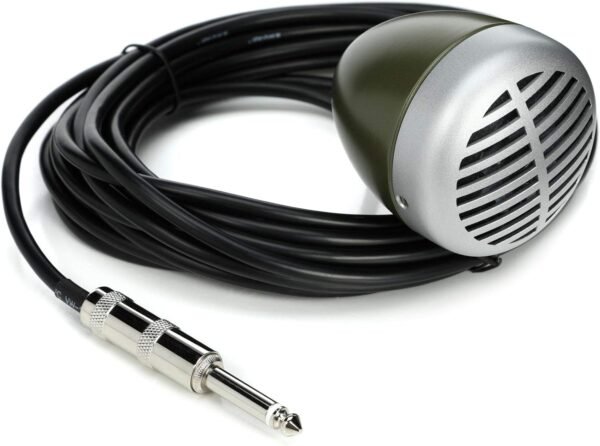
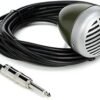
This is the detail that trips up most first-time buyers, and it is not obvious from the product images. The 520DX is high impedance with a permanently attached cable terminating in a quarter inch jack plug. It is designed to be plugged directly into a guitar amplifier input, in exactly the way a guitar is.
What it is not designed for is a standard mixing desk or audio interface, which expects a low impedance balanced signal on an XLR connector. Connecting a high impedance microphone into a low impedance input, or running its unbalanced cable over any distance, produces a weak signal and picks up interference. There are impedance-matching transformers that solve this, but they are an additional purchase and an additional thing to understand. Buyers planning to record directly rather than mic an amplifier should factor that in before ordering.
Working with an Amplifier
Shure gives unusually specific operating guidance in the listing, which is worth repeating because it is genuinely useful. The volume control should be turned down before the microphone is plugged into an amplifier, and raised as the player moves away from the speaker. Feedback control is achieved by maximizing distance from monitors and loudspeakers, and by setting the mixing console levels so that no feedback occurs with the microphone volume at maximum.
That advice describes the real working method. An omnidirectional microphone cupped tight to a harmonica, feeding a guitar amplifier in the same room, is a feedback loop waiting to happen, and the onboard volume knob exists precisely so the player can manage it in real time. It also functions as a mute between numbers. The amplifier is as much part of the sound as the microphone, and small valve or modeling combos are the traditional partner; options include the Positive Grid Spark 40 and the Soldano SLO Mini, and the wider combo amps category covers the range.
Build, Weight and Handling
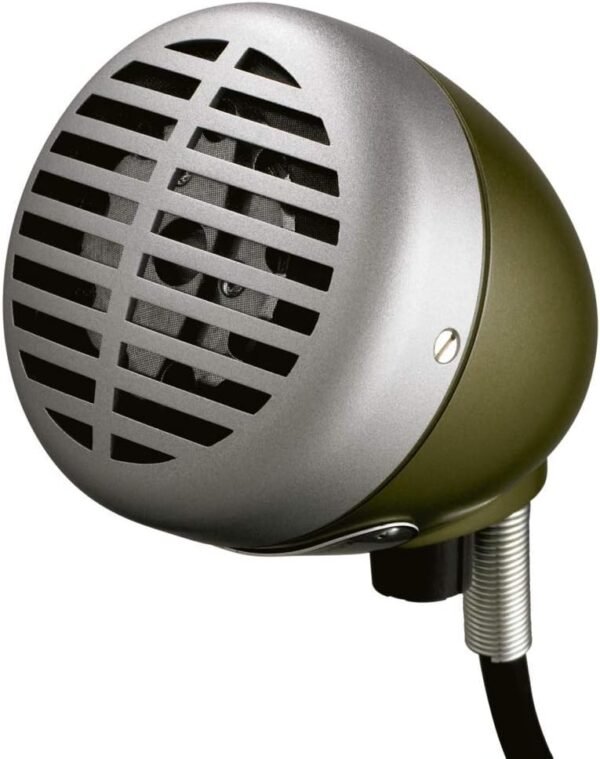
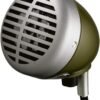
The housing is die-cast in the green and chrome finish that has become the visual shorthand for the instrument. The listing gives the weight as 1.62 pounds and the dimensions as 3.25 by 2.5 by 2.5 inches, and the mass is not incidental: a heavy microphone cupped in the hands for a whole set is physically demanding, and players who work long gigs frequently mention hand fatigue with bullet microphones generally.
The contoured shape is what makes the cupping technique possible at all. A conventional handheld microphone cannot be sealed against a harmonica and two hands simultaneously, and that seal is what produces the compressed, amplified tone the instrument is bought for. Shure lists the product as available since December 2006 and manufactured in Mexico, ranked 39th in Multipurpose Dynamic Microphones. The rest of the multipurpose microphones category shows how differently the neighboring products are designed.
Why the Omnidirectional Pattern Is Deliberate
An omnidirectional pattern on a stage microphone looks like a design error until the playing technique is understood. Most vocal microphones are directional precisely so that they reject sound coming from the sides and rear, which is what keeps them from feeding back. The 520DX does the opposite, and it does so because the cupping technique makes directionality irrelevant: the hands and the harmonica form the acoustic enclosure, and the capsule is inside it.
That arrangement also produces the characteristic tone. Sealing a microphone inside a cupped pair of hands creates a small resonant cavity, boosts the low midrange heavily, and restricts the high frequencies, which is why amplified harp sounds thick and vocal rather than thin and reedy. Opening and closing the hands during a phrase changes that cavity in real time and is a core part of the playing vocabulary, in the same way that a wah pedal is for a guitarist. A directional capsule would respond far less predictably to that gesture. Shure’s cartridge is also described as rugged with improved response, which matters given how much physical contact the microphone takes during a performance.
Highlights
- Purpose-built shape that seals between harmonica and hands, which no conventional microphone can do.
- Onboard volume control for managing feedback and muting between numbers.
- Rugged die-cast housing with an iconic and unchanged finish.
- Attached quarter inch cable, so it plugs straight into an amplifier with nothing else required.
- Clear operating guidance from Shure on volume staging and feedback control.
- Also usable for deliberately lo-fi vocals, per Shure’s own description.
Things To Consider
The specification block for this microphone claims that a single AAA battery is required, and it states this twice in different fields. The 520DX is a passive dynamic microphone and requires no power of any kind. The signal to noise ratio and noise level fields both read 78 dB, which is the same number pasted into two places where it means different things. These are import artifacts and should be disregarded entirely.
- High impedance and unbalanced, so it does not connect cleanly to a mixer or interface without a matching transformer.
- The cable is permanently attached, so cable damage means microphone damage.
- Omnidirectional pickup makes feedback control an active part of playing it.
- 1.62 pounds is heavy to hold cupped for an entire performance.
- The battery requirement in the specification is false.
- Tonally narrow by design, which is the point but limits it to one job.
Who Should Buy It and Who Should Skip It
The Green Bullet is the right purchase for a blues harmonica player who wants the traditional amplified sound and intends to play through a guitar amplifier. It also has a niche following among vocalists and producers who want a deliberately degraded, telephone-like vocal texture for a specific effect, which Shure acknowledges in its own copy.
Skip it if the harmonica is to be recorded cleanly, where a conventional dynamic or condenser into a proper interface will sound far better and give an engineer something to work with. Skip it too if there is no amplifier in the setup, because plugging this into a mixer without an impedance matcher will produce a thin, noisy signal and a disappointing first impression. It is a specialist instrument, and it rewards being used as one.