
Description
What the ULTIMEA Poseidon D80 Includes
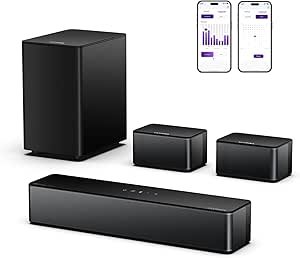
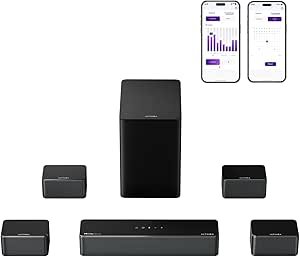
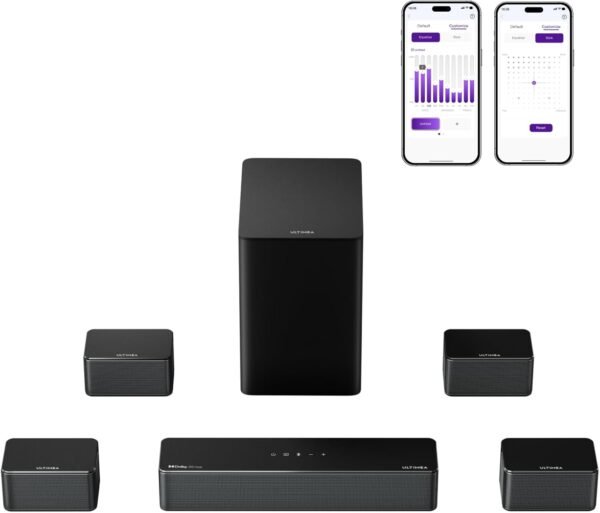
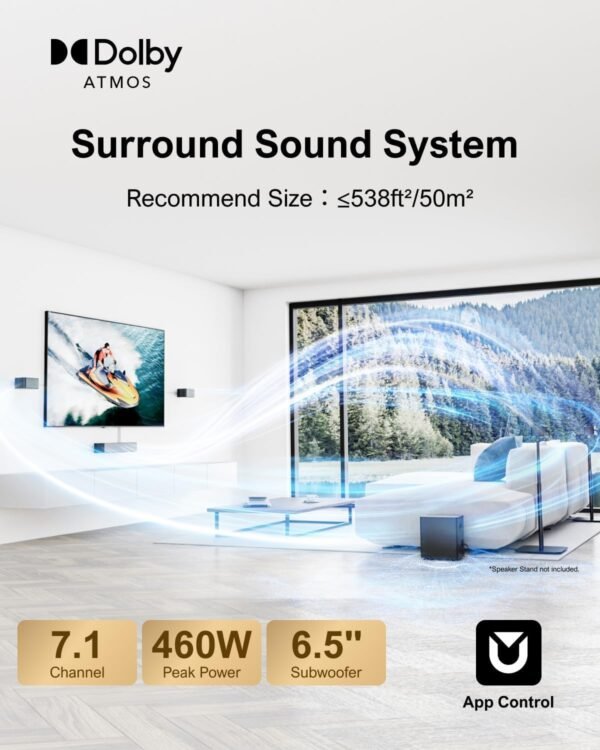
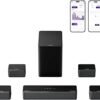
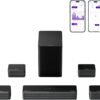
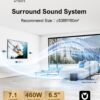
The ULTIMEA Poseidon D80 is a packaged home theater system built around a sound bar, a subwoofer with a 6.5 inch driver, and four additional surround speakers, marketed as a 7.1 configuration with Dolby Atmos support and a 460 watt system rating. The listing describes application control with equalization options and identifies the product as a 2025 upgrade of the Poseidon line.
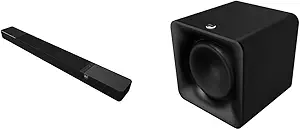
Packaged systems of this kind occupy a specific place between a plain sound bar and a component home theater. A plain bar is one box and a compromise on channel separation. A component system is a receiver plus five or more separate speakers, with all the wiring and setup that implies. A bar plus satellites lands in between: more channel separation than a bar alone, less installation work than a component system. Buyers deciding between those approaches should compare the simpler ULTIMEA Poseidon D60 5.1 sound bar and browse the sound bars category.
What 7.1 and Dolby Atmos Mean Here
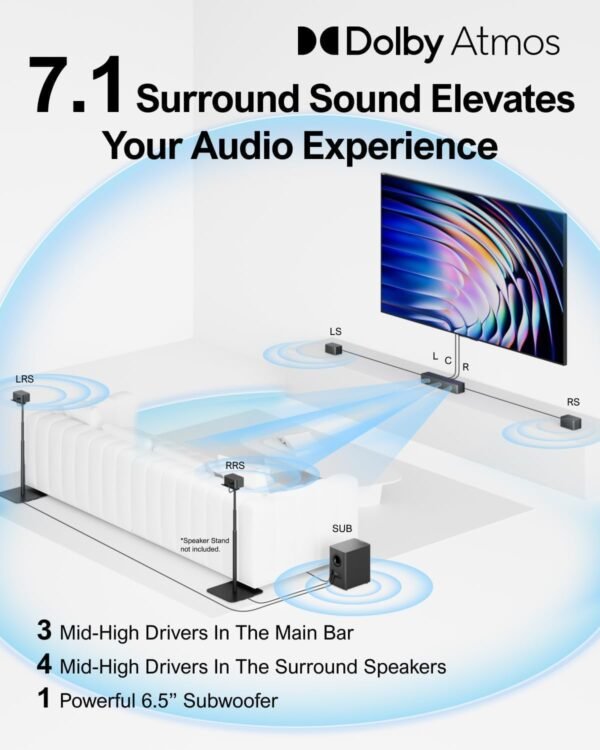
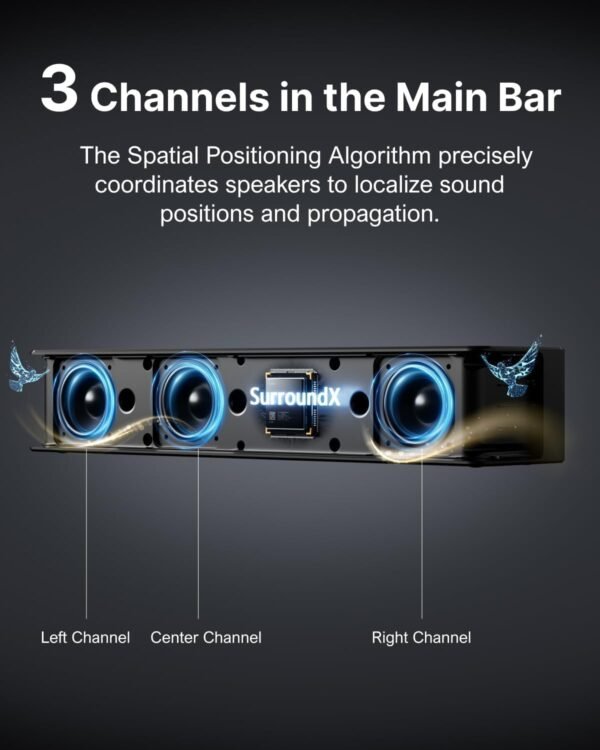
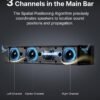
A 7.1 designation describes seven full range channels plus a subwoofer, which conventionally means front left, center, front right, two side surrounds, two rear surrounds, and a subwoofer. In a bar based system, several of those channels are produced by drivers inside the bar rather than by separate cabinets, so the channel count describes the processing and driver allocation rather than the number of boxes in the room.
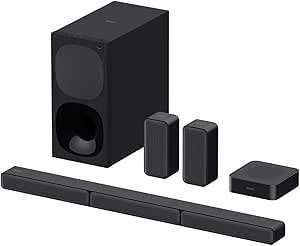
Dolby Atmos is a different thing again. It is an object based format, meaning the soundtrack carries sounds as positioned objects rather than as fixed channels, and a decoder places them using whatever speakers are available. Atmos is usually associated with height information, which requires either ceiling speakers or upward firing drivers that bounce sound off the ceiling. The listing states Atmos support without specifying how height is produced, which is the detail that determines whether the overhead effects are actually delivered or simply processed into the existing speakers. Anyone whose interest in this system is specifically Atmos should confirm that point with ULTIMEA. Buyers comparing a Dolby Atmos bar with a built in subwoofer can look at the Sony HTX8500 Dolby Atmos soundbar.
The Subwoofer, the Satellites, and the Wiring
A 6.5 inch subwoofer driver is modest by home theater standards, where 8, 10, and 12 inch drivers are the norm, and it sets a realistic expectation for how low and how loud the system will go. That is not a criticism of a packaged system at this level, but it does mean anyone expecting the low frequency weight of a dedicated subwoofer such as the Klipsch RP-1000SW subwoofer should adjust their expectations.
The wiring question deserves attention because the listing answers it two different ways. The product title states four wired surround speakers, while the marketing bullets describe a wireless subwoofer and additional front surround speakers. Those cannot both be a complete description. The most likely reading is that the subwoofer connects wirelessly while the satellite speakers connect by cable to the subwoofer or to the bar, which is a common arrangement, but the listing does not say so. This matters enormously in practice, because running speaker cable to the rear of a living room is the single biggest obstacle to installing any surround system, and a buyer needs to know before ordering whether that work is required.
Highlights
- Sound bar, subwoofer, and four surround speakers supplied as one package.
- 7.1 channel processing with Dolby Atmos decoding.
- System rating of 460 watts and a 6.5 inch subwoofer driver.
- Application control with equalization and sound mode adjustment.
- Listed as a 2025 revision of the Poseidon range.
Things To Consider
The wiring contradiction described above is the most consequential problem with this listing. A buyer planning a room needs to know exactly which components are wireless and which are not, and the listing states it two ways without resolving the difference. Anyone considering this system should get that answer before ordering, because the installation effort differs completely between the two readings.
The 460 watt figure should also be read with caution. Power ratings on packaged home theater systems are typically peak figures summed across every channel, which is not comparable to the continuous per channel ratings used for component amplifiers. It is a marketing number rather than a specification a buyer can use to compare against a receiver.
The imported record provides no specification table at all beyond the product title, so there is no driver complement for the bar, no dimensions for any component, no weight, no input list, no HDMI or optical connection detail, and no confirmation of whether HDMI eARC is supported. HDMI eARC is the connection that matters most on a modern television, because it is the only way to receive a full quality Atmos stream from the set, and its presence or absence would change the purchase decision. That should be confirmed with ULTIMEA rather than assumed.
Finally, application dependence is worth weighing. Equalization and sound modes accessed through a phone application are only available for as long as the application is maintained and remains compatible with current phones, which is a shorter horizon than the life of a speaker system.
Who Should Buy It and Who Should Not
The Poseidon D80 suits someone who wants discrete rear channels rather than a virtualized soundstage, is willing to place and connect four satellite speakers, and prefers a matched package over choosing components individually. For a medium sized living room used mostly for films and games, that combination delivers more separation than a single bar can.
It is the wrong purchase for anyone who cannot run cable to the rear of the room, for anyone whose priority is low frequency impact, given the 6.5 inch subwoofer driver, and for buyers who need the connection specification confirmed before ordering. Those buyers should consider a single bar with a wireless subwoofer, a component system built around a receiver, or a packaged alternative such as the Rockville RHB70 home theater speaker system from the home theater systems category.