


Description
What the Marshmallow Is
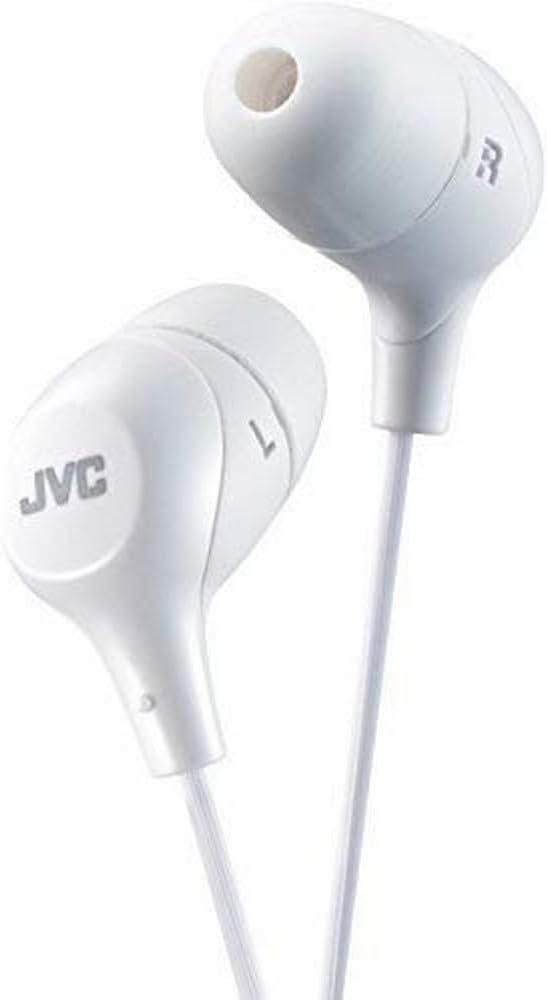
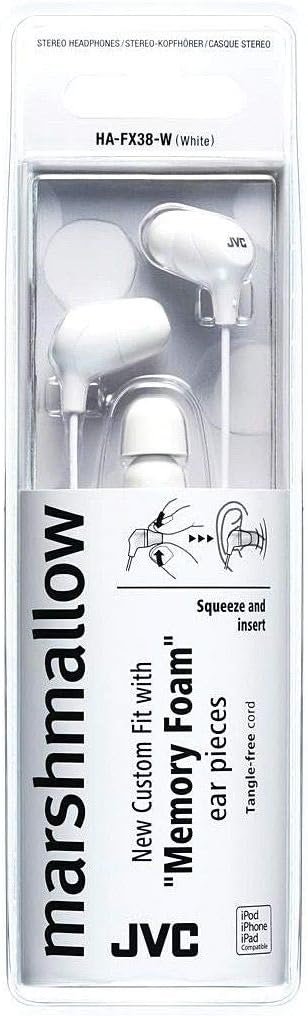
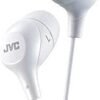
The JVC HA-FX38W belongs to the Marshmallow line, a long-running JVC series whose defining feature is not a driver or a circuit but an ear tip. Instead of the silicone tips that ship with almost every in-ear earphone, the Marshmallow uses memory foam. That single decision changes how the product behaves more than any specification on the listing does.
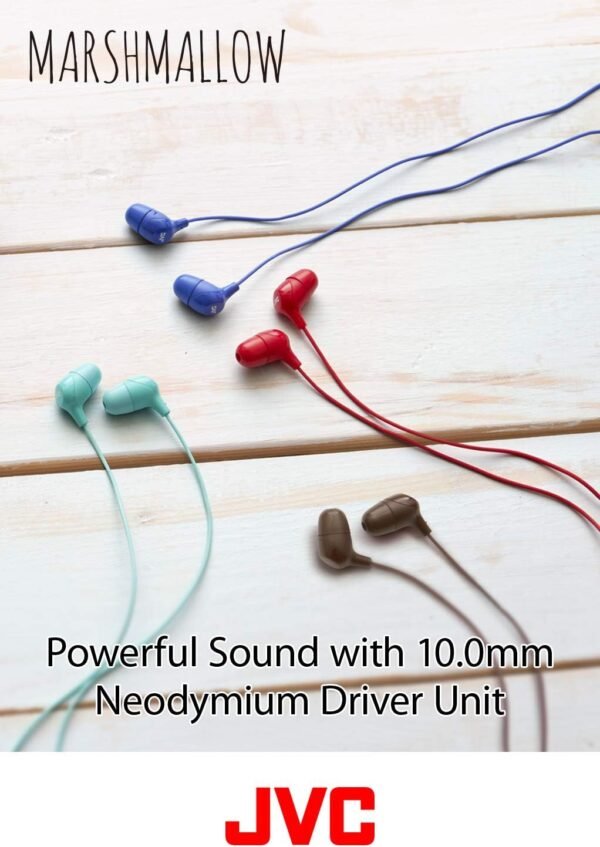
Everything else about it is conventional: a wired in-ear earphone with a 3.5 mm plug, a single dynamic driver per side, and no electronics of any kind. JVC publishes a frequency response of 8 Hz to 20,000 Hz and an impedance of 16 ohms, and that is the entirety of the technical information provided. Buyers who want a wired earphone with detailed engineering disclosure should look at the TRUTHEAR HEXA or the SoundMAGIC E80D.
Why Memory Foam Tips Matter
A silicone ear tip works by pressing outward against the ear canal wall. It seals well in ears that match its shape and poorly in ears that do not, which is why manufacturers supply multiple sizes and why so many people never find one that fits properly. Memory foam works differently: it is compressed between the fingers, inserted while still small, and then expands to fill whatever shape the canal actually is.
The consequences are real. A foam seal is usually more complete than a silicone one, which improves passive isolation and, because bass response in an in-ear depends entirely on the seal, improves the perceived low end as well. Foam also spreads pressure over a larger area, which many people find more comfortable during long sessions. In an in-ear earphone the fit is not a detail around the sound; the fit largely is the sound, which is why an inexpensive earphone that seals properly often outperforms a costlier one that does not.
The Cost of Foam
Memory foam tips have drawbacks that JVC does not mention and buyers should know about. They are a consumable: foam tears, absorbs earwax and moisture, loses its ability to rebound, and generally needs replacing every few months with regular use. Silicone tips can be washed and reused almost indefinitely.
Foam also takes a few seconds to expand after insertion, so the earphones cannot simply be pushed in and used immediately. And because foam damps high frequencies slightly more than silicone, the treble is typically a little softer, which some listeners prefer and others do not. None of these are faults, but they are trade-offs, and the Marshmallow line is bought specifically for that trade.
Isolation Without Electronics
The isolation on offer here is entirely passive. A well-sealed foam tip blocks a surprising amount of steady noise, particularly in the midrange where speech and traffic sit, and it does so with no battery, no processing and no pressure sensation. What it cannot do is cancel low frequency rumble, which is where active noise cancellation earns its keep on an aircraft or a train.
For an office, a library, a walk or a bus, passive isolation from a good seal is often enough, and it never runs out of charge. Buyers who need genuine cancellation should look at the powered options in the earbud headphones category, understanding that they cost several times as much and require charging.
The Wired Question
A 3.5 mm plug is both this product’s simplest virtue and its biggest practical obstacle. There is nothing to pair, nothing to charge, no codec negotiation, no latency and no firmware. The earphones work with anything that has a headphone socket, and they will still work a decade from now.
The obstacle is that many current phones no longer have that socket, which means an adapter. That adds cost, adds something else to lose, and on some devices adds a quality variable of its own. Anyone whose phone still has a socket, or who mainly listens on a laptop, a tablet or a dedicated player, avoids the issue entirely. Listeners who want a comparable wired earphone with a modern connector should compare the alternatives that ship with a USB-C adapter, and those wanting a similar budget option should look at the MEE audio M6 or the Xiaomi Redmi Buds 4 Lite for the wireless equivalent.
Highlights
- Memory foam tips that conform to the individual ear canal rather than pressing against it.
- Better passive isolation than most silicone-tipped earphones at any price.
- Nothing to charge or pair, and no latency in games or video.
- 16 ohm impedance, so a phone or laptop output drives them without difficulty.
- Stated 8 Hz to 20,000 Hz response per JVC.
- Simple and inexpensive, with no software or account required.
Things To Consider
This listing carries almost no data at all. The specification block is completely empty, and the entire technical description consists of two bullet points giving frequency response and impedance. There is no driver size, no sensitivity figure, no cable length, no weight, no information about what is in the box, and no indication of how many replacement tips are supplied. There is also no customer rating data on the listing. For a product whose defining feature is a consumable ear tip, the absence of any information about spares is a genuine gap.
- Foam tips are a consumable and will need replacing periodically.
- Foam expands slowly, so insertion takes a few seconds each time.
- No active noise cancellation, only passive isolation from the seal.
- Most current phones need a 3.5 mm adapter.
- The listing publishes almost no specifications, and none about the box contents.
- No microphone or controls are described anywhere.
Who Should Buy It and Who Should Skip It
These make sense for someone who has never got on with silicone ear tips, who wants better isolation without paying for electronics, and who still has a device with a headphone socket. They are also a sensible inexpensive way to find out whether foam tips suit you before committing to a more expensive earphone and buying aftermarket foam separately. As a spare pair for a bag, a desk drawer or a gym locker, they cost little and lose nothing when they eventually fail.
Skip them if the foam consumable cycle sounds like an annoyance, if you need active cancellation, or if you want a microphone for calls. Skip them too if you were hoping to compare specifications before buying, because this listing does not give you enough to compare. Buyers who want an on-ear alternative that avoids the ear canal entirely should look at the on-ear headphones category instead.