

Description
What the Q9U Is
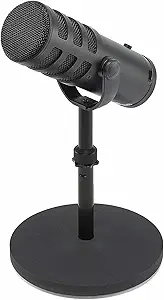
The Samson Q9U is a broadcast dynamic microphone with two outputs: a conventional XLR connector and a USB-C port carrying 24-bit, 96 kHz digital audio. Both are present on the same body, which places it in a small category of dual-output microphones designed to work in either a computer-based setup or a traditional mixer-based one without a compromise in either direction.
That dual path is the entire argument for the product, and it matters most to people whose setup is going to change. A podcaster starting on a laptop can use USB today and move to an interface and a mixer later without replacing the microphone, which is the single most common upgrade path in home recording. Buyers committed to XLR from the start might spend the same money on a single-output design such as the Rode Procaster, and buyers committed to USB should compare the Apogee MiC Plus.
The Gain Problem It Solves
Dynamic microphones produce far less output than condensers, and close-miked speech through a low-output dynamic often demands 60 dB or more of clean preamp gain. Many affordable interfaces cannot deliver that without audible hiss, which is why an entire accessory category of inline gain boosters exists. Samson addresses this directly by specifying a modern capsule with a neodymium magnet that provides, in the company’s words, plenty of output to work with any mixer or audio interface without an external gain device.
That claim is the most consequential thing on the listing. If it holds, the Q9U removes both a cost and a complication for anyone using a budget interface. It is worth noting that Samson publishes no sensitivity figure to substantiate it, and the listing does not give a frequency range either, which is a meaningful gap for a microphone at this level.
Built-In Protection: Shock Mount and Windscreen
The Q9U includes an internal pneumatic shock mount that isolates the capsule from the body, and a dual-layer windscreen behind the grille. Both address problems that would otherwise require external hardware. An external shock mount is bulky, costs money and takes up desk space; an external pop filter sits between the speaker and the camera and looks poor on a stream.
Building both inside the microphone is the right decision for the intended use, and it is the same approach taken by every broadcast dynamic designed in the last decade. The dual-layer windscreen in particular is more effective against plosives than a single mesh layer, because the two layers break up the air blast at different distances from the diaphragm.
Monitoring, Mute and Onboard Controls
The headphone output provides zero-latency monitoring, meaning the voice is fed directly to the headphones in the analog domain rather than travelling into the computer and back. That round trip is what causes the disorienting delay some people experience on a USB microphone, and hearing your own voice a few milliseconds late is genuinely difficult to talk through.
The onboard mute switch is the feature most likely to be used every day, and Samson makes an important design choice with it: the mute silences both the XLR and the USB outputs. A mute that only affects one path is a trap waiting to embarrass someone on a call. Onboard controls also let the balance between the microphone signal and computer playback be set at the hardware, which is how a mix should be adjusted while recording.
Build and Physical Considerations
The listing gives the packaged weight as 1.76 pounds and the dimensions as 10 by 5.1 by 5.2 inches. This is a substantial microphone, and anyone planning to mount it on a boom arm should check the arm’s rating; a light spring arm will droop under a broadcast dynamic. Samson describes the construction as durable with included accessories, though the listing does not enumerate what those accessories are, which is another gap.
The product has been listed since January 2020 and sits at number 14 in Multipurpose Dynamic Microphones. For a multi-host production studio, matching several units is straightforward since each can run into a mixer over XLR while a single unit handles a solo session over USB. Anyone building a studio around this should compare the alternatives in the multipurpose microphones category and the handheld options in the vocal microphones category.
Highlights
- XLR and USB-C on one body, so the microphone survives a change of setup.
- 24-bit and 96 kHz conversion with no driver installation on Mac or Windows.
- High-output dynamic capsule intended to work without an inline gain booster.
- Internal pneumatic shock mount, removing the need for an external cradle.
- Dual-layer windscreen for plosive control.
- Mute switch that silences both outputs, not just one.
Things To Consider
The specification block describes the form factor as “Handheld”, which is not what this is; it is a desk or boom-mounted broadcast microphone with a body far too large to hold comfortably. The hardware platform field says “Television”. The power source is listed as USB-C, which is true for the digital path but says nothing about the XLR path, where the microphone is passive and requires no power at all. Most significantly, the listing publishes neither a frequency response range nor a sensitivity figure, which are the two specifications a buyer would most want.
- No frequency response range is published anywhere in the listing.
- No sensitivity figure to support the claim about gain requirements.
- The included accessories are not enumerated, so what arrives in the box is unclear.
- Substantial size and weight, which a light boom arm will not hold.
- The form factor specification is wrong, describing a handheld microphone.
- No XLR cable is described as included.
Who Should Buy It and Who Should Skip It
The Q9U suits a podcaster or streamer who wants one microphone that works today on a laptop and tomorrow in a mixer-based studio, and who values not having to buy an inline preamp to make a dynamic microphone usable. The onboard mute and headphone monitoring make it a complete solution for solo recording without any additional hardware. It is equally sensible as the standard unit for a multi-host studio where every position needs the same microphone.
Skip it if the setup will never change, since a single-output microphone at the same price will put more of the budget into the capsule. Skip it too if the recording includes acoustic instruments or requires the detail of a condenser, and if a smaller footprint matters, since a compact USB model such as the FIFINE K669B or the entry-level MAONO PD100 takes up considerably less desk.