



Description
What the PD100 Is
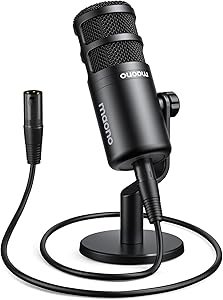
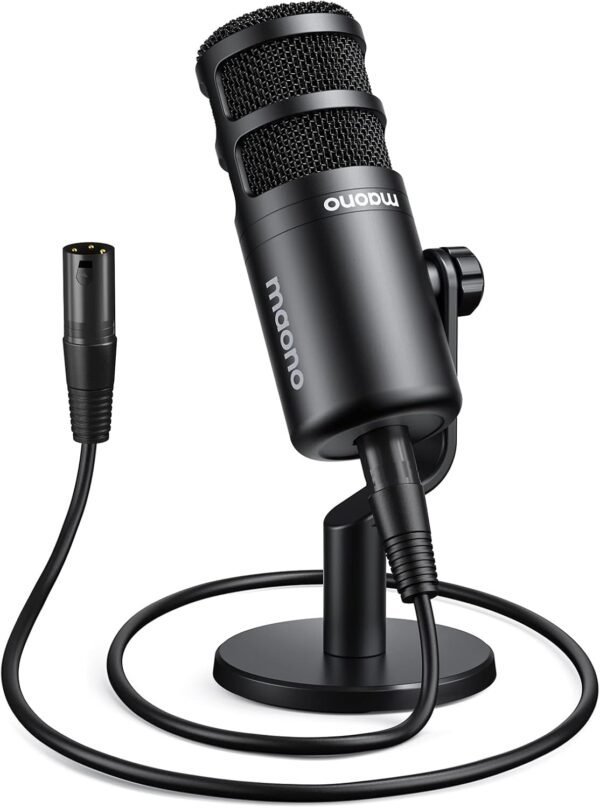
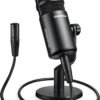
The MAONO PD100 is an XLR dynamic microphone sold as a complete desk kit rather than as a bare microphone. The box contains the microphone, a heavy round metal base, a 2.36 inch rod extender, a 6.56 foot XLR cable and a manual, which means everything needed to get from the delivery box to a mounted microphone on a desk is present. That is unusual at this price and it removes the most common hidden cost of an XLR purchase.
It sits at the entry point of the broadcast dynamic category, competing with far more expensive designs on the same basic principle: a cardioid dynamic capsule that hears the speaker and not the room. Buyers who want to understand what the extra money buys further up the range should compare the Rode Procaster and the dual-output Samson Q9U.
The Narrow Frequency Range Is a Design Choice
MAONO specifies 60 Hz to 14 kHz, which looks poor on paper next to competitors quoting 20 Hz to 20 kHz. It is worth resisting that reading. A speech microphone has no use for content below 60 Hz, which contains only rumble from footsteps, traffic and desk knocks, and very little above 14 kHz, where sibilance and room hiss live. Rolling both ends off in the capsule rather than in software means those problems never enter the recording.
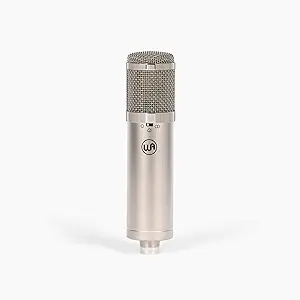
The consequence is that this microphone is genuinely unsuitable for music. Recording an acoustic guitar or a cymbal through it would sound dull and truncated, and MAONO does not claim otherwise. Anyone whose work spans both speech and instruments should be looking at a condenser such as the Warm Audio WA-47Jr, and the wider multipurpose microphones category covers both approaches.
Pattern, Pop Filtering and Technique
The capsule is cardioid, meaning it is most sensitive directly in front and progressively less so toward the sides and rear. MAONO describes a top-address pickup pattern, which is worth flagging clearly because it determines how the microphone is used: the speaker talks into the top of the microphone, not into the side. Talking into the side of a top-address microphone is one of the most common causes of a thin, distant recording, and the shape of the PD100 does not make the correct orientation obvious.
An internal double-layer pop filter handles plosive consonants, attenuating the blast of air produced by hard P and B sounds before it reaches the diaphragm. Building it into the head means no external screen is needed on the desk, which keeps the arrangement tidy and keeps the microphone visible on camera. The listed signal to noise ratio is 78 dB.
Connection, Gain and What Else You Need
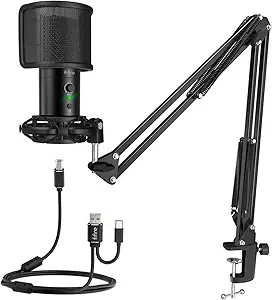
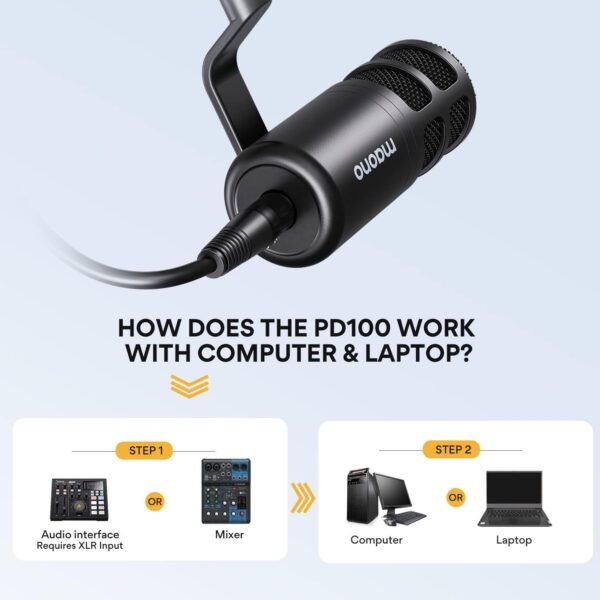
This is an XLR microphone with no USB path, so a separate interface, mixer or sound card is mandatory and is not included. MAONO names its own Maonocaster units alongside generic audio interfaces and external mixers as suitable partners. Budgeting for that device is the real cost of entry, and buyers who expected to plug straight into a laptop should reconsider and look at a USB model such as the FIFINE K669B instead.
The listed impedance of 600 ohms is high compared with most modern dynamic microphones, which typically sit between 150 and 250 ohms. A higher output impedance makes a microphone more sensitive to the input impedance of whatever it is plugged into and to long cable runs. On a short cable into a standard interface it is unlikely to cause a problem, but it is a specification worth knowing about. As with all dynamics, this microphone will want a preamp with generous clean gain; a weak or noisy preamp will show up as hiss behind the voice.
Highlights
- Complete desk kit including base, rod extender and XLR cable, with nothing else to buy except an interface.
- Internal double-layer pop filter, so no external screen is required.
- Speech-focused 60 Hz to 14 kHz range that excludes rumble and sibilance at source.
- Metal body and metal base for stability and vibration damping.
- Standard 5/8 inch and 3/8 inch threads, so it fits any normal stand or boom arm.
- Strong category position, listed at number 8 in Multipurpose Dynamic Microphones.
Things To Consider
The listing data contains the usual artifacts. The frequency range is given correctly as 60 to 14 kHz in one field and then as a bare “14 KHz” in a separate frequency response field, which means nothing on its own. The hardware platform field contains a full-width comma left over from a translation, rendering as “PC,Laptop,Computer”. MAONO’s marketing copy is also written in noticeably awkward English, with phrases like “let your sound more center and front”, which affects confidence in the listing rather than in the hardware.
- No USB output: an interface or mixer is a mandatory additional purchase.
- Unsuitable for music given the deliberately restricted frequency range.
- 600 ohm impedance is high relative to comparable modern dynamics.
- Top-address orientation is not obvious from the shape and is easy to get wrong.
- The supplied desk stand is short, so a boom arm is still likely for serious use.
- Dynamic capsules need generous preamp gain, which cheap interfaces often lack.
Who Should Buy It and Who Should Skip It
The PD100 makes sense for someone starting a podcast or a stream who has already decided on the XLR route, wants a complete desk setup in one order, and understands that an interface is part of the plan. It is also a reasonable second or third microphone for a multi-guest podcast, where matching several inexpensive dynamics is more practical than buying one costly one. The narrow frequency range works in its favor in an untreated room.
Skip it if a computer is the only piece of equipment you own, since without an interface the microphone is inert. Skip it too if the recording will include instruments or singing, where the restricted response will be immediately audible, or if you need a microphone that also works for stage vocals; a handheld from the vocal microphones category is the right tool for that job.